
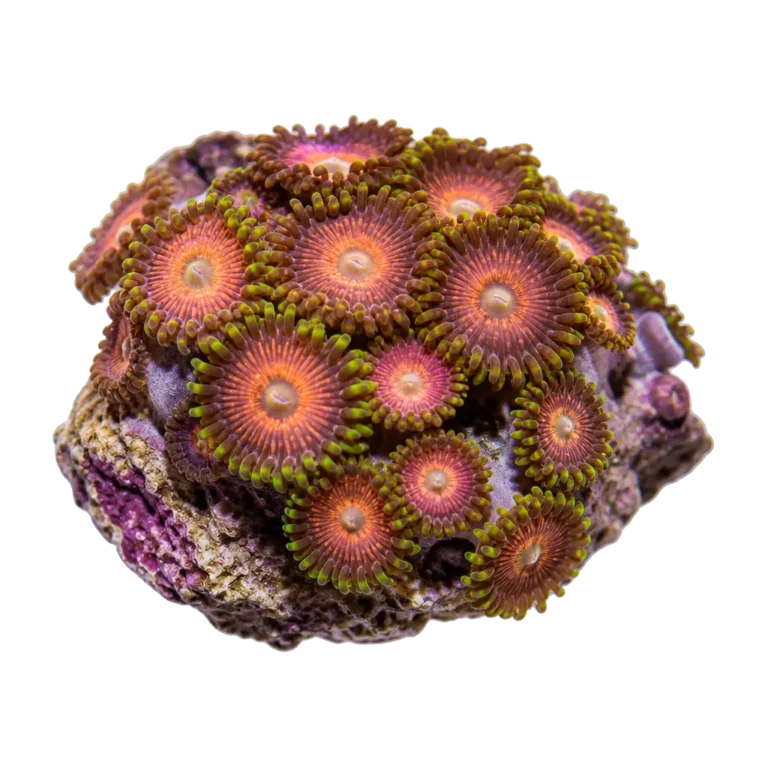
Zoanthid Coral
Summary
Zoanthus sp. is a genus-level identification, so polyp size, colour, and tolerance can vary among trade colonies. These colonial zoanthids form connected mats of button-like polyps over hard surfaces, a growth habit that makes them adaptable but capable of claiming rockwork quickly. Give a new colony a defined patch of removable rock rather than treating it as a small, static frag.
Many Zoanthus occur on shallow, well-lit reef and rocky substrates, which helps explain their preference for consistent light and water movement rather than dark, stagnant corners. Their lack of a hard stony skeleton makes colony shape easy to manage at first, but the living mat can spread around and beneath neighbouring corals before the conflict is obvious.
General care
Place Zoanthus sp. on secure mid-level rockwork where the colony can receive indirect flow and be inspected easily. An isolated rock or a clear break in the aquascape is the simplest way to control spread; once the mat reaches the main structure, removal usually means cutting back living tissue.
Handle the plug or rock, not individual polyps. The polyps and connecting mat can tear if pulled, and damaged areas may stay closed or collect debris. Wear gloves and eye protection whenever moving, cutting, or scrubbing a colony, keep it out of the face, and never expose it to hot water or aerosolize tissue; trade identification can be uncertain and some zoanthids may present a toxin hazard when injured.
Lighting needs
Acclimate a new Zoanthus sp. colony from a slightly shaded position, then move it gradually toward its intended placement after it is opening reliably. This avoids a sudden light shock, especially when the colony came from a system with unknown lighting.
Well-adjusted polyps open broadly and hold consistent colour. Too little light often produces taller, stretched polyps that lean toward the light and a slower-spreading mat. Too much light can cause persistent partial closure, washed-out or pale colour, and polyps that remain tightly contracted during the photoperiod; reduce intensity or add shade before assuming a feeding problem.
Flow needs
Aim for indirect, variable flow that keeps the polyp skirts and tentacles moving lightly without folding the polyps over. Correct flow carries away mucus and detritus while allowing the colony to stay fully open.
If flow is too weak, debris and film algae settle between polyps, and portions of the mat may remain closed or accumulate brown material. If flow is too forceful or constantly directional, polyps stay pinched, lean hard in one direction, or close repeatedly; redirect the outlet rather than placing the colony directly in the pump’s path.
Feeding and growth
Zoanthus sp. is usually sustained mainly by its photosynthetic symbionts, so feeding is most useful for newly established frags, colonies in very nutrient-lean systems, or keepers trying to support faster growth. Offer finely sized zooplankton or suspended particulate foods after the polyps are open; large pieces are more likely to be rejected or foul the colony than to provide a benefit.
Expect a low, encrusting mat to expand outward across rock, plugs, and seams rather than growing upward as a rigid branching coral. Plan for that footprint from the beginning: a small colony can turn a mixed-rock display into a Zoanthus-dominated area if its advancing edge is not trimmed.
Compatibility
The main competitive mechanism of Zoanthus sp. is rapid physical occupation of substrate. Its mat can grow into neighbouring colonies, shade low-growing tissue, and win direct space contests even when it is not visibly stinging at a distance. Leave at least 10 cm3.9 in of open, inspectable rock around slower-growing encrusters, and treat that clearance as a maintenance zone rather than permanent protection.
Avoid placing it beside corals that cannot tolerate contact or that have powerful sweeper tentacles. Some angelfish, butterflyfish, and filefish may nip polyps, while zoanthid-eating nudibranchs and sundial snails can cause a colony to stay closed or develop missing patches. Check a declining colony after dark and inspect the mat and plug closely before blaming lighting or water chemistry.
Water parameters
Zoanthus sp. is generally more forgiving than many small-polyp stony corals, but it responds poorly to abrupt changes. A sudden shift in salinity, temperature, or alkalinity commonly shows first as persistent closure, excess mucus, or recession at the mat edge rather than an immediate dramatic loss.
Do not run the system so nutrient-poor that the colony fades, stalls, and remains undersized despite suitable light. Conversely, heavy detritus accumulation can encourage algae to grow between polyps and smother expanding tissue. Stable, moderately clean water and regular observation of the colony edge are more useful than chasing minor day-to-day changes in polyp opening.