
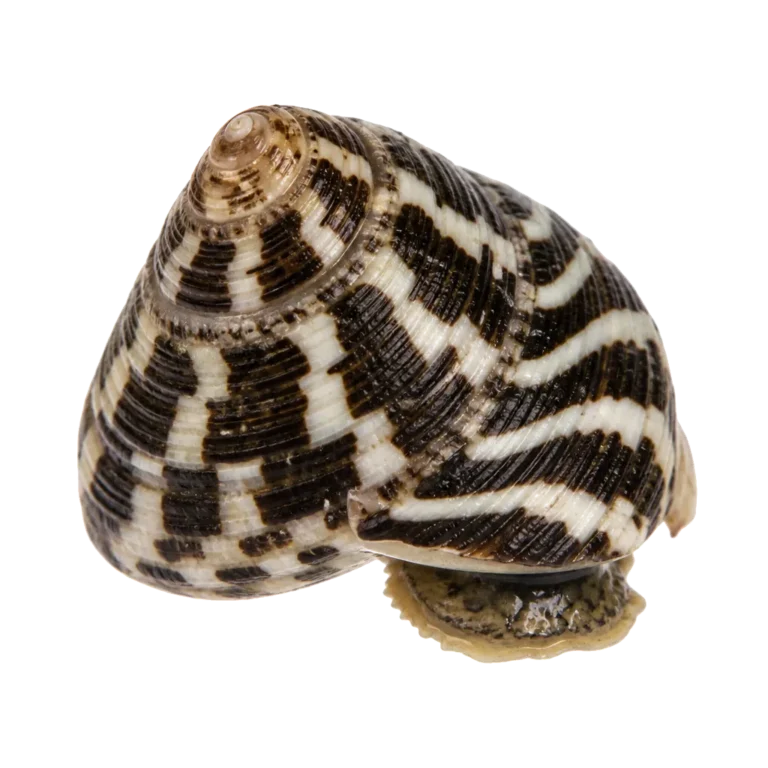
Zebra Turbo Snail
Summary
Cittarium pica, sold as the Zebra Turbo Snail, is a large, heavy-shelled Caribbean topshell rather than a true Turbo snail. Its natural life on algae-covered rock in shallow, wave-washed shore habitat explains its preference for solid grazing surfaces and its tendency to become most active after the lights dim.
Choose it for established rockwork with a dependable algae crop, not as a small-tank solution for a brief algae bloom. Its size and strength make it an effective grazer of accessible hard surfaces, but also make unsecured frags and loosely balanced rockwork a practical risk.
Care
Provide extensive, stable live rock or other hard surfaces with mature algal films. Sand is not required for Cittarium pica; the important feature is accessible rockwork rather than an open sandbed.
Use lighting sufficient to sustain natural algae on the rocks, rather than placing the snail under any special lighting. Moderate to brisk circulation over grazing surfaces suits its rocky-shore background, but avoid arranging flow so that it repeatedly tumbles the snail from ledges.
Add this species only after the aquarium has developed persistent film algae and other natural grazing material. Secure coral frags and test the stability of stacked rock before introduction, because a snail moving through the aquascape can shift light objects.
Feeding and role
Cittarium pica grazes microalgae, softer filamentous algae, seaweed surface growth, and some detritus. When visible algae becomes scarce, offer dried seaweed or spirulina-based herbivore foods directly on a clip or against the rock so the snail has food after more mobile fish have fed.
Treat one snail as maintenance for a limited area of accessible rock and glass, not as a cure for an established algae problem. It can reduce film algae and short turf where it can reach, but it will not compensate for excess nutrients, poor husbandry, or algae growing in protected crevices.
A snail that remains inactive while available surfaces are clean may be short of food. Supplement early rather than waiting for it to consume all visible grazing growth and decline.
Compatibility
Cittarium pica is peaceful with corals and other non-predatory reef livestock, and it does not normally feed on healthy coral tissue. The main coral risk is mechanical: place frags securely and keep loose rubble away from colonies, because the snail can dislodge them while grazing.
Do not keep it with animals that routinely crush or consume snails, including pufferfish, large triggerfish, snail-eating wrasses, predatory crabs, or lobsters. Repeated probing, flipping, shell damage, or a snail that disappears shortly after introduction are reasons to reassess tankmates rather than replace it immediately.
It has no known need for a partner or group. Add individuals according to the amount of algae the aquarium can continually produce; adding several to a clean system creates direct competition for the same limited food.
Good to know
Acclimate slowly to the display’s salinity and temperature, especially when its source water differs substantially from the aquarium. Abrupt adjustment can leave the snail withdrawn, unable to attach firmly, or inactive for an extended period.
Do not use copper-based medications in a system containing Cittarium pica. As with other marine snails, copper exposure can be fatal; move the snail before treatment and do not assume a previously medicated system is safe without addressing residual copper.
Watch for persistent failure to grip the glass or rock, prolonged retraction, or an unusual lack of nighttime movement. Check first for starvation, predation, and chemical exposure, then correct the cause rather than repeatedly handling the snail.