
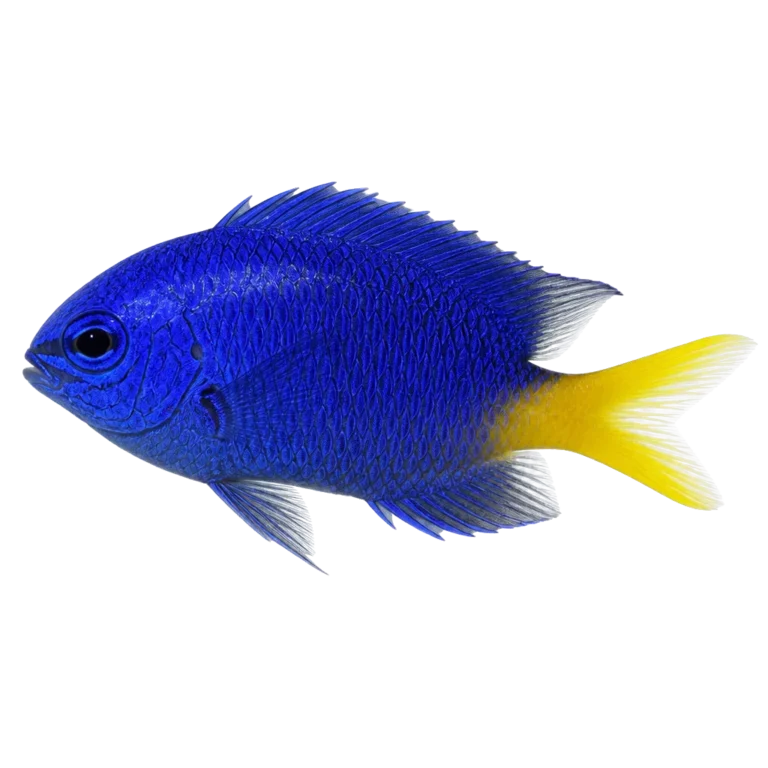
Yellowtail Blue Damselfish
Summary
Chrysiptera parasema is a rock-associated damselfish that spends much of the day making short, purposeful swims above and around its chosen section of reef, then darting back into cover. That close attachment to a home patch explains why an adult that initially seems mild can later defend a crevice, ledge, or coral base from fish that venture too near.
Its small size should not be read as a passive temperament. A settled individual is often a confident, visible fish, but repeated charges, fin-nipping, or another fish being confined to one side of the aquarium indicate that territorial behaviour has become a stocking problem rather than normal reef activity.
Care
Build a broken-up rockscape with several caves, overhangs, and separate sight lines rather than one open pile of rock. Chrysiptera parasema uses the structure as both a retreat and a territory boundary; when it cannot get out of another fish’s view, chasing tends to become persistent.
It usually holds close to the rockwork rather than cruising continuously in open water. Leave clear swimming lanes around the reef but give it a secure route back to cover from several directions. Moderate, variable water movement suits this active reef-edge swimming style better than a stagnant corner or a direct, relentless blast.
Feeding
Offer a varied omnivorous diet in small portions, preferably split into two feedings each day. Use a quality marine pellet or flake as a reliable base, then rotate mysis, enriched brine shrimp, small zooplankton-style foods, and algae-containing foods. Variety matters because a fish that eagerly takes only rich frozen fare can still receive too little plant material over time.
Feed in more than one area when faster fish are present. This damselfish is usually quick at food, but a timid newcomer may be repeatedly driven away from the preferred feeding zone. Watch that every tankmate gets to eat rather than assuming the damsel’s strong feeding response means the community is feeding well.
Compatibility
Keeping one Chrysiptera parasema is the most predictable option. More than one can work when all are introduced together into a reefscape with enough separated cover for each fish to claim space, but do not add a second individual later to an established resident’s territory. Expect a hierarchy, and intervene if the subordinate fish is hiding continuously, losing condition, or being excluded from food.
Choose active but not bullying tankmates that use different parts of the aquarium, such as appropriately matched clownfish, wrasses, cardinalfish, or larger peaceful reef fish. Avoid combining it with other territorial damselfish, similarly shaped blue damsels, very shy small fish, or fish likely to regard it as prey. Add Chrysiptera parasema after the most timid fish have settled, rather than allowing it to establish ownership of the aquascape first.
It is suitable for coral and typical motile invertebrate reef systems. The practical reef-safety caveat is behavioural: it may defend the rock around a coral or anemone-like shelter, so a peaceful fish that needs that same zone can be harassed even though the coral itself is not at risk.
Good to know
Territorial behaviour commonly strengthens after the fish has settled and learned the layout of the aquascape. A sudden increase in chasing is especially likely around a chosen nest site or sheltered crevice. Rearranging a small part of the contested rockwork can interrupt an established boundary, but repeated aggression is often a sign that the mix of fish is unsuitable.
Use a secure cover, particularly during introduction or periods of chasing. A frightened damselfish can launch from the water, and an otherwise healthy fish that disappears after conflict may have jumped rather than died unnoticed in the rockwork.
Removing an established individual can be disproportionately difficult because it retreats deep into the rockwork. Plan the stocking order before adding one, since compatibility problems are much easier to prevent than to correct once it has claimed the reef.