
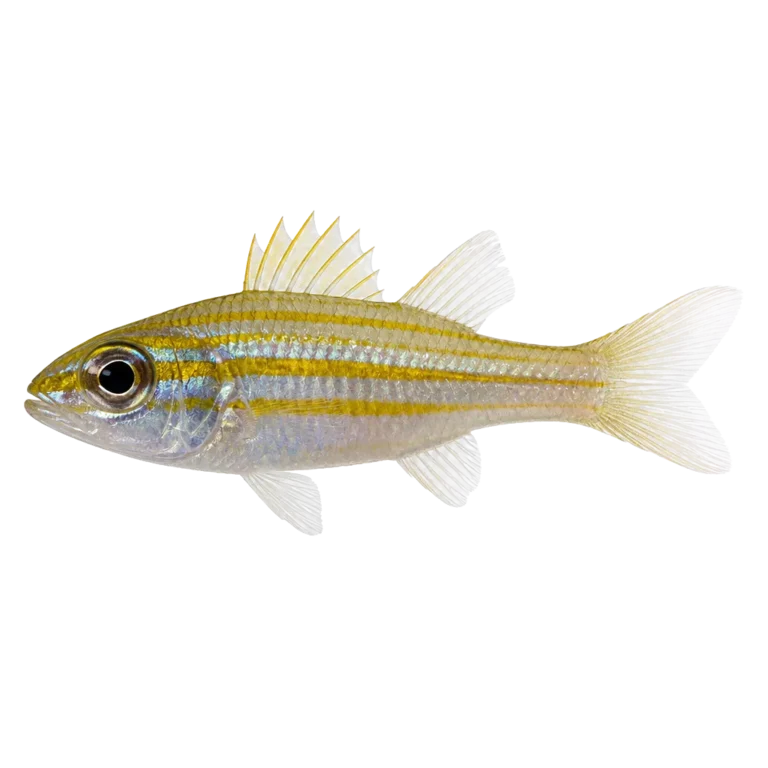
Yellowstriped Cardinalfish
Summary
Ostorhinchus cyanosoma is a peaceful cardinalfish that usually holds position in loose groups beneath an overhang or beside other cover, rather than constantly crossing the aquarium. Its habit of gathering in sheltered reef spaces explains why it can look withdrawn in a bare or brightly exposed tank, yet remain visible and active once it has a shaded reference point nearby.
It is a small-plankton hunter, so expect deliberate hovering and short feeding dashes into the water column. A group that remains tightly packed in one dark corner, skips meals, or only appears after lights-out is usually being intimidated or does not feel secure in the aquascape.
Care
Build the rockwork with stable caves, ledges, and shaded overhangs, while leaving open water immediately in front of them for hovering and feeding. Ostorhinchus cyanosoma does not need a large defended territory, but it needs nearby retreat cover; fish forced to cross exposed open water to rest tend to stay hidden.
Use gentle to moderate, non-blasting flow around its preferred resting areas. Strong, direct flow can keep the fish pinned behind rockwork and makes it harder for this deliberate swimmer to take suspended foods. A dimmer or sheltered zone is especially useful in brightly lit coral displays.
Feeding
Offer small marine meaty foods that remain suspended long enough to be noticed: mysis, enriched brine shrimp, zooplankton-style frozen foods, finely chopped marine flesh, and appropriately sized marine pellets. Feed more than one small portion through the day when possible, rather than relying on one fast, heavy delivery.
Target-feed or briefly pause stronger circulation if quicker fish strip the water column before the cardinalfish feed. Watch the group at feeding time: individuals that hang back under a ledge while tankmates take every item can slowly lose condition even when food is being added generously.
Do not make nutrient-poor brine shrimp the main diet. Rotate more substantial crustacean and marine foods so the fish receives a broader nutritional profile.
Compatibility
Keep Ostorhinchus cyanosoma with peaceful fish that do not repeatedly rush its shelter or dominate every feeding. Calm gobies, assessors, smaller peaceful wrasses, and similarly non-aggressive community fish are generally better matches than boisterous, territorial, or predatory species.
A group is usually preferable to a lone fish, provided all members are introduced together and the aquarium has several sheltered resting positions. Adding one newcomer to an established group can leave it excluded at the edge of the group, especially if there is only one favored overhang.
It is reef compatible with corals, but very small ornamental shrimp or newly introduced tiny crustaceans are a poor gamble. Its natural prey includes small crustaceans and invertebrates, so a fish that ignores corals may still take suitably small mobile invertebrates. Add this species before large, assertive fish that could make it stay in cover or miss food.
Good to know
This species is a mouthbrooder. A male carrying eggs may hold its mouth noticeably full, feed little or not at all, and remain more secluded than usual. Treat that change as possible breeding behavior rather than automatically assuming disease, but investigate if the fish also shows rapid breathing, lesions, or persistent isolation after the brood period.
Courtship and spawning involve pairing even though the fish is often kept as a group. Do not expect a mouthbrooding male to be easy to identify before he is carrying; external sex differences are not dependable for routine aquarium selection.
A sudden pattern of daytime hiding is useful feedback. First check whether a faster feeder or territorial fish has claimed the preferred ledge, then add or rearrange sheltered sight breaks if needed; simply increasing food rarely fixes a fish that feels unable to emerge.