
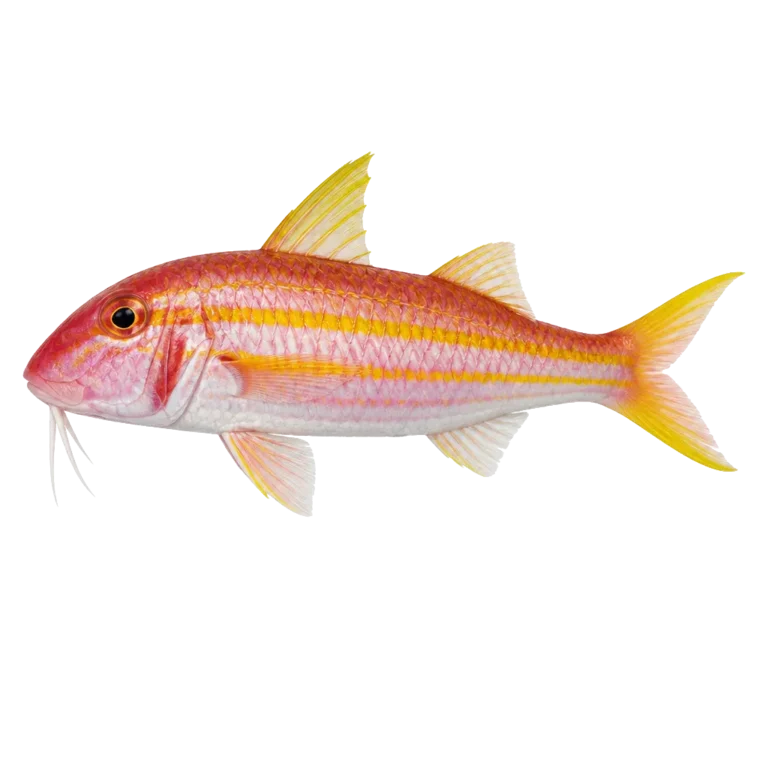
Yellowfin Goatfish
Summary
Yellowfin Goatfish, Mulloidichthys vanicolensis, is a wide-ranging sand-foraging predator rather than a typical rock-picking reef fish. Its chin barbels are used to locate prey in the substrate, so persistent cruising, pausing to probe the sand, and sudden short dives toward the bottom are normal feeding behaviour rather than signs of distress.
It may gather with other goatfish or similar fishes during the day, then spread out to forage more independently after dark. Expect an individual to become noticeably more active around dusk; a fish that remains hidden, refuses food, or breathes heavily during its usual active periods needs investigation.
Care
Build the aquascape around open, unobstructed sand lanes rather than filling the footprint with dense rockwork. This goatfish needs room to cruise and work the substrate with its barbels; a cramped, rock-packed layout can lead to repetitive pacing along the glass and prevents normal foraging behaviour.
Use stable rock structures with broad sandy areas around them. The fish does not need a maze of caves, but it should be able to move around and behind the reef structure without becoming trapped by narrow gaps or forced into constant contact with territorial residents.
Choose a system with strong biological filtration and reliable oxygenation. A large, continually moving carnivore produces substantial waste and repeatedly disturbs the sand surface, so detritus can become conspicuous if flow and export are inadequate.
Feeding
Offer a varied carnivorous diet of thawed marine-origin foods such as chopped shrimp, clam, squid, mussel, and fish flesh, supplemented with quality prepared carnivore foods. Deliver part of the ration close to the sand so the goatfish can feed in its natural zone instead of competing only in the water column.
Feed smaller portions more than once through the day, with an additional feeding toward dusk if the fish is actively searching the substrate then. It can learn to eat in daylight, but a fish that continually probes the sand after meals may be underfed or losing food to faster tankmates.
Do not use ornamental shrimp, crabs, snails, worms, or small fishes as a feeding plan. A full goatfish may still hunt suitable prey; regular, varied meals reduce food competition but do not make vulnerable livestock safe.
Compatibility
Treat Mulloidichthys vanicolensis as peaceful toward appropriately sized fishes, not harmless toward all livestock. Favour robust, non-combative fish that will not block it from bottom foods, and avoid tiny gobies, juvenile fishes, and other tankmates that could eventually be swallowed.
It is unsuitable with ornamental crustaceans and can quickly reduce populations of small benthic invertebrates. Corals themselves are not its usual target, but a reef is only compatible with caution when the loss of cleaners, decorative shrimp, crabs, snails, and sand-dwelling fauna is acceptable.
A single fish is the most straightforward arrangement. Daytime aggregations occur in nature, but multiple goatfish need substantially more open bottom area and feeding capacity; do not add a small group to a merely adequate aquarium expecting it to behave like a compact schooling fish. Add it before highly territorial bottom-oriented fishes become established, or ensure those residents cannot monopolize the sand bed.
Good to know
Keep the aquarium tightly covered. Goatfish can jump, particularly when startled during introduction, chased by an established fish, or disturbed after lights-out; an unexplained disappearance is a realistic risk in an open-topped system.
Its day-and-night behaviour can be misread as a personality change. A fish that rests with a group or appears relatively inactive by day may become a solitary, intent sand hunter in the evening. Watch for normal probing and cruising, but respond if the fish stops using its barbels, develops rapid respiration, or loses condition despite eating.