
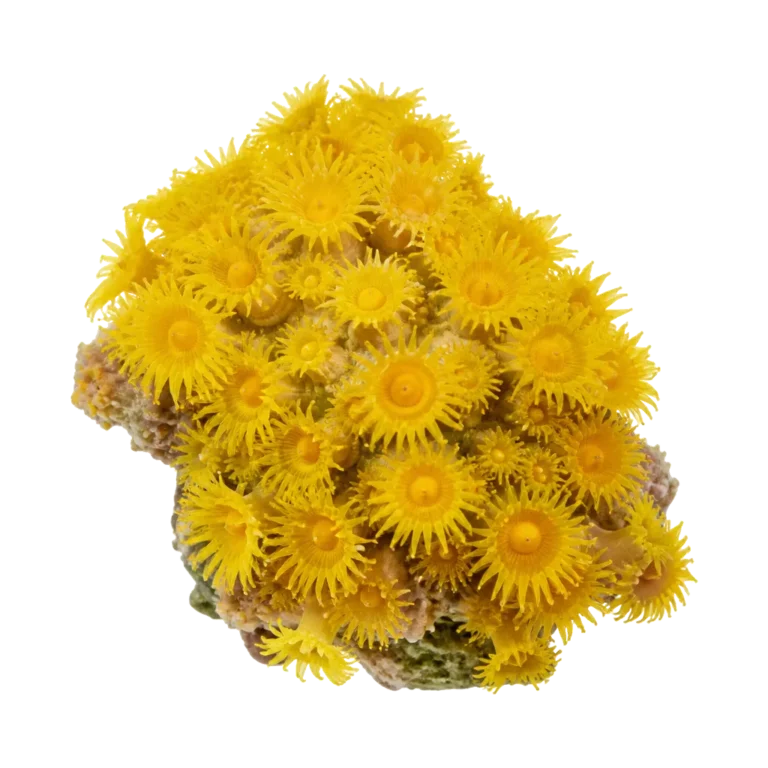
Yellow Polyp Coral
Summary
Yellow Polyp Coral sold as Parazoanthus sp. is a colony of individual, tentacled polyps connected across the rock by spreading tissue. “Yellow polyps” is a trade name rather than a precise species identification, so growth habit and color can vary among imports; plan for a fast-covering colony rather than treating a small frag as a permanently small coral.
Its practical defining trait is rapid encrusting spread. Choose it when you can dedicate an isolated rock or a clearly bounded section of hardscape, because the colony can turn available attachment space into new polyps quickly.
General care
Start the frag on an isolated rock in the middle area of the reef, with a gap that prevents its spreading tissue from reaching the main aquascape. This is easier than trying to remove established polyps from porous live rock later.
Handle the plug or rock rather than squeezing, peeling, or scraping individual polyps. Wear gloves and eye protection when cutting or relocating any zoanthid-type coral, and avoid actions that can splash or aerosolize mucus; damage to the colony’s connecting tissue can leave patches slow to reopen.
Lighting needs
Acclimate Parazoanthus sp. from gentler light toward the intended position over time, especially when moving a freshly shipped colony under a stronger fixture. A gradual change lets the polyps adjust without prolonged closure or paling.
In dimmer placement, polyps may become larger, more extended, and less vividly yellow; that can be a normal light response if the colony remains open and continues adding polyps. Under brighter placement, a more compact polyp and clearer yellow color can also be normal. Treat sudden bleaching, a washed-out appearance, or persistent daytime closure as signs to reduce exposure and reassess the move.
Flow needs
Provide indirect, variable medium flow that makes the tentacles move gently while allowing the colony to stay fully open. Correct flow keeps fine particles in circulation for feeding and prevents detritus from settling among the polyps.
Too little flow is suggested by trapped debris, algae collecting at the base, and polyps that stay partly closed beneath buildup. Too much flow whips the tentacles flat, bends polyps continuously in one direction, or causes repeated retraction; redirect the outlet rather than placing the colony directly in the jet.
Feeding and growth
Photosynthesis supplies much of this coral’s energy, so feeding is optional for basic maintenance but useful when you want faster expansion, are rebuilding a recently stressed colony, or keep the system lightly fed. Offer suspended small zooplankton-sized foods or finely minced meaty foods when the tentacles are extended, and let the current carry food across the colony rather than burying the polyps.
Expect the colony to enlarge by adding polyps and spreading its connecting tissue over nearby hard surfaces. Extra feeding can accelerate that process, so feed with the expectation that the coral will need more room and occasional containment rather than assuming growth will stay confined to the original plug.
Compatibility
The main aggression risk is expansion into neighboring sessile invertebrates, followed by direct tentacle contact and stinging. Keep at least 10 cm3.9 in of bare separation from other corals, but an isolated island remains the more reliable boundary because the colony can eventually bridge a simple gap.
Do not place it beside slow-growing encrusting corals or corals that cannot be moved easily; Parazoanthus sp. can occupy their attachment space before damage is obvious. Avoid fish known to pick at coral polyps, as repeated nipping can keep the colony closed and prevent feeding; persistent daytime closure with no flow or lighting explanation warrants watching for a grazer.
Water parameters
Parazoanthus sp. is generally more forgiving than many stony corals, but it performs best in a mature reef where salinity and major chemistry do not swing abruptly. Rapid changes commonly show first as a colony that remains tightly closed, sheds mucus, or reopens unevenly across the mat.
It has no unusually high skeletal mineral demand, so chasing elevated supplementation is less useful than preventing instability and keeping detritus from accumulating around the colony. If only part of the colony stays closed while other polyps are normal, check first for localized sediment, algae, pest irritation, or contact from a neighboring coral rather than changing the whole system’s chemistry.