
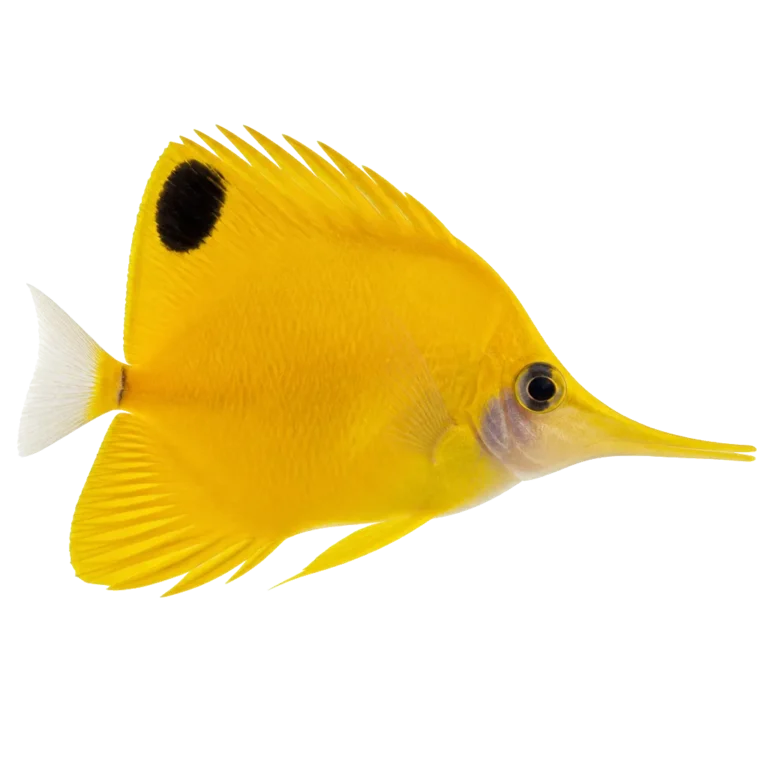
Yellow Longnose Butterflyfish
Summary
Forcipiger flavissimus spends much of the day methodically inspecting rockwork, coral bases, and crevices with its long snout rather than cruising continuously in open water. That probing behaviour makes it engaging in a mature reef structure, but it also explains why an individual may investigate polyps, clam mantles, feather dusters, and other small attached invertebrates.
Care
Build an open, stable reefscape with broad swim-throughs and plenty of narrow rock crevices to inspect. This fish needs room to make deliberate circuits around the display, while the crevices support its natural foraging pattern; a sparse layout often leaves it pacing the glass or repeatedly working the same small area.
Give a newly introduced fish a calm period with low competition at feeding time and accessible cover nearby. A stressed individual may hover behind rockwork, avoid the front of the aquarium, or fail to begin foraging; these are signs to reduce pressure from established fish rather than assuming it will settle while being chased.
Feeding
Offer a varied meaty diet in several small meals spread through the day, using mysis, enriched brine shrimp, finely chopped marine seafood, and prepared foods formulated for butterflyfish. Place part of the food close to the rockwork or deliver it in a way that lets the fish pick deliberately, because it is adapted to taking small animal prey from confined surfaces rather than winning a fast open-water scramble.
Watch the individual fish, not just the tank’s overall feeding response. It should actively peck and take repeated bites; a fish that follows food without eating, spits items, or loses body condition needs a quieter feeding zone and more suitable particle size. Do not rely on live ornamental worms or a reef’s resident microfauna to sustain it, as this can lead to losses among desirable invertebrates without meeting its nutritional needs.
Compatibility
Keep a single Forcipiger flavissimus as the straightforward choice. A genuine bonded pair can work when introduced together into a spacious, complex display, but adding another later can trigger persistent chasing because established fish may defend feeding routes from conspecifics or similarly shaped butterflyfish.
Favour peaceful community fish that leave it time to feed, and avoid boisterous food competitors or fish that repeatedly claim the same rock faces. Add this butterflyfish before strongly territorial butterflyfish or other similar-looking foragers when possible, since an established rival is more likely to treat it as an intruder.
Treat reef compatibility as conditional rather than assured. It may sample coral tissue or clam mantles and can consume feather duster worms and other small ornamental invertebrates, so it is a poor fit where those animals are a priority.
Good to know
Do not interpret constant inspection of coral bases or worm tubes as harmless curiosity. Repeated attention to the same coral, clam, or ornamental worm is the observable warning sign that the fish has begun using it as a food source; protect or remove the target, or reconsider the fish’s place in that reef.
Long-term trouble is more often a feeding and social-pressure issue than overt aggression. An individual that becomes withdrawn, misses meals, or is confined to one corner after tankmates are added may be getting displaced from its feeding circuit, even when no dramatic attacks are seen.