
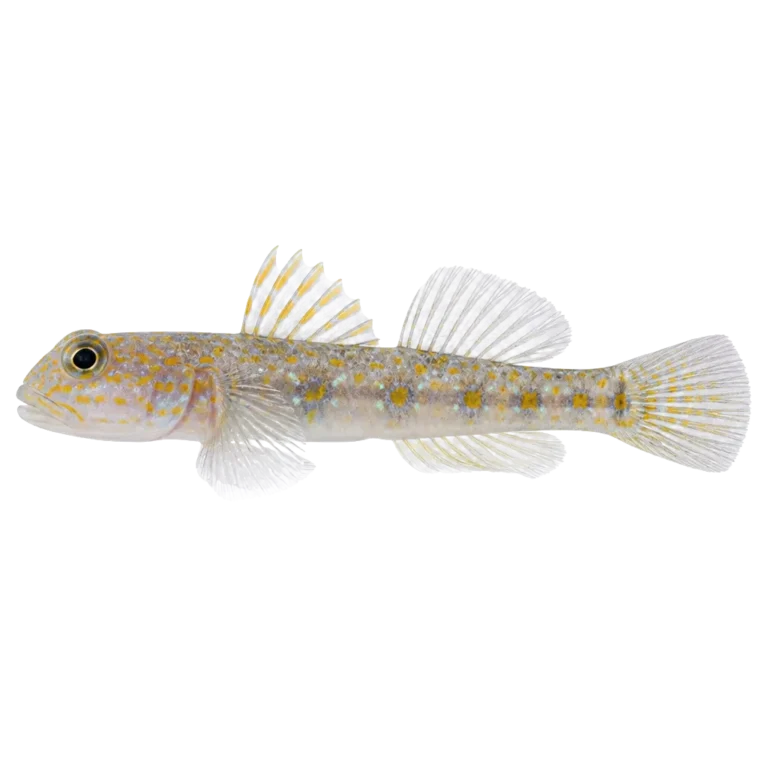
Yasha Goby
Summary
Stonogobiops yashia is a watchful, bottom-dwelling shrimp goby that spends much of its time hovering immediately above a burrow, then reversing into cover when it feels threatened. A fish that remains low and close to one chosen opening is behaving normally; a fish forced to stay hidden all day is usually being intimidated or lacks a secure retreat.
In nature it commonly shares a burrow with Randall’s pistol shrimp, Alpheus randalli. The shrimp maintains the excavation while the goby acts as the visual lookout, so a settled pair often stays in close contact at the burrow entrance rather than swimming through the aquarium. The goby can be kept without a shrimp, but should still be given a secure, low-level refuge.
Care
Build the lower aquascape around an open area of sand with small rubble or rock at the edge, leaving a stable site for a burrow. Place base rocks securely before adding sand: a partnered pistol shrimp can excavate beneath loose rockwork, and repeated collapses will make both animals retreat or relocate.
Keep water movement moderate around its chosen area rather than directing a strong stream at the substrate. Stonogobiops yashia is a short-range hoverer, not an open-water swimmer; persistent effort to hold position or refusal to leave the burrow can mean the flow is too forceful.
Expect it to select one territory and spend long periods near it. Do not interpret this sedentary routine as a problem if it emerges promptly for food and is not being displaced by other bottom dwellers.
Feeding
Offer small, appropriately sized meaty foods such as enriched mysis, enriched brine shrimp, copepods, and finely chopped marine flesh. Feed small portions once or twice daily, aiming food toward the burrow entrance so the goby can take bites without crossing exposed sand.
Do not rely on a single large feeding when fast midwater fish are present. This goby is easily outcompeted because it makes brief dashes from cover; use a pipette or baster to deliver a little food near its station and confirm that it actually swallows food.
If kept with a pistol shrimp, provide enough food at the burrow for both partners. A goby that repeatedly appears at feeding time but falls back into the burrow without taking food may be losing the competition rather than simply being shy.
Compatibility
Keep one Stonogobiops yashia, or add only an established compatible pair. Introducing unrelated individuals can lead to a dispute over the single preferred burrow, with one fish confined to hiding or driven away.
Choose calm, small fish that leave the sand bed alone. Avoid larger predatory fish and assertive bottom-oriented species, especially other shrimp gobies, watchman gobies, or fish that monopolize caves and sand territories; these are the tankmates most likely to prevent it from feeding or using its burrow.
Add Stonogobiops yashia before more assertive bottom fish whenever possible, so it can establish a refuge first. It is reef compatible, but a pistol-shrimp partner may move sand and rubble around the burrow, so secure coral frags and do not place loose corals beside the excavation site.
Good to know
Use a tightly fitting lid and close cable or plumbing gaps before introduction. A startled Yasha Goby can jump, particularly while it is still learning its territory or when a tankmate rushes the burrow.
New arrivals may disappear into cover while settling, especially after the substrate is disturbed or a shrimp begins digging. Watch feeding response rather than demanding constant visibility: regular appearances to take food are reassuring, while continued refusal to feed or a fish that never leaves cover after settling points to stress, harassment, or an unsuitable burrow site.
A goby-and-shrimp partnership may take time to form and is not guaranteed simply because both animals are added. Avoid repeatedly netting, moving, or digging around them to force contact; this usually resets their sense of security instead of speeding pairing.