
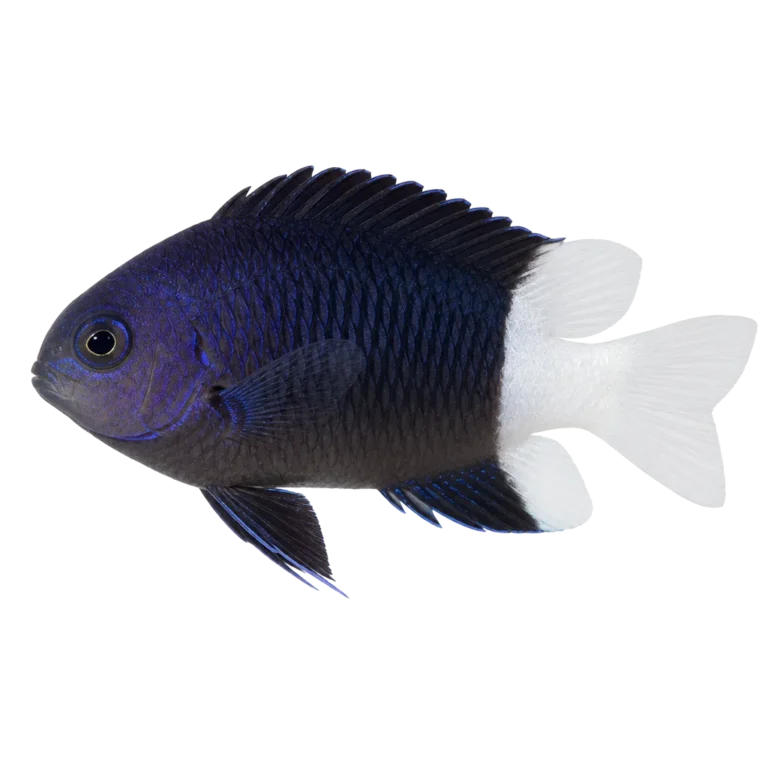
White-tail Damsel
Summary
White-tail Damsel (Pomacentrus chrysurus) is a bold, bottom-oriented damselfish that quickly adopts a rock outcrop and the surrounding food patch as its own. Its natural habit of picking at algae while taking small drifting foods explains the aquarium pattern: it repeatedly patrols a compact area, darts out to challenge intruders, then returns to cover.
It is best chosen for a reef built around assertive fish rather than a gentle mixed community. A fish that holds its ground around one section of rock is normal; repeated charges that keep other fish confined to a corner are a stocking problem rather than harmless activity.
Care
Build the aquascape with stable rock structures, overhangs, and several routes through or around the territory. This species alternates between short open-water forays and close inspection of the rockwork, so a bare, open layout gives it little room to establish itself without treating the whole aquarium as its territory.
Secure rock and coral bases rather than resting them loosely on sand. White-tail Damsels may dig beneath ledges to make or enlarge a retreat, and shifting substrate beneath an unsupported rock can create a collapse risk.
Feeding
Offer a varied omnivore diet with quality marine pellets or flakes that include algae, plus suitably sized frozen foods such as mysis and finely chopped seafood. Include vegetable-based foods routinely rather than relying on rich meaty foods alone, reflecting its frequent grazing behaviour.
Feed small portions once or twice daily and spread food across the tank when housed with slower fish. This damsel is usually quick to leave its territory for food and can repeatedly intercept a timid tankmate; a fish that hangs back during every feeding should be target-fed or reconsidered as a companion.
Compatibility
Keep one White-tail Damsel per aquarium. Adding another of the same species, or a similarly shaped damselfish, commonly turns a defined territory into continuous chasing because neither fish has room to yield without crossing the other’s feeding and shelter area.
Choose sturdy, self-assured tankmates that do not rely on a single small cave or a quiet corner of the rockwork. Avoid timid gobies, passive planktivores, and other small territorial damsels, especially where the rockscape offers only a few prime shelters.
Add this fish after the less assertive residents are settled. Once it has claimed a section of reef, later additions are more likely to be treated as intruders. It is generally suitable around corals, but its excavation behaviour means loose frags and unsecured coral rubble can be disturbed near its chosen shelter.
Good to know
Aggression may intensify after an initially calm introduction, once the fish has selected a shelter and feeding area. Brief displays and short chases are expected; persistent pursuit that prevents another fish from feeding, resting, or leaving the surface is a reason to separate the aggressor or substantially reset the territory.
Do not assume a smaller individual will remain community-safe as it settles in. Plan capture options before adding one to a densely packed reef, because a territorial damsel can be difficult to remove after it has learned the rockwork and established a retreat.