
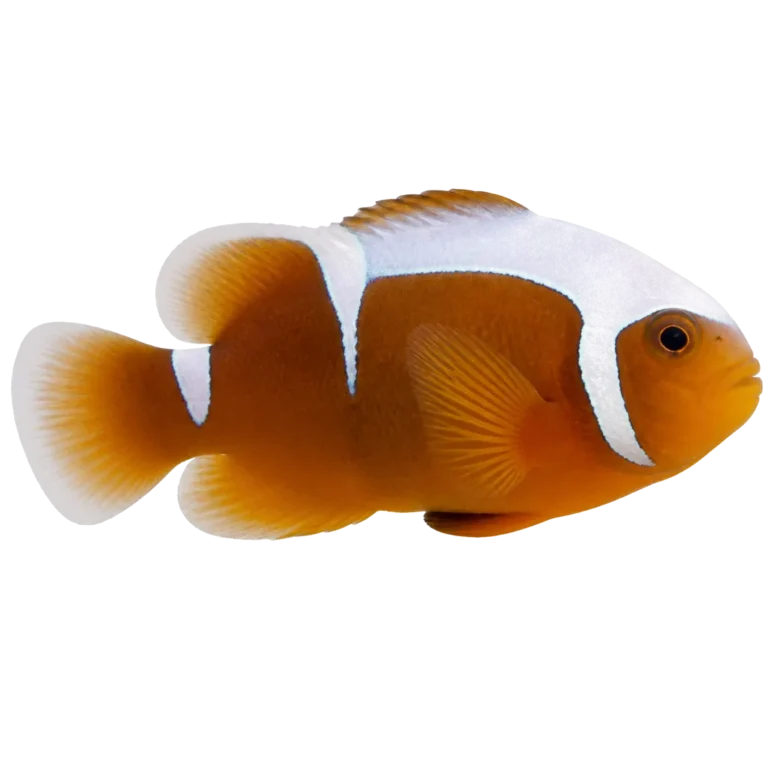
White Bonnet Clownfish
Summary
Amphiprion leucokranos is a naturally occurring hybrid anemonefish, associated with the overlap between Amphiprion chrysopterus and Amphiprion sandaracinos. Its appearance can vary between individuals, so use the scientific name rather than colour pattern alone when identifying it or assessing a prospective mate.
Expect a site-attached swimmer rather than a fish that uses the whole aquarium continuously. Once it adopts an anemone, coral colony, rock overhang, or other landmark, it will spend much of its time hovering close to that spot and may defend it.
Care
Build the aquascape with a sheltered home base beside open water, rather than making every rock face a high-flow corridor. This lets the fish hover, retreat, and make short foraging trips without being forced to fight a relentless current; a fish repeatedly sheltering in a corner or struggling against flow needs a calmer zone.
A host anemone is not required for Amphiprion leucokranos to settle, and it should not be added just for the clownfish unless the aquarium is already equipped for the anemone’s separate lighting, flow, and stability needs. Without one, the fish may adopt a fleshy coral or a fixed patch of rock as its territory.
Feeding
Offer a varied omnivore diet in small portions once or twice daily: quality marine pellets or granules can form the base, with frozen mysis, finely chopped crustacean foods, and suitably enriched frozen preparations for variety. Rotate foods rather than relying on brine shrimp alone, which is too poor as a staple.
Feed where the fish normally holds station and make sure food remains available long enough for it to take several bites. In a tank with fast, assertive planktivores, a timid new arrival may stay near its chosen shelter and lose out at feeding time; target-feed that area until it begins entering the water column confidently.
Compatibility
Keep one fish or a compatible pair. The most reliable route is to introduce two smaller individuals together and allow them to establish their hierarchy; adding a second clownfish after the first has claimed a host or corner can lead to persistent chasing and exclusion.
Choose peaceful to moderately assertive community fish that will not repeatedly enter the clownfish’s chosen site. Avoid combining it with other anemonefish, particularly established pairs, because separate clownfish territories can become a continuous conflict rather than two independent groups.
It is reef compatible, but its chosen host can be the exception. If it repeatedly rubs through the tentacles or branches of a particular coral, that coral may remain retracted or show damaged tissue; redirecting the fish is rarely dependable, so be prepared to relocate the coral or accept that site as the clownfish’s territory.
Good to know
Pair formation involves a size-based hierarchy: the dominant fish becomes female and the smaller partner functions as male. Brief quivering or submissive postures from the smaller fish can be normal, but torn fins, refusal to leave a corner, or missed meals indicate that the pairing is not settling safely.
Do not use colour variation to judge sex, maturity, or expected behaviour in Amphiprion leucokranos. Its hybrid origin can produce variable markings, while social rank and the presence of a claimed host are much more useful predictors of territorial behaviour.