
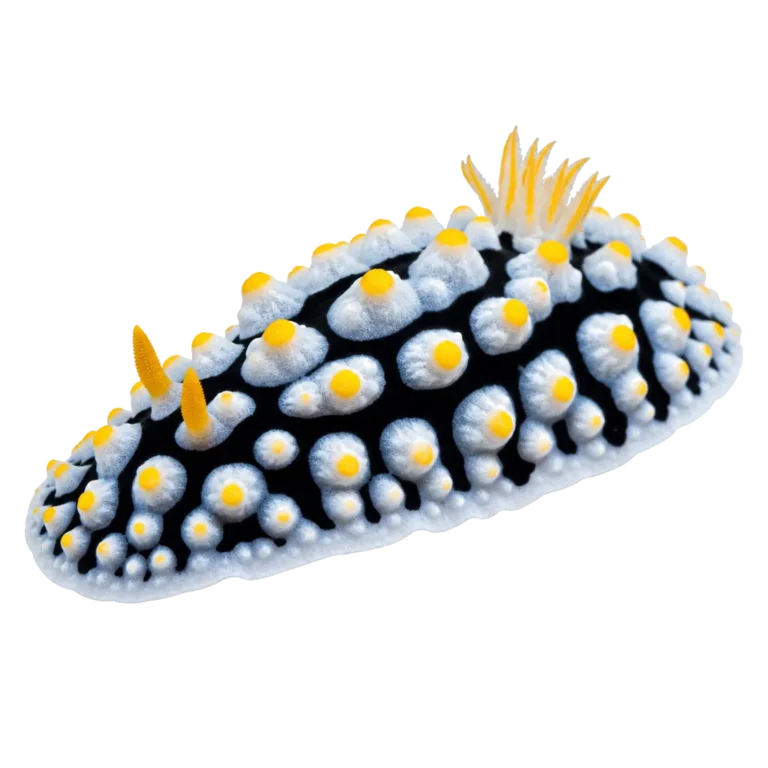
Warty Nudibranch
Summary
Phyllidia varicosa is a shell-less phyllidiid nudibranch, usually recognized by its dark body with raised yellow ridges and warty tubercles. Correct identification matters: similarly patterned sea slugs can have different prey requirements, while this species is a highly specialized sponge eater rather than a general scavenger.
It comes from tropical Indo-Pacific reef and rocky areas where suitable demosponges grow on hard surfaces. In an aquarium it will spend its time slowly searching live rock for edible sponge tissue; persistent roaming is not useful “cleanup” activity and can mean the available food is unsuitable or running out.
Care
Keep Phyllidia varicosa only in a mature system that already supports substantial, established growth of the particular encrusting sponges it will accept. Live rock that merely has occasional incidental sponge patches is not a dependable food reserve, and adding the slug in the hope that it will adapt to whatever is present commonly ends in starvation.
Build the aquarium around accessible sponge-covered rock rather than a special sand bed or decorative shelter. Screen pump intakes and overflows, because a slow-moving nudibranch can crawl into equipment and be seriously injured; an injured animal is also a water-quality and toxicity emergency.
Feeding and role
Provide only a sustained supply of compatible living encrusting sponges. Phyllidia varicosa generally does not accept pellets, frozen foods, algae, detritus, or common substitute foods, so there is no reliable prepared-food supplementation plan when its preferred sponges are exhausted.
It is not a practical cleanup-crew animal. It does not control nuisance algae or uneaten food, and its grazing can remove desirable filter-feeding sponges. Purchase it only when the aquarium can support its specialized diet, not to solve a husbandry problem.
Compatibility
Treat this species as reef compatible only with caution. It does not normally target corals, but it can consume encrusting sponges growing among corals or on coral bases. Do not add it to a system where ornamental or ecologically important sponge growth is something you want to preserve.
Do not keep it with fish or crustaceans likely to peck, bite, trap, or repeatedly harass it. When severely stressed, injured, or dying, Phyllidia varicosa can release defensive mucus compounds that are harmful to fish and crustaceans, so a predator attempting to eat it can turn into a risk for the whole aquarium.
Add singly. Multiple specimens sharply increase demand for an already difficult-to-provide food source and increase the consequences if one is injured or dies.
Good to know
Plan for rapid removal before adding one. If the nudibranch is damaged, becomes unresponsive, or dies, remove it immediately, replace chemical filtration with fresh activated carbon, and perform a substantial water change; its defensive secretion can affect other livestock.
Do not buy an individual that cannot be traced to a system with an identified, accepted sponge food. A healthy-looking animal may still decline after it has consumed the food collected or supplied before sale, and ongoing wandering with no visible feeding is a reason to reassess food availability rather than to wait for it to switch diets.