
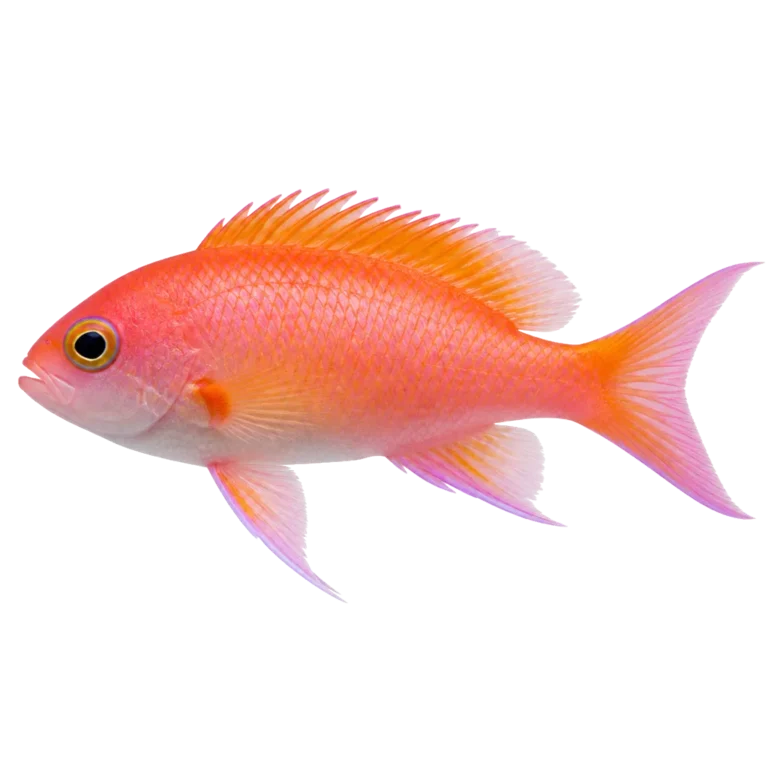
Ventralis Anthias
Summary
Pseudanthias ventralis is a secretive, midwater planktivore that tends to hover close to a rock face or overhang, then retreat quickly into cover when startled. In an aquarium, a fish that remains tucked into the rockwork is not necessarily failing to settle; persistent hiding combined with missed meals is the warning sign.
Its natural preference for caves and rubble around steep reef structure explains why it is less suited to exposed, brightly lit displays with nowhere to withdraw. It is best chosen for a calm, established reef where its repeated short feeding forays can become a regular visible routine.
Care
Build the aquascape with shaded overhangs, deep crevices, and broken sightlines near an open water column. Give the fish a clear hovering and feeding lane immediately outside its shelter; a solid wall of rock or a bare, exposed layout can leave it either confined or chronically alarmed.
Use circulation that keeps fine food moving through the water column without pinning the fish against rockwork. A Ventralis Anthias that repeatedly faces into flow, makes short excursions, and returns to the same shelter is behaving normally; one that is constantly swept around the aquarium needs a calmer feeding area.
This species is poorly suited to newly established systems or displays with erratic availability of small foods. Its high feeding demand makes nutrient export and uneaten-food management part of the stocking decision, rather than an afterthought.
Feeding
Choose an individual that is already taking prepared foods before purchase. Start with very small, energy-rich marine foods such as copepods, finely chopped crustacean foods, enriched frozen plankton, and suitably small pellets, then keep a varied rotation rather than relying on one food.
Feed several times daily in small portions, releasing food into the current so it passes repeatedly through the fish's hovering zone. Watch the fish actually capture particles: a bold tankmate can clear the food before this anthias leaves cover, even when the aquarium appears to be fed heavily.
Do not assume a fish that pecks once or twice is adequately fed. A shrinking belly, reduced interest in food, or increasingly long periods spent hidden usually means it is losing the feeding competition or has not adapted to captive fare; address that promptly rather than waiting for visible emaciation.
Compatibility
Keep Pseudanthias ventralis either singly or as a deliberately planned group with one established male and multiple females. Do not combine males casually, as male-to-male aggression can become focused and relentless in the confined territory of an aquarium.
Introduce a group together whenever possible, and add it before territorial, fast-feeding fish are established. Peaceful fish that leave the midwater feeding zone accessible are better companions than active wrasses, larger dottybacks, hawkfish, or other assertive species that repeatedly rush the same food stream.
It is generally suitable around corals, but reef compatibility does not make it suitable for every reef community. Avoid pairing it with animals likely to outcompete it at every feeding, since slow starvation is the more realistic compatibility failure than direct fighting.
Good to know
Social rank can change after the group settles. A dominant female may transition to male when no male is present, after which chasing and territorial displays may increase; a formerly peaceful all-female group should therefore still be monitored for one fish preventing another from feeding.
Use a secure lid, particularly during introduction or after a major disturbance. This species has a strong startle response and may bolt from cover when frightened.
The most consequential early problem is often refusal to feed, not visible disease. A newly acquired fish that stays hidden but takes food can improve as it learns the feeding routine; one that remains hidden and ignores successive feedings is a poor candidate to leave in a competitive display.