
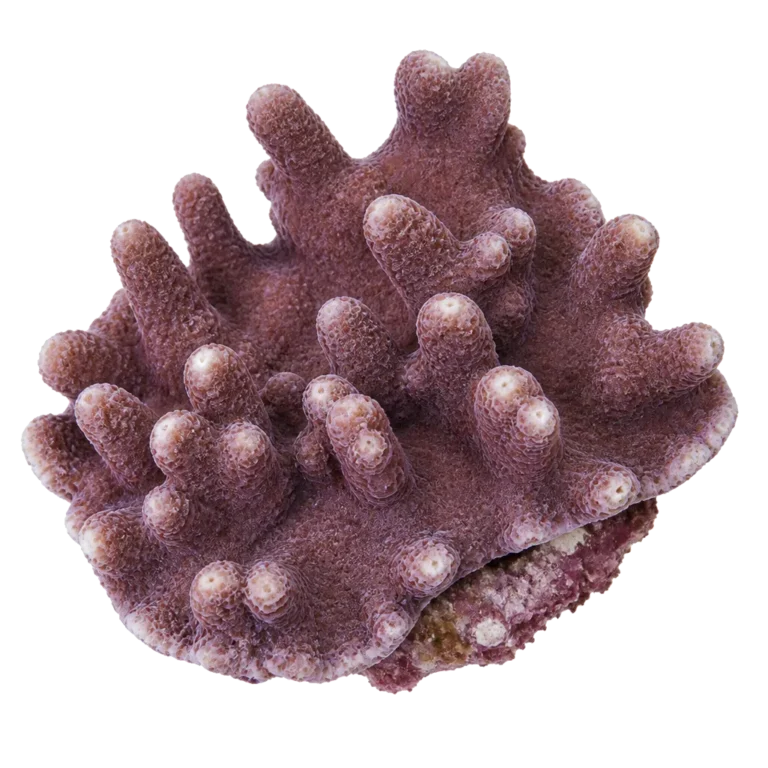
Velvet Rock Coral
Summary
Montipora nodosa is a small-polyp stony coral with a textured, velvety surface created by raised skeletal papillae around its tiny corallites. Colonies may encrust, form thick plates, or become low and submassive rather than producing long branches. Its shallow-reef origin explains its preference for bright placement, clean moving water, and an unobstructed surface.
General care
Mount Montipora nodosa securely on stable rock in the upper-middle aquascape, where its growing edge can expand without being shaded or knocked loose. Avoid placing a new frag on loose rubble: repeated rocking can damage the thin tissue at the base and start recession.
Handle the plug, bare skeleton, or underside rather than rubbing the living surface. Inspect new frags closely for bare patches, algae growing from the tissue edge, and Montipora-specific pests or egg clusters before mounting; small localized damage can spread across an SPS colony if conditions are poor.
Lighting needs
Begin a new or recently shipped frag toward the gentler end of the listed lighting range, then move it upward only after it remains colored and shows normal polyp extension for a couple of weeks. This avoids light shock in a coral adapted to shallow, bright reefs but often stressed by abrupt changes in aquariums.
Too little light commonly shows as slowed encrusting, a darker or browner appearance, and loss of crisp coloration. Too much light, especially after a sudden increase, shows as paling or bleaching on the uppermost surfaces, persistently withdrawn polyps, or tissue loss beginning on exposed edges; reduce intensity or provide temporary shading rather than making repeated rapid moves.
Flow needs
Provide medium, varied flow that passes across the colony from more than one direction. At the right setting, the small polyps can extend without being pinned flat, and the textured surface stays free of settled detritus.
Increase or redirect flow if detritus collects in the surface texture, mucus lingers, or algae establishes along shaded or dirty edges. Reduce direct pump pressure if polyps stay tightly retracted, tissue ripples violently, or an exposed edge begins to look abraded; the goal is broad movement across the colony, not a concentrated jet.
Feeding and growth
Most energy comes from photosynthesis, so feeding is supplementary rather than essential. Occasional suspended fine particulate coral food or appropriately small zooplankton is most useful in very lean systems or when growth has slowed despite otherwise suitable light and chemistry; large meaty foods are poorly suited to its small polyps and can foul the colony.
Expect the colony to spread as an encrusting base and develop thick plates or low mounds. Plan its location as a permanent growth zone: its expanding edge can cover nearby rock and progressively shade or contact corals beneath an overhanging plate.
Compatibility
Montipora nodosa is generally peaceful at a distance and does not rely on long sweeper tentacles, but it competes by direct tissue contact and can overgrow slower sessile neighbors. Leave at least 10–15 cm3.9–5.9 in of open rock around the growing margin, with extra clearance below any developing plate.
Keep it away from corals that inflate, sting on contact, or are likely to grow into it. Butterflyfish, some angelfish, and other known coral nippers can repeatedly damage its thin tissue, while crabs or snails that dislodge an unsecured frag can create a vulnerable damaged base.
Water parameters
Treat this as more demanding than a typical soft-coral aquarium: it responds best to consistent chemistry and routine, rather than frequent corrective dosing. Sudden alkalinity or salinity shifts can cause color loss and tissue recession even when test results soon return to the desired range.
Avoid driving nutrients to an excessively stripped state, and avoid large swings caused by abrupt changes in feeding, filtration, or dosing. A healthy colony should retain even color and a clean, intact growing edge; a receding edge, dulling color, or exposed white skeleton calls for checking recent stability changes before assuming the problem is simply light or flow.