
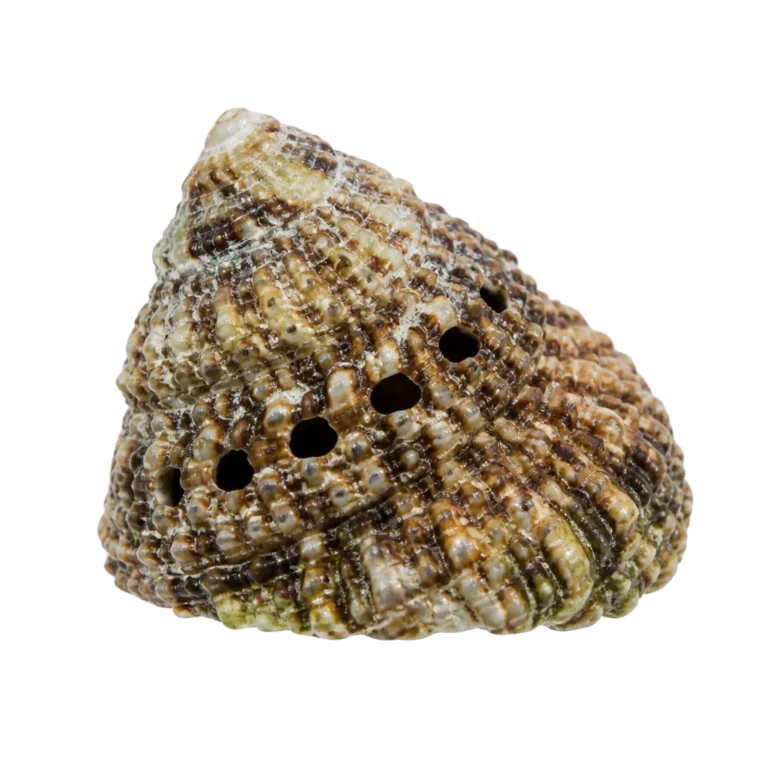
Trochus Snail
Summary
Tectus fenestratus is a conical top snail sold as a Trochus snail. Its strong preference for hard surfaces reflects its shallow-reef grazing lifestyle: expect it to spend most of its time on live rock, glass, overflows, and other firm surfaces rather than burrowing through sand.
Choose it for ongoing control of light film algae and diatoms in an established reef, not as a cure for a heavily algae-choked aquarium. A snail that remains out in the open and leaves clean grazing tracks is behaving normally.
Care
Add Tectus fenestratus only after rock and glass have developed a visible, renewable film of algae and biofilm. Newly set-up or exceptionally sterile systems can look suitable but provide too little natural food, so the snail gradually loses condition despite moving normally at first.
Build the aquascape with accessible rock faces and secure loose frags, plugs, and small rubble. This snail travels across hardscape while grazing and can shift unsecured pieces as it passes.
Feeding and role
Its main food is film algae and diatoms grazed from rock and glass. When those surfaces are consistently clean, offer marine algae or seaweed in small portions where the snail can reach it, then remove leftovers so supplemental feeding does not become a nutrient source.
Treat each snail as a surface grazer rather than a general-purpose cleanup crew. It can keep some hard surfaces tidier over time, but it will not eat uneaten meaty foods, replace manual removal of nuisance algae, or reliably solve a nutrient-driven algae outbreak.
Compatibility
Tectus fenestratus is coral-safe in the sense that it does not feed on corals, but its shell and foot can topple poorly attached frags while it grazes. Mount frags securely, especially those placed on ledges or near the glass.
Keep it away from animals that eat or crack snails, including many puffers, triggerfish, larger predatory wrasses, predatory crabs, and shell-hunting hermit crabs. Repeated pecking, a chipped shell, or a snail that stays withdrawn during the day can indicate harassment.
It does not need companions, but several can be kept when the aquarium has enough mature grazing area and supplemental food for all of them. Stock according to the amount of visible algae growth, and avoid adding a large group to a small, already-clean system.
Good to know
Acclimate slowly to avoid abrupt salinity and pH changes, which marine snails tolerate poorly. After introduction, check that the snail attaches firmly and begins grazing; a snail that repeatedly falls, stays sealed for an extended period, or fails to attach should be inspected promptly.
Keep copper-based medications and contaminated equipment out of the system, as copper is toxic to snails. If a snail dies, remove it promptly rather than leaving it to decay in the aquarium.
Check any snail found upside down or stranded in an inaccessible spot and place it upright on a firm surface if it cannot recover. A healthy individual should extend its foot and resume moving once it has regained purchase.