
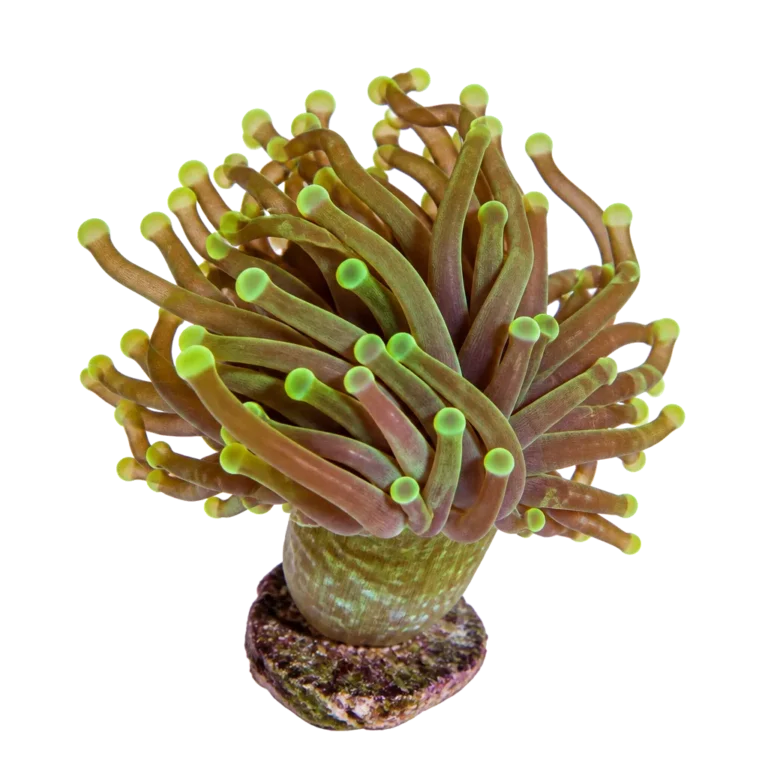
Torch Coral
Summary
Euphyllia glabrescens is a branching large-polyp stony coral with long, single-ended tentacles extending from separate skeletal heads. Its tentacles create the familiar flowing appearance, but they also make the coral easy to damage through contact with rockwork, neighbouring corals, or excessive current.
This species occurs across Indo-Pacific reef habitats, including lagoons and reef slopes. In an aquarium, that translates to a preference for moderate conditions with broad, indirect water movement rather than a fixed jet aimed at the colony.
General care
Place a Torch Coral in the lower to middle area of the aquascape, where every head has open water around it and cannot rub against rock as it expands. Secure the bare skeleton firmly; a loose frag that rolls or knocks against rock can tear the soft tissue at the rim of the corallite.
Handle Euphyllia glabrescens only by its skeleton, never by the tentacles or fleshy oral area. Inspect a prospective purchase for full tissue coverage over the upper skeleton, normal inflation, and no rapidly receding, discoloured, or gelatinous tissue; damage around a single head can progress quickly in this coral.
Lighting needs
Acclimate a newly acquired Torch Coral from a dimmer position or with temporary shading, then increase exposure gradually only after it resumes normal daytime expansion. This avoids a sudden change in light intensity that can cause a coral moved from a dealer system to remain contracted or pale.
Too much light is suggested by persistent retraction, paling or bleaching, and tissue that looks thin rather than inflated. Too little light is more often seen as reduced vigor, darker or browner coloration, and poor long-term expansion or growth; correct either problem gradually, since abrupt moves can create a second stress event.
Flow needs
Aim for indirect, changing flow that keeps the tentacles gently moving in several directions without flattening the polyp against one side. A well-placed Torch Coral stays inflated and shows a relaxed, rolling tentacle motion rather than a rigid stream of tentacles pointing in one direction.
Increase or redirect flow if detritus repeatedly settles among the tentacles or around the oral disc. Reduce direct flow if tentacles snap sharply, fold over the skeleton, remain tightly withdrawn, or appear to be whipped into nearby rock; repeated abrasion can lead to tissue loss at the skeletal edge.
Feeding and growth
Photosynthesis supplies much of this coral's energy, but feeding can be useful for recently fragmented colonies, recovering specimens, nutrient-lean systems, and hobbyists seeking steadier growth. Offer small zooplankton-sized foods or finely chopped marine meaty foods when the tentacles are receptive, usually after lights begin to dim, and use portions the mouth can retain rather than repeatedly expel.
Euphyllia glabrescens grows by adding heads to a branching skeleton. Growth may be slow, but each new head expands the colony's daytime footprint and its nighttime reach, so leave open space around the frag from the beginning rather than planning to move neighbours later.
Compatibility
Torch Coral is semi-aggressive because it can deploy long, potent sweeper tentacles, often most noticeably after dark. Keep a minimum of 20 cm7.9 in of clear space between its normally expanded tentacles and any other coral, and allow more room for a large colony or an individual known to extend especially long sweepers.
Do not assume that another Euphyllia will be safe simply because the two corals look similar; some colonies tolerate close neighbours while others sting after contact. Coral-nipping fish, especially larger angelfish, butterflyfish, and filefish, can keep the tissue retracted or cause visible bite damage. A clownfish that persistently nestles in a small or newly introduced torch can also prevent full expansion and abrade the tissue.
Water parameters
This is moderately demanding chiefly because it responds poorly to rapid changes rather than because it requires unusually extreme reef conditions. Keep alkalinity and salinity consistent; sudden swings can show up as prolonged contraction, failure to inflate, or recession where the flesh meets the skeleton.
Avoid driving nutrients abruptly to near-zero through aggressive filtration changes. Torch Corals generally fare better with a consistent, available nutrient supply than with repeated cycles of heavy feeding followed by stripping the water, and a colony that closes after such a change should be assessed for recent chemistry shifts before being repeatedly moved.