
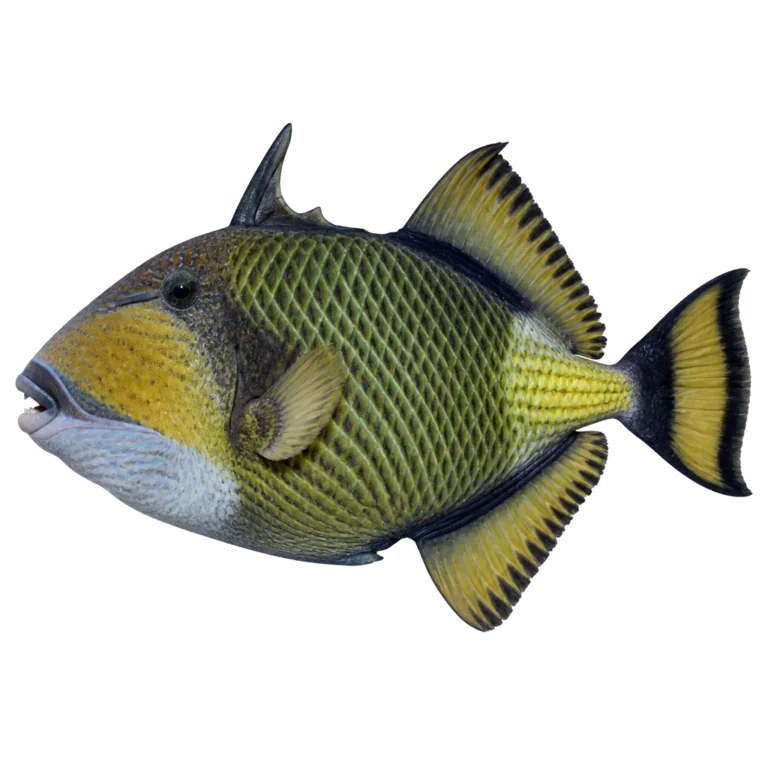
Titan Triggerfish
Summary
Balistoides viridescens is a powerful, inquisitive predator that spends much of its time patrolling, investigating crevices, and working over rock and substrate for hard prey. Expect it to test loose objects, excavate around structures, and treat much of the aquascape as foraging territory rather than fixed décor.
A calm juvenile should not be taken as evidence of a community temperament. As this fish settles in and gains size, its confidence, food competition, and territorial behaviour can increase dramatically; plan it as a long-term solitary predator from the outset.
Care
Build the aquascape for force rather than appearance: secure rockwork directly on stable supports before adding sand, eliminate unstable stacks, and leave broad open routes for turning and patrols. A Titan Triggerfish can undermine rocks while excavating or shift unsecured pieces, creating a collapse risk for fish, corals, and equipment.
Include a few large, open-sided caves or overhangs where the fish can retreat and brace itself, but do not fill the aquarium with narrow rockwork that restricts its movement. Strong mechanical filtration, protein skimming, and vigorous gas exchange are important because this species produces substantial waste and scatters food while feeding; accumulating debris is a sign that export capacity is inadequate.
Feeding
Use a rotating menu of substantial marine foods rather than relying on one item. Meaty crustaceans, mollusks, squid, and marine fish flesh can form the core diet, while intact shell-on foods should be offered routinely so the teeth receive normal wear. A diet made mostly of soft foods can leave the fish without enough crushing work and makes nutritional variety harder to maintain.
Offer controlled portions in at least two feeding opportunities each day, adjusting quantity to body condition and removing large leftovers promptly. Feed with long tools rather than fingers, and give any compatible tankmates food at a separate end of the aquarium before target-feeding the trigger; otherwise it can monopolize meals and injure slower fish during the rush for food.
Compatibility
Keep one Balistoides viridescens per aquarium. Do not plan on adding another Titan Triggerfish later in the hope that extra space will prevent conflict; established individuals can treat the entire display as territory, and serious fighting may be difficult to stop once it begins.
A dedicated species system is the most predictable option. If tankmates are attempted, restrict them to large, fast, robust fishes that can withstand assertive feeding and do not fit into the trigger's prey range; even then, compatibility can fail as the trigger matures. Avoid peaceful, slow-moving, small, or bottom-associated fish, and introduce the Titan Triggerfish last where possible so it has less opportunity to claim an already occupied aquarium.
This species is not suitable for a conventional reef or invertebrate display. Crustaceans, mollusks, echinoderms, worms, and similar animals are likely to be treated as food, while coral colonies may be bitten, overturned, or damaged when the fish excavates and rearranges rockwork. Tough corals do not create a meaningful reef-safe exception.
Good to know
Treat repeated charging, biting at tools, or rushing the glass during maintenance as a handling warning, not harmless begging. An adult can inflict a serious bite, so use long-handled equipment, avoid hand-feeding, and isolate or block access to the work area before moving rocks or servicing equipment.
Aggression often becomes more obvious after the fish has established routines around feeding sites and shelters. A tankmate that is repeatedly confined to one corner, excluded from food, or showing torn fins needs prompt separation rather than a wait-and-see approach; this species can escalate from intimidation to injury quickly.