
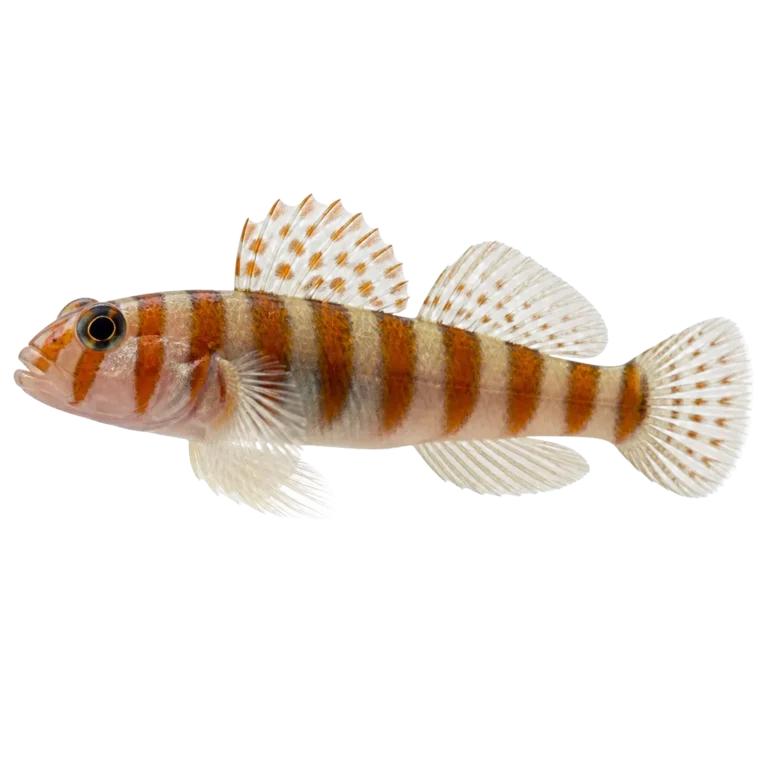
Tiger Goby
Summary
Tigrigobius macrodon is a small, perch-oriented goby rather than an active open-water swimmer. It typically holds close to a chosen rock face, sponge-like structure, or algae-covered ledge, then makes short dashes to inspect food or retreat. A fish that remains close to cover can be behaving normally; persistent hiding combined with missed meals is the more useful warning sign.
Its peaceful nature applies chiefly to unrelated tankmates. The main social risk is another Tiger Goby occupying the same limited perching territory.
Care
Build the aquascape with stable rockwork that includes shaded cracks, narrow ledges, and vertical or sloping faces near the lower half of the tank. This gives the goby defined perches and quick retreat routes; in an overly bare layout it may stay concealed and be harder to feed.
Keep its preferred perch out of the strongest direct flow. It can tolerate normal reef circulation, but should not have to fight a continuous blast just to remain in place. It is not a sand-sifting goby, so choose it for rockwork-focused behavior rather than for turning over the substrate.
Feeding
Offer small meaty foods that can be swallowed whole or in small pieces, such as finely chopped marine crustacean foods, enriched frozen brine shrimp, copepod-based foods, and small mysis. Deliver some food close to its usual perch with a pipette or target feeder, because this goby may not compete effectively at the surface or in a fast-moving feeding frenzy.
Feed modest portions regularly and confirm that the goby is actually taking food rather than only watching larger fish feed. A noticeably hollow abdomen, reduced interest in food, or repeated retreat when feeding begins usually means it is being outcompeted or offered pieces that are too large.
Compatibility
Keep Tigrigobius macrodon singly unless acquiring a settled, compatible pair. Do not add an unpaired second specimen to an established individual’s territory; chasing, fin displays, and one fish being restricted to hiding places can escalate into chronic stress.
Choose calm community fish that leave rock perches available and do not monopolize every small food item. Avoid large predatory fish and persistently pushy bottom-oriented fish that can claim the same crevices or prevent the goby from emerging to eat. Add the Tiger Goby before more assertive rock-dwellers when possible.
It is suitable for a reef aquarium, but place corals so the goby has alternative perches. It may rest on hard surfaces around the rockwork, and relying on a single coral colony as its only elevated shelter can lead to repeated disturbance of that coral.
Good to know
Watch the social relationship after introduction rather than assuming initial tolerance will last. A compatible pair will share space without one fish being continually displaced; repeated lunging, prolonged pursuit, or a fish that only emerges briefly to feed calls for separation.
The common name Tiger Goby is used for more than one goby in the aquarium trade. Confirm that the fish is Tigrigobius macrodon before applying this care profile, especially if the seller also uses the name for a larger sand-associated goby.