
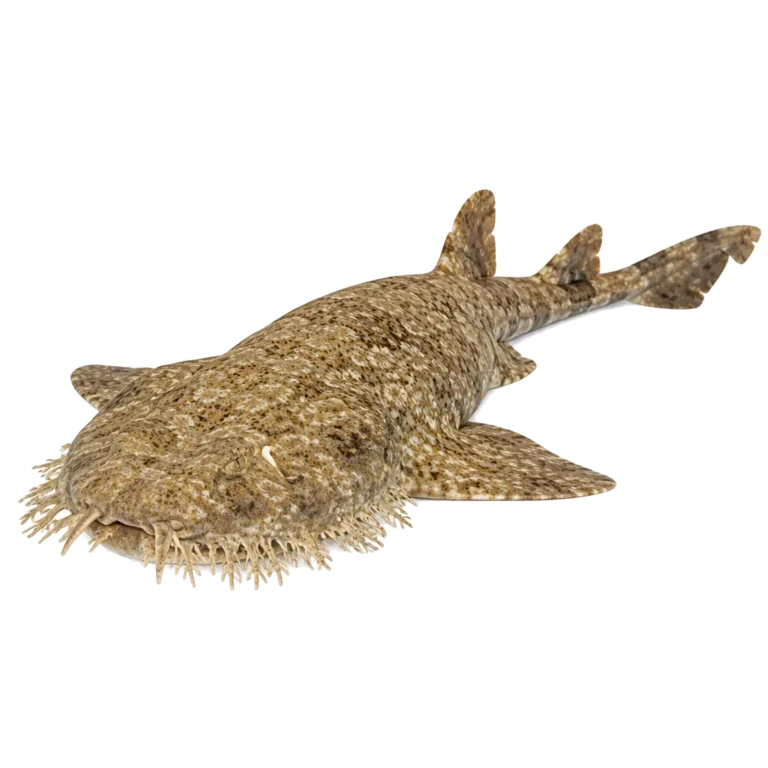
Tasselled Wobbegong Shark
Summary
The Tasselled Wobbegong is a nocturnal ambush shark that spends much of the day motionless beneath ledges or against the substrate, then becomes more active after dark. Its camouflage and fringed head make it easy to overlook, while its sudden suction-feeding strike means any fish or mobile invertebrate that can fit into its mouth should be considered prey rather than a companion.
Care
Provide a shark-focused system with a broad, uninterrupted floor area, fine sand, and low, stable rockwork that creates shaded overhangs without narrow passages. This species rests on the bottom rather than cruising continuously, but it still needs room to turn without scraping its body, trapping its head, or dislodging aquascape. Keep rock structures firmly supported from below rather than balanced on sand, as a moving shark can undermine loose pieces.
Use strong filtration and reliable oxygenation while preserving calmer resting areas under cover. Avoid rough rock, coarse gravel, exposed pump intakes, and cramped caves: skin and eye damage are far more consequential on a bottom-resting shark than on a midwater fish.
Feeding
Offer varied marine-origin meaty foods by target feeding near the shark after the main lights dim. Whole or appropriately sized pieces of marine fish, squid, prawn, clam, and other crustacean flesh can be rotated so the diet is not based on a single food. Feed measured meals on a spaced schedule and adjust portions to body condition; a persistently swollen abdomen or heavy deposits behind the head suggest excess feeding.
Do not depend on freshwater feeder fish or plain fish fillet as a staple, since they are a poor long-term substitute for varied marine prey. Feed with long tools and keep hands away from the mouth: a resting wobbegong can strike rapidly when it detects food, and faster tankmates may otherwise take the offering before the shark responds.
Compatibility
Keep this species singly in most private systems. There is little practical margin for managing another large bottom-dweller or another wobbegong in an enclosed footprint, and close resting positions can turn into injury or predation risks rather than a stable social arrangement.
Choose only calm, robust fish that are far too large to be swallowed and that will not nip at the shark's eyes, fins, or skin. Avoid triggers, puffers, large assertive angelfish, and persistent wrasses, as well as all ornamental shrimp, crabs, lobsters, and similarly sized fishes. Adding the shark after smaller residents are established does not make those residents safe; its hunting response is based on opportunity, not familiarity.
Corals are not its intended food, but this is not a typical reef-safe animal. Its size, resting behaviour, and movements can block access to the substrate, disturb unsecured corals, and make a mixed reef impractical even before predation on mobile invertebrates is considered.
Good to know
Treat a wobbegong that appears to be asleep as an animal that can still defend itself. Its camouflage makes accidental close contact during maintenance especially likely, and it can bite when touched, cornered, or approached near the head. Plan all servicing so the shark has a clear retreat route and never attempt to move it by hand.
Expect a reverse day-night rhythm. A shark that remains hidden through the photoperiod but emerges, repositions itself, and accepts food after dark is showing normal behaviour; repeated daytime exposure, frantic circling, abrasions, or refusal of food are more useful warning signs than daytime inactivity alone.
Do not medicate the display with copper-based treatments while the shark is present. Elasmobranchs are unusually sensitive to copper, so disease treatment plans must protect the shark rather than assuming standard marine-fish medications are acceptable.