
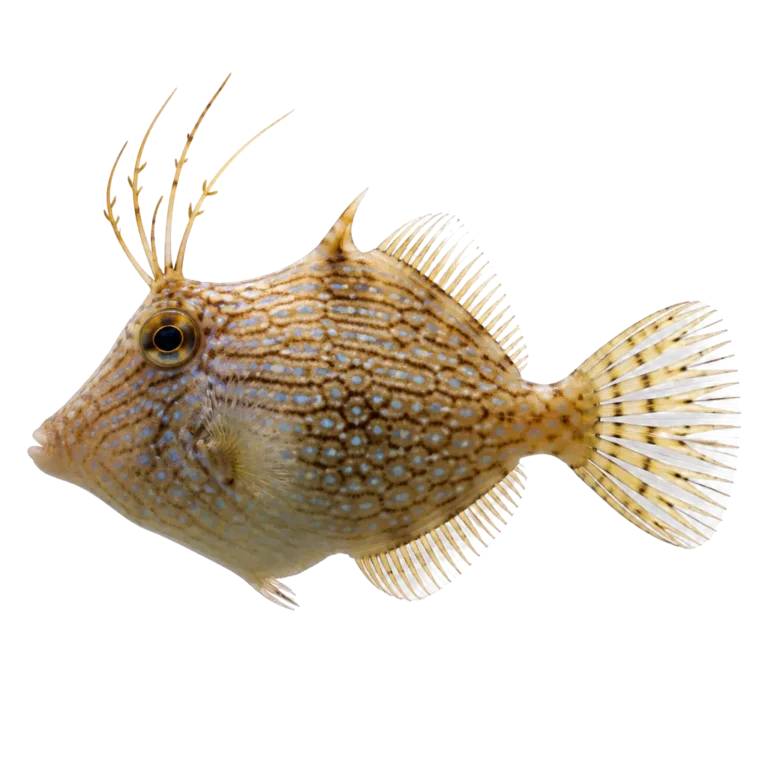
Tassel Filefish
Summary
Chaetodermis pencilligerus is a slow, deliberate browser that often hovers, sways, or rests close to rockwork rather than cruising in open water. Its tasselled body is camouflage for weedy habitat, so a fish that spends long periods motionless among rock and algae is usually behaving normally; persistent pacing along the glass or refusal to emerge for food is more concerning.
This is a large filefish with a mouth adapted to picking at surfaces. Expect it to inspect nearly every rock, coral, and ornamental invertebrate for a possible meal rather than behaving like a strictly planktivorous community fish.
Care
Set up a mature fish-only-with-live-rock system with broad, broken sightlines, substantial rockwork, and calm resting areas. Chaetodermis pencilligerus needs room to make slow feeding circuits, but also needs textured surroundings where it can blend in and retreat when startled.
Keep direct, high-energy flow away from its preferred shelter and feeding surfaces. This species is a comparatively weak, slow swimmer; being continually pushed into open water can leave it withdrawn, unable to feed comfortably, or visibly exhausted.
A bare, newly established display is a poor fit. Established rockwork and natural surface growth give the fish places to browse between meals and make its normal cryptic behaviour easier to accommodate.
Feeding
Offer several small, varied meals through the day rather than relying on one large feeding. Rotate finely chopped mysis, shrimp, clam, squid, and other marine invertebrate foods with marine algae or algae-based preparations; a meat-only routine does not reflect its omnivorous feeding pattern.
Target-feed at least part of each ration near its usual cover if faster fish strip food from the water column. A well-settled fish should repeatedly pick at food and surfaces; food that is consistently ignored, or a fish that only watches bolder tankmates eat, calls for reducing competition rather than simply adding more food.
Do not use hunger to encourage nuisance-pest feeding. A hungry Tassel Filefish is more likely to sample corals and ornamental invertebrates, while overfeeding large portions can quickly foul a system.
Compatibility
Keep one Chaetodermis pencilligerus per display unless a proven compatible pairing is being managed in a very large, carefully planned system. Individuals can become territorial toward other Tassel Filefish and may also direct that behavior at similarly shaped filefish.
Choose peaceful, non-nipping fish that will not outcompete a slow feeder. Avoid triggers, puffers, and other assertive species that may harass the fish or bite its tassels, and be cautious with fast, food-dominant tankmates that leave it without enough to eat.
Add the filefish before highly assertive community fish when possible, or give it a protected feeding routine from the start. It is not reef-safe: coral polyps, anemones, mollusks, crustaceans, and other sessile or ornamental invertebrates may all be sampled or eaten. An individual that appears tolerant of corals for a time should not be treated as a dependable reef-safe exception.
Good to know
Its camouflage can make a settled fish surprisingly difficult to find. Check its usual sheltered areas before assuming it has disappeared, and judge its condition by whether it emerges and feeds reliably rather than by how much time it spends in open water.
Territorial behavior is most likely to become apparent after the fish has settled and claimed feeding routes or cover. Repeated chasing, blocking another filefish from food, or forcing it into a corner is a stocking problem, not normal play; separation is usually safer than waiting for the hierarchy to resolve.
The fish's skin tassels and slow movement make physical harassment especially damaging. Frayed tassels, torn fins, or a specimen that remains hidden at feeding time are practical signs that tankmate pressure or flow is unsuitable.