
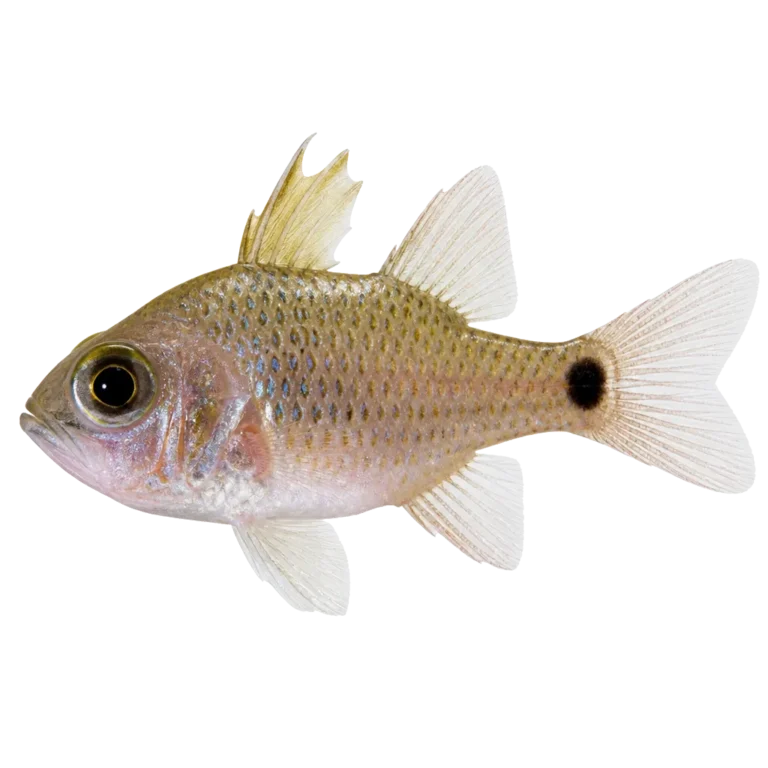
Tailspot Cardinalfish
Summary
Tailspot Cardinalfish, Apogon dovii, is a quiet, deliberate cardinalfish that tends to hover near rockwork rather than cruise continuously through open water. Its large eyes and preference for shaded reef structure explain why it may remain tucked beneath ledges during the day, then become more willing to forage as the display dims.
A fish that stays close to cover but emerges promptly for food is usually behaving normally. Constantly pacing exposed glass, being unable to settle near shelter, or missing meals around more forceful fish points to social pressure rather than a need for more open swimming space.
Care
Build the aquascape around shaded overhangs, caves, and crevices with clear escape routes, while leaving a short open area immediately outside them for feeding. Apogon dovii uses reef and rocky structure as a daytime base; a brightly lit display can work when the fish can retreat from the light without being trapped in a dead-end cave.
Keep it with gentle circulation rather than a relentless direct blast. It is a slow, controlled swimmer, and a fish repeatedly pinned behind rockwork or struggling to approach food is being overpowered by flow or by tankmates. A mature aquarium with reliable, low-conflict feeding access is more useful than a sparsely scaped display.
Feeding
Offer varied, appropriately small meaty foods such as mysis, copepod-based foods, finely chopped marine seafood, and quality carnivore pellets or granules. Feed in small portions on a dependable routine, with at least one offering near dusk if the fish is hesitant under bright lighting.
Deliver food close to its chosen cover or use a target-feeding zone when kept with fast feeders. Tailspot Cardinalfish can lose condition quietly when tangs, wrasses, or other rapid feeders intercept every particle; a sunken belly or repeated aborted feeding dashes is a reason to change delivery rather than simply add more food. Do not rely on unenriched brine shrimp as the staple diet.
Compatibility
A single Tailspot Cardinalfish fits best in a peaceful community built around calm gobies, firefish, dragonets, and similarly non-confrontational fish. Avoid aggressive cave-holders, persistent chasers, and very fast feeders, since even a fish that is not physically injured may spend the day confined to a retreat and fail to eat enough.
If keeping more than one, introduce the group together into an aquascape with several separate shaded retreats and monitor closely after they settle. Do not assume that fish sold together will remain equally tolerated once they establish preferred shelter; persistent exclusion of one individual calls for separation or removal.
It is generally suitable around corals, but treat the reef-safe rating as conditional: tiny shrimp and other mobile invertebrates small enough to swallow can be prey. Larger ornamental shrimp and sessile corals are the safer match. Add the cardinalfish before more territorial community fish claim the best caves and feeding lanes.
Good to know
Daytime shyness is not automatically a health problem. A settled fish may hold position under a ledge for much of the photoperiod and become noticeably more active in low light; investigate only when this is paired with rapid breathing, persistent hiding through feeding, or loss of body condition.
Apogon dovii is a mouthbrooding cardinalfish. In a bonded breeding situation, a male carrying eggs may stop feeding for a period; observe the overall posture and mouth area before treating a sudden refusal of food as disease. Breeding males may also show a reduced or missing tail-base spot, so the marking is not a reliable indicator of health or identity on its own.