
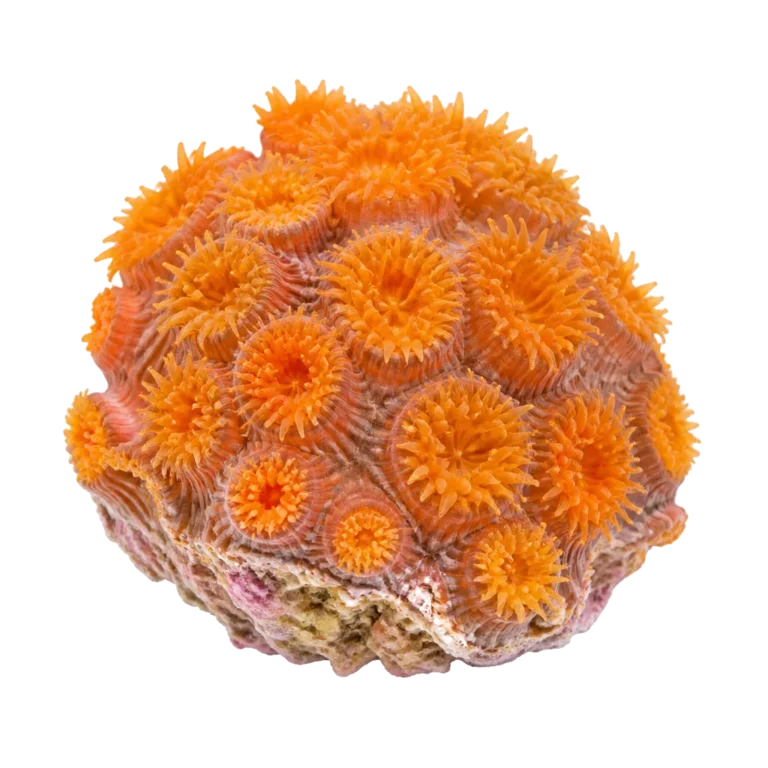
Sun Coral
Summary
Sun Coral is a trade name for Tubastrea sp., so colony shape and polyp size can vary between imports. These are azooxanthellate LPS corals: their large, fleshy polyps catch food rather than depending on light. Their usual habit of living on shaded hard surfaces, ledges, and vertical rock explains why a regularly fed, low-light position works better than a brightly exposed display location.
Buy only if you can commit to frequent target feeding and can keep the colony accessible at feeding time. A closed colony can look like bare skeleton during the day, but healthy polyps should extend when food is introduced and gradually become conditioned to a consistent feeding routine.
General care
Mount Tubastrea sp. securely on lower rockwork, ideally on a shaded face or overhang where detritus will not collect in the cups. Keep it accessible enough to target-feed every polyp; placing it deep behind an immovable rock often turns feeding into a missed routine and leads to gradual polyp loss.
Handle the hard base or plug rather than squeezing, scraping, or lifting the colony by its soft polyps. Avoid burying any part of the colony in sand and prevent falls or repeated abrasion from loose rock, because damaged tissue can recede from individual corallites and expose white skeleton.
Lighting needs
Do not acclimate this coral by progressively increasing light. Instead, begin it in shade and judge its adjustment by feeding behaviour: polyps that open readily around feeding time are responding appropriately, regardless of how brightly other corals nearby are lit.
There is no useful sign of “too little” light because Tubastrea sp. does not need light for energy. If a colony remains persistently withdrawn in a bright, exposed position yet opens after being shaded, move it into lower light; also check feeding opportunity, flow, and tissue condition before assuming light is the only cause.
Flow needs
Provide a moderate, indirect current that carries food across the colony without blasting the polyps. At suitable flow, extended tentacles sway and retain delivered food while the cups stay clear of settled debris.
Too little flow leaves detritus and food residue trapped between corallites, which can suppress extension and encourage tissue recession. Too much direct flow makes tentacles stream hard in one direction, prevents food capture, or keeps polyps partly closed; redirect the outlet rather than placing the coral directly in the pump’s path.
Feeding and growth
Feeding is essential rather than optional for Tubastrea sp. Target-feed each open polyp several times per week, using zooplankton-sized foods, copepods, enriched brine shrimp, finely chopped marine foods, or small mysis appropriate to the polyp’s mouth. Broadcast feeding alone is unreliable when fish or shrimp intercept the food.
Use a small food plume to trigger extension, then place food gently on individual polyps once tentacles are out. A colony that opens but repeatedly fails to hold food may be receiving particles that are too large, flow that is too forceful, or too much competition at feeding time.
Healthy colonies add new polyps around the base and outward from existing corallites, creating a thicker branching or clumping structure. Leave room for the colony’s footprint to expand and for every new polyp to remain reachable with a feeding tool.
Compatibility
Treat Tubastrea sp. as semi-aggressive when its feeding tentacles are extended. Those tentacles can sting neighbouring sessile invertebrates, so keep at least 10 cm3.9 in of clear space around the colony and allow more room if nearby corals extend long sweepers of their own.
Avoid placing it where a spreading coral can overgrow its base or where another coral’s tentacles regularly contact its polyps. Fish, cleaner shrimp, crabs, and other opportunistic scavengers may steal target food; if the coral cannot retain a meal, feed distracting tankmates first or shield the colony briefly while it eats. Coral-picking fish can prevent normal extension and are a poor match.
Water parameters
Tubastrea sp. benefits from the same consistent reef chemistry needed to maintain an LPS skeleton, but its main husbandry challenge is the nutrient load created by frequent feeding. Match feeding volume to export capacity: accumulating uneaten food, rising nuisance algae, or declining water clarity means the routine needs better capture, cleanup, or filtration rather than simply more food.
Avoid abrupt shifts in salinity, alkalinity, or temperature, especially after water changes or dosing corrections. A colony that suddenly remains closed, sheds tissue, or develops exposed corallites after a parameter swing needs the instability corrected promptly; do not attempt to solve that response by increasing feeding.