
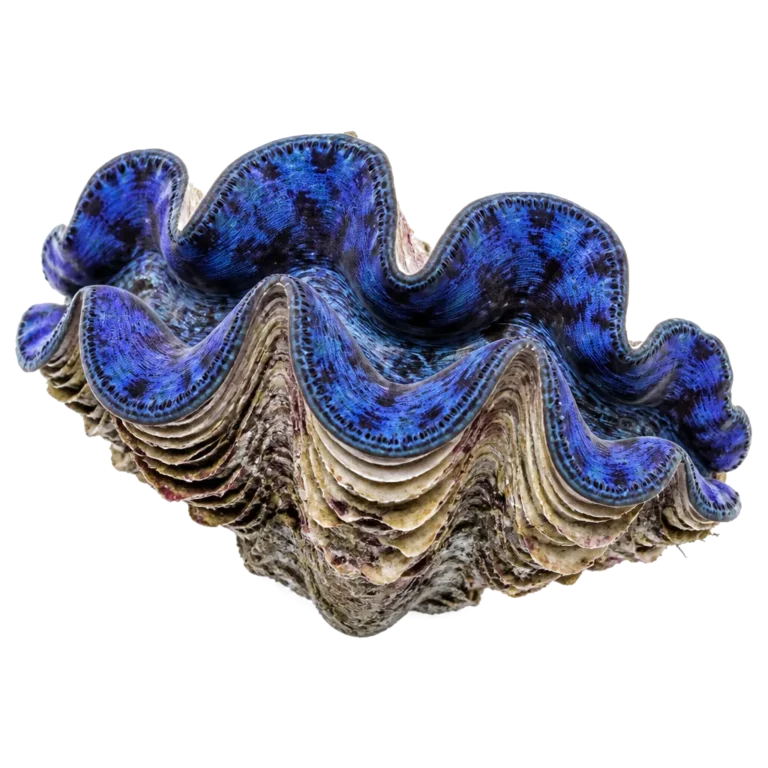
Squamosa Clam
Summary
Tridacna squamosa is identified by the large, fluted scales on its shell. It comes from clear, sunlit Indo-Pacific reef habitats, where it commonly settles on sand, rubble, or reef pockets and exposes a broad, light-harvesting mantle. That natural preference makes a stable, well-lit bottom placement more suitable than a shaded crevice or a narrow ledge.
It is a sessile giant clam rather than an active scavenger. A healthy specimen usually opens its mantle fully under the lights and closes promptly when a shadow passes; persistent withdrawal during the photoperiod is a reason to check flow, lighting, pests, and fish behavior.
Care
Place Tridacna squamosa upright on a level area of sand or on a stable, low rock support surrounded by sand. A shallow cradle made from a flat shell or rock can prevent a younger clam from being toppled by snails, burrowing animals, or shifting substrate while allowing it to attach if it chooses.
Provide moderate to strong reef lighting, then increase exposure gradually after introduction. Sudden placement directly under much stronger lighting can bleach or keep the mantle retracted, while insufficient light leads to poor mantle extension and gradual decline.
Use moderate, indirect water movement that carries suspended food past the clam without folding or whipping the mantle. Redirect a pump if the mantle flaps continuously or the clam remains tightly closed in the current.
Add this species only to a biologically established reef with dependable calcium and alkalinity management. Shell growth consumes these building materials, so repeated swings can show up as poor extension, stalled growth, or a weakening shell edge.
Feeding and role
Most of the clam's energy comes from its symbiotic zooxanthellae under appropriate lighting, but Tridacna squamosa also captures very fine phytoplankton and suspended organic matter. In a well-lit, established reef, routine target feeding is usually unnecessary; if supplementation is used for a small specimen or a very low-nutrient system, use an appropriate fine phytoplankton product and avoid coating the mantle with concentrated food.
Do not buy this species as a cleanup-crew animal. It does not graze nuisance algae from rock or glass and will not remove settled detritus. Its filter feeding is a minor contribution to overall water clarification, not a substitute for nutrient export or maintenance.
Compatibility
Tridacna squamosa is peaceful and does not harm corals, but its exposed mantle is vulnerable to repeated nipping. Avoid fish known to sample clam tissue, especially angelfish, butterflyfish, puffers, triggerfish, and individual wrasses or other fish that show persistent interest in the mantle. Repeated closing in response to a particular fish is a compatibility problem even when no obvious wound is visible.
Keep the clam clear of coral that can shade it or repeatedly touch the mantle with sweeper tentacles. A coral may not need to overgrow the shell to cause trouble; frequent mantle contact can lead to chronic retraction and lost feeding time.
One specimen is entirely suitable, with no need to add a mate or group. Multiple Tridacna squamosa can coexist when each has its own stable, unshaded placement and the system can support their combined light and mineral demand; do not crowd them where growing shells or mantles will touch.
Good to know
Inspect the shell, byssal area, and surrounding substrate after dark for pyramidellid snails and their egg masses. These small parasitic snails feed on clam tissue, often remain hidden near the base during the day, and can weaken a clam before daytime behavior makes the problem obvious.
Never pull an attached clam from its support. Younger specimens may secure themselves with byssal threads, and tearing those tissues can cause serious injury. If relocation is necessary, move the entire support beneath it whenever possible rather than tugging on the shell.
Avoid copper-based medications and contaminated treatment water, as copper is toxic to clams. Acclimate carefully to the receiving aquarium's salinity and temperature, because a stressed clam may remain tightly closed or show a persistently withdrawn mantle. A persistently wide-open shell combined with a retracted mantle, bleaching, or failure to react to shadows warrants immediate inspection for pests, nipping, excessive flow, and unsuitable lighting.