
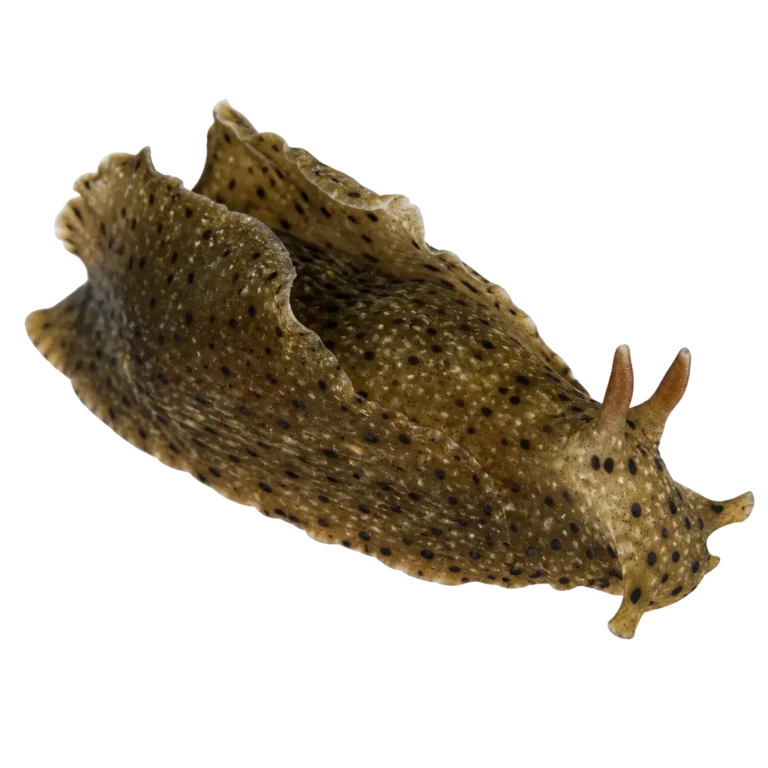
Spotted Sea Hare
Summary
Aplysia punctata is a soft-bodied, ear-tentacled sea hare rather than a typical snail. Its variable olive, brown, red, or purplish coloration and spotted pattern can make identification by common name unreliable, so confirm the scientific name before buying.
This is a cool-water herbivore from shallow North-East Atlantic and Mediterranean algal beds, seagrass areas, lower shores, and rock pools. That origin matters in captivity: it is a poor fit for a conventional warm tropical reef and needs a system run within 15–20 °C59–68 °F, with dependable seaweed production rather than incidental algae alone.
Care
Keep it in a mature cool-water marine aquarium with accessible rock, sand, or other broad grazing surfaces and a reliable source of edible macroalgae. A shaded ledge or loose rock shelter gives it somewhere to settle when inactive, but leave open routes around the aquascape because a sea hare can dislodge poorly secured frags while moving.
Use flow that keeps food and oxygen moving without continually tumbling or pinning the animal against rockwork. Bright reef lighting is not a direct requirement; light is useful only insofar as it supports the macroalgae on which the animal depends.
Feeding and role
Provide a continuous supply of suitable marine macroalgae, especially Ulva, alongside other accepted green, red, or brown seaweeds. Grow or source the algae before adding the animal, and offer dried marine algae such as nori only as a supplement when it is accepted; a sea hare that spends time roaming glass and rock after available algae has been stripped is at real risk of running out of food.
Its cleanup role is limited to grazing edible algae. One Aplysia punctata can reduce patches of palatable macroalgae or soft algal growth, but it will not reliably correct an algae problem caused by excess nutrients, nor will it distinguish nuisance growth from ornamental macroalgae.
Compatibility
Do not house it with fish, crabs, or other invertebrates that may nip, seize, or repeatedly investigate a slow soft-bodied grazer. Harassment can cause withdrawal, persistent hiding, physical injury, or defensive inking. Corals are normally left alone, but ornamental macroalgae should be treated as potential food.
Keep a single specimen unless the aquarium has a deliberately planned, sustained algae supply for more. Sea hares do not need companions for day-to-day welfare, and adding several simply multiplies the likelihood that the available macroalgae will be exhausted.
Good to know
Purple ink or pale opaline secretion is a stress response, often following handling or an attempted attack. If it occurs, stop handling the animal, identify and remove the source of harassment, and use fresh activated carbon and a water change if the water remains discolored. Repeated inking is not normal behavior to ignore.
Avoid copper-based medications and other treatments unsafe for marine mollusks. Acclimate carefully to the receiving system’s salinity and especially its cool temperature; placing this species into a typical tropical reef temperature can lead to rapid decline even when food is available.