
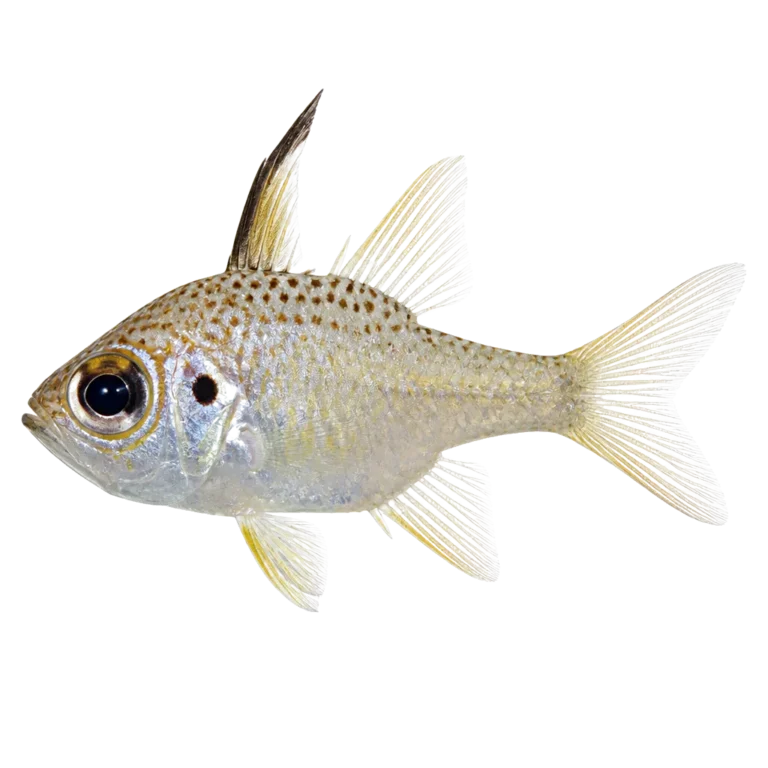
Spotted-gill Cardinalfish
Summary
The Spotted-gill Cardinalfish, Ostorhinchus chrysopomus, is a mainly dusk-and-night-active cardinalfish that spends the day hovering quietly within branching coral-like cover. Its tendency to gather around complex branches in nature explains why it is often inconspicuous at first, then becomes more visible as room lighting softens and it learns the aquarium’s routine.
Care
Build the aquascape with open, branching shelter and shaded recesses rather than a bare, exposed rock wall. This fish needs to be able to hover just inside cover and retreat without being trapped; a specimen that remains pressed into a corner, repeatedly darts for cover, or stays hidden through feeding is not settling in well. Leave calm swimming lanes around the shelter and avoid placing it where strong, direct flow continually pushes it into the rockwork.
Feeding
Offer small, marine-based meaty foods such as mysis, enriched brine shrimp, finely chopped seafood, and suitably sized crustacean-based frozen blends. Feed in more than one small delivery when fast tankmates are present, and place some food close to its chosen shelter during the evening transition; a timid cardinalfish can otherwise miss meals while bolder fish clear the water column. Avoid relying on large pellets or oversized chunks, which are easy for this small-mouthed feeder to reject or spit out.
Compatibility
Keep one specimen as the simplest option, or introduce a group together only where the aquascape provides multiple separated cover areas and every fish can reach food. Established individuals may chase conspecifics when space or feeding access becomes uneven, so do not expect a later single addition to be accepted automatically. Choose peaceful fish that will not repeatedly displace it from cover or outcompete it at feeding time, and avoid predators capable of swallowing a cardinalfish.
It is reef compatible with caution: very small ornamental shrimp and other tiny crustaceans can be treated as prey. Larger, established shrimp are the safer choice, but newly introduced miniature shrimp should not be assumed safe simply because the fish appears peaceful toward other fish.
Good to know
Expect its activity pattern to be shifted toward dusk and nighttime. A fish that stays sheltered during the brightest part of the day but emerges predictably as lights dim is showing normal behavior; concern is warranted when it also refuses food, breathes heavily, or is being excluded from its shelter.
Watch group members at feeding time after the initial settling period. Persistent one-sided chasing, a fish forced into the upper corners, or an individual that only appears after food is gone indicates a developing hierarchy problem; increase the separation between shelter sites and ensure food reaches more than one location.