
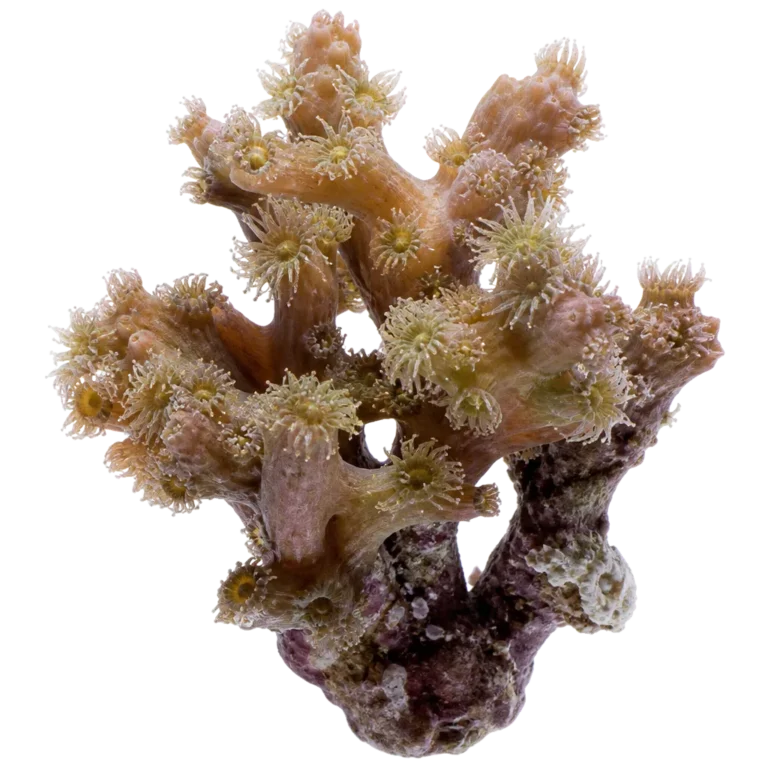
Snake Polyp Coral
Summary
Snake Polyp Coral, Isaurus sp., is a zoanthid with thick, knobbly, cylindrical polyps rather than a flat mat of button-like polyps. The trade name covers more than one possible Isaurus species, so colour, polyp length, and how tightly the colony groups can vary. Expect many colonies to look like bent, closed stems in daylight and to show their feeding tentacles mainly after dark; judge health by repeated nighttime expansion and firm, intact tissue rather than daytime appearance alone.
Isaurus occurs on tropical reef and rocky-shore habitats, including exposed areas, which helps explain its preference for moving water without a constant hard jet. Its slow, space-seeking polyp growth makes it better suited to a defined patch of lower rockwork than a crowded gap between established corals.
General care
Place Isaurus sp. low in the aquascape on a stable, removable rock or plug, with open water around the side toward which the polyps lean. Avoid wedging it under a ledge or between rocks: the stalks need room to extend and can stay compressed or collect detritus when boxed in.
This is a soft-bodied zoanthid, not a stony coral, so do not grip, crush, scrape, or repeatedly reposition the polyps. Hold the plug or underlying rock instead. Wear gloves and eye protection when mounting, trimming, or removing it, and avoid cutting or scrubbing it in a poorly ventilated indoor area; zoanthids can release irritating compounds when damaged. A colony that remains tightly closed after handling should be left in calm, clean flow to recover rather than repeatedly prodded open.
Lighting needs
Begin a new Snake Polyp Coral in the dimmer part of its suitable lighting zone, then increase exposure gradually only after it is settling and showing its usual nighttime opening. Because daytime contraction is normal for many Isaurus colonies, do not move it toward brighter light simply to force a daytime display.
Too much light is more likely to show as progressive paling, bleached-looking tissue, or persistent closure that continues into the normal nighttime feeding period. Too little light is suggested by loss of colour and a colony that remains poorly extended even after it has had time to acclimate. Change placement or intensity in small steps and allow several nights of observation before judging the response.
Flow needs
Provide indirect, variable medium flow that keeps the stalks and nighttime tentacles gently moving and clears settled particles without pinning the polyps in one direction. Correct flow lets the colony remain clean while still extending its feeding tentacles after dark.
Too little flow leaves detritus caught among the stalks, encourages a dull film on the tissue, and can lead to repeated partial closure. Too much flow keeps the polyps bent flat, causes them to stay withdrawn, or makes tentacles whip sharply rather than sway. Redirect the outlet rather than placing the colony directly in a pump stream.
Feeding and growth
Photosynthesis supplies much of this coral's energy, but feeding can help a recently imported, nutrient-limited, or slowly recovering colony. Offer finely sized zooplankton-style foods, rotifers, copepod-sized fare, or suspended coral foods after lights out when the feeding tentacles are visible. Large chunks are poorly suited to the small feeding structures and are more likely to foul the colony than help it.
Growth is usually slow and takes the form of additional thick polyps or small clusters that lean and spread across available hard surface. Leave a clear landing area around the plug, because a colony can eventually occupy adjoining rock even when it does not rapidly form a broad mat.
Compatibility
Treat Isaurus sp. as semi-aggressive through direct contact and gradual encroachment rather than as a coral that should be packed tightly into a mixed-polyp garden. Keep at least 10 cm3.9 in of open space between it and neighbouring sessile invertebrates, and increase that gap if either colony leans, expands, or grows toward the other. Tissue contact can keep the affected edge closed and may cause recession in a less competitive neighbour.
Most reef fish will ignore an established colony, but persistent pickers can prevent its already limited daytime display and reduce nighttime extension. Do not place it where coral-feeding fish, nipping angelfish, or large roaming invertebrates repeatedly disturb the polyps. If a formerly reliable nighttime opening stops after adding an animal, inspect for picking after dark before changing light or water chemistry.
Water parameters
Isaurus sp. is moderately demanding because it responds poorly to abrupt changes, especially during the first weeks after introduction. Match the source water as closely as practical, then avoid rapid swings in salinity or alkalinity; repeated instability often appears first as prolonged closure, tissue thinning, or failure to resume nighttime feeding.
It is less suited to an aggressively stripped, ultra-low-nutrient system than to a mature reef with enough dissolved and particulate nutrition to support both its symbiotic algae and feeding response. If the colony becomes pale and remains withdrawn despite suitable placement, review nutrient availability and recent parameter changes before increasing light. Keep detritus from accumulating around the base, since dirty, stagnant contact areas can irritate the soft tissue.