
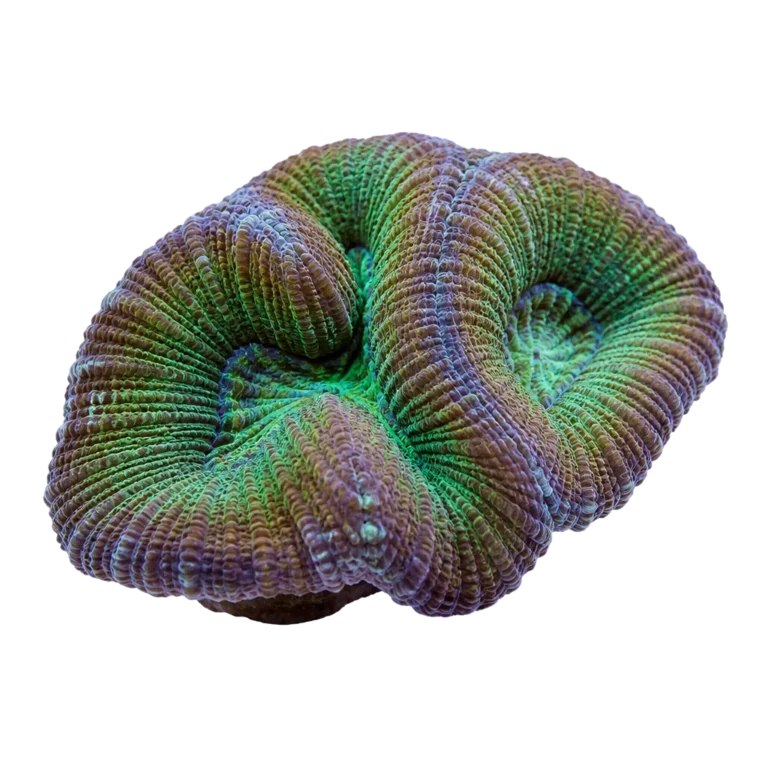
Slipper Coral
Summary
Polyphyllia talpina is a free-living fungiid coral rather than a coral that should be fixed to rock. Its elongated, slipper-like skeleton carries many small mouths and a dense covering of long tentacles, which may remain visible in daylight. In nature it occurs on reef slopes; in aquaria, that translates to an open substrate position with room around the entire coral rather than a crowded ledge.
Choose a specimen with fully inflated tissue, intact margins, and a clean underside. A deflated coral immediately after transport is not unusual, but persistent gaping, peeling tissue, or exposed skeleton around the edge are warning signs of injury or ongoing stress.
General care
Place it flat on open sand or fine, stable rubble at the bottom of the aquarium. Keep sharp rock, coarse abrasive substrate, and unstable frags away from the underside: a free-living coral can shift position, and repeated scraping can damage the soft tissue where it meets the skeleton.
Handle Polyphyllia talpina only by supporting the rigid skeleton from underneath, ideally while it is submerged. Do not lift it by the expanded tissue or let its weight rest on a narrow rock point. If it repeatedly inflates, shifts, or ends up tipped against rock, move it to a smoother, more open patch of substrate before the edge becomes damaged.
Lighting needs
Begin a new specimen in the dimmer end of its intended bottom placement and increase exposure gradually over several weeks. This is especially important when the coral comes from a system with different lighting or has been shipped with retracted tissue.
At suitable light, the tissue remains evenly expanded and the tentacles extend without a bleached or tightly pinched appearance. Fading, bleaching, persistent contraction, or tissue pulling away from the skeleton after a lighting increase suggests excessive exposure; progressively darker tissue, weak inflation, and reduced tentacle extension can indicate that the coral needs more usable light after other causes are ruled out.
Flow needs
Aim for indirect, variable flow that gently moves the tentacles and carries away mucus and detritus without pushing the coral across the substrate. The correct response is a broadly inflated animal with tentacles able to extend and settle naturally rather than being pinned flat in one direction.
Too little flow allows debris to collect between the tentacles and along the central furrow; remove settled material gently and improve circulation around, not directly at, the coral. Too much flow causes persistent whipping, folded tissue, repeated retraction, or a coral that rolls or migrates into contact with hardscape; diffuse or redirect the flow rather than simply placing it in a dead spot.
Feeding and growth
Light can meet much of this coral’s energy demand, but supplemental feeding is useful for recently stressed specimens, corals kept in lean systems, and aquarists seeking better tissue condition and growth. Offer small zooplankton-sized or finely chopped meaty foods when the tentacles are extended, and use temporary flow reduction only long enough for food to settle onto the tissue.
Avoid large chunks that sit on the surface or foods that nearby fish can repeatedly steal. Polyphyllia talpina expands as an elongated, multi-mouthed plate across the substrate, so reserve open sand around its present footprint and likely growth path instead of treating it like a compact round mushroom coral.
Compatibility
Keep at least 15 cm5.9 in of clear substrate between Polyphyllia talpina and other corals, with more room for corals that also expand long tentacles. Its tentacles can sting neighboring tissue, and its free-living habit means a coral placed safely at purchase can later drift into contact.
Avoid placing it beside encrusting corals, aggressive LPS, or rockwork that leaves no escape route when it shifts. Fish and invertebrates that pick at fleshy corals, steal food, or repeatedly walk over the expanded surface can prevent normal inflation; investigate repeated retraction at feeding time rather than assuming it is only a lighting or flow problem.
Water parameters
This is moderately demanding chiefly because damaged tissue and abrupt chemistry changes can be slow to recover. Keep the aquarium biologically mature and avoid rapid swings, especially in salinity and alkalinity, rather than chasing day-to-day corrections that create further instability.
Do not let detritus accumulate around the underside or central grooves, and avoid prolonged ultra-low nutrient conditions that leave the coral pale and poorly inflated. When a previously healthy specimen remains deflated or shows edge recession, check for recent parameter changes, sediment buildup, and physical contact before making large lighting or flow adjustments.