
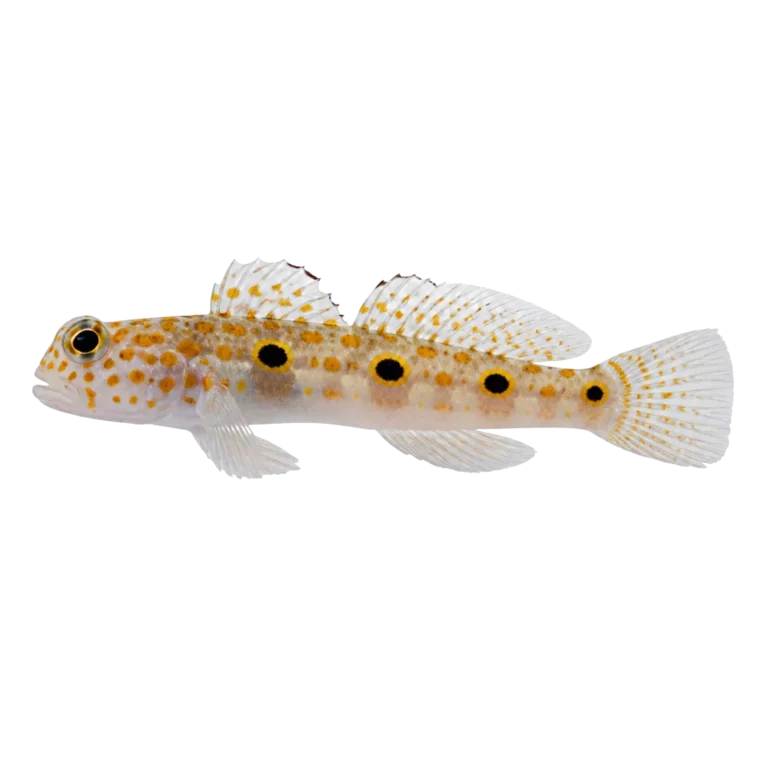
Sixspot Goby
Summary
Valenciennea sexguttata spends much of the day taking sand into its mouth, retaining tiny prey and expelling the cleaned sand in conspicuous sprays. This makes it an active bottom-area fish rather than a passive “clean-up crew”: it needs a mature, food-producing sand bed and can rearrange the appearance of the substrate as it feeds.
Care
Build the aquascape around open sand lanes and firmly supported rockwork. Valenciennea sexguttata repeatedly works the substrate and may excavate beneath ledges; rock resting on loose sand can shift as a burrow is enlarged. Expect it to use a chosen burrow or rock base as a retreat, then range widely over the bottom between visits.
Add this goby only after the aquarium’s sand bed has developed visible microfauna and the fish has room to sift without continually colliding with coral bases. A sparse or newly installed substrate may look clean but supplies little natural forage, and the goby can gradually lose body condition while remaining busy and active.
Feeding
Feed small meaty items in several spread-out meals rather than relying on what the sand bed provides. Frozen mysis, finely chopped crustacean flesh, enriched brine shrimp and other suitably sized sinking marine foods are useful choices; deliver part of each feeding onto the sand near its working area so the goby can find it naturally.
Do not assume an actively sifting fish is well fed. Watch for a pinched belly, narrowing along the back, reduced sand-sifting, or food repeatedly being taken by faster fish before it reaches the bottom. In tanks with assertive water-column feeders, target-feed the goby after the initial feeding rush or use a feeding tool to place food close to its burrow.
Compatibility
Keep one Valenciennea sexguttata, or introduce a confirmed compatible pair together. Unrelated individuals can claim the same feeding ground and burrow sites, and persistent chasing is more likely once one fish has settled first. Avoid mixing it with other Valenciennea and similar sand-sifting gobies unless the system provides clearly separate bottom territories and ample natural food.
Peaceful fish that use the water column are generally the easiest companions. Avoid large predatory fish that may treat a bottom-dwelling goby as prey, along with pushy bottom feeders that monopolize sinking foods or repeatedly invade its retreat. Add the goby after the sand bed is established, but before a territorial sand-sifting competitor has claimed the entire substrate.
It is reef compatible in the sense that it does not normally feed on coral tissue, but its sand handling is the important exception. Keep loose frags and low, sand-level corals out of its preferred routes, because expelled sand can bury or irritate them.
Good to know
Use a tight-fitting lid and close gaps around plumbing or cables. Valenciennea sexguttata can jump when startled, particularly during introduction, territorial disputes, or sudden disturbance near its burrow.
A newly introduced individual may spend time hiding or working only a small area while it establishes a retreat. That can be normal at first, but continued reclusion combined with weight loss, a pinched abdomen, or refusal of offered foods is a feeding problem rather than a behaviour to wait out.