
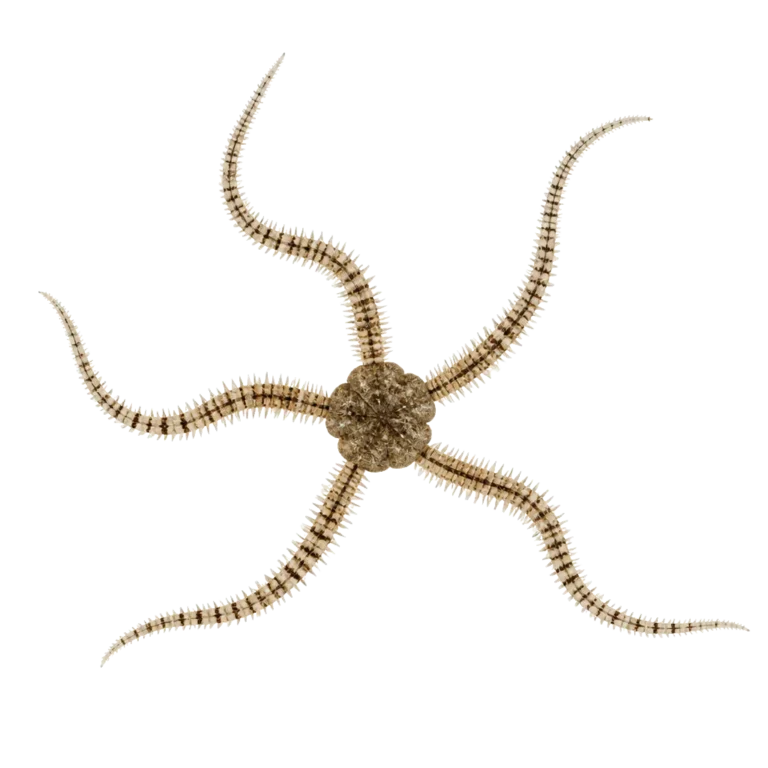
Six-armed Brittle Star
Summary
Ophiactis savignyi is a very small, cryptic brittle star that usually stays tucked into live-rock pores, rubble, algae, or sponge-like growths, extending arms to collect fine particles. Its six-armed appearance is characteristic, but individuals can show uneven or shorter regenerating arms after splitting.
It is best treated as a resident micro-scavenger rather than a display animal. Seeing arms emerge from a crevice after lights dim is normal behaviour, while a specimen remaining exposed and inactive for an extended period can indicate poor acclimation, injury, or inadequate cover.
Care
Use an established reef aquarium with mature live rock, small crevices, and pockets of rubble or other protected structure. Ophiactis savignyi does not need an open sand bed; it needs narrow refuges where it can remain concealed while intercepting detritus and suspended food.
Moderate, indirect water movement is useful because it carries fine food toward the animal without repeatedly dislodging it from its shelter. Lighting is not a husbandry requirement for this non-photosynthetic brittle star, and it will usually choose shaded spaces during the day.
Avoid adding it to a newly set-up or exceptionally sterile aquarium. A tank with little settled organic material, biofilm, or particulate feeding tends to offer too little food for a population of these tiny scavengers.
Feeding and role
Ophiactis savignyi feeds on fine detritus, biofilm, and tiny meaty or planktonic particles caught from the water. In a lightly stocked or very clean aquarium, direct a small amount of finely crushed marine food or suspended particulate food near its rockwork during feeding; large chunks are not useful to it.
Its cleanup role is limited to small, inaccessible deposits and suspended leftovers around its hiding places. One brittle star will not remove visible waste, control nuisance algae, or correct excess nutrients; a growing population simply reflects that enough fine food is available to support it.
Compatibility
This species is reef-compatible and is not a coral predator. It may live within crevices around corals, rubble, or sponges without harming healthy coral tissue, but avoid disturbing it unnecessarily when moving or fragging encrusted rock.
Keep it away from animals that pick through rockwork for small invertebrates, especially predatory fish and larger crabs. Repeated predation may leave only detached arms or prevent the population from becoming established.
It does not need a partner or a deliberately stocked group. Add an individual or allow hitchhiking animals to establish naturally; when food is abundant, this species can multiply by fission and several individuals may share the same sheltered rockwork.
Good to know
A brittle star with several short arms, or with three larger arms and three smaller regenerating arms, may be recovering from fission rather than dying. Leave it in place if it remains attached and responsive; repeated handling can damage the regenerating disc and arms.
Do not expose Ophiactis savignyi to copper-based medications, which are hazardous to echinoderms. Acclimate carefully to avoid abrupt salinity change, then transfer it underwater rather than leaving it in air while arranging rockwork.
A sudden increase in numbers is usually a feeding signal, not a pest outbreak by itself. Reduce excess fine food and detritus if the population becomes more visible than desired, rather than trying to remove every individual from the rockwork.