
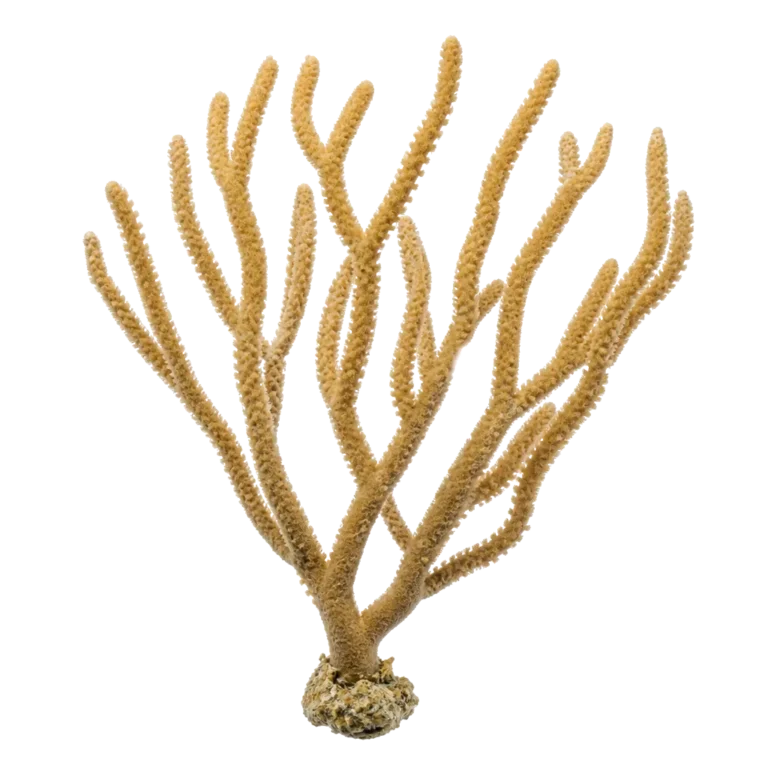
Siphonogorgia Coral
Summary
Siphonogorgia sp. is a genus-level identification, so branch shape and color can vary between imports. The shared husbandry issue is more important than appearance: these are non-photosynthetic, suspension-feeding soft corals that depend on a continual supply of appropriately small food moving past extended polyps. Their branching form is adapted to intercept particles in moving water, which makes them a poor choice for a conventional low-nutrient reef that receives only occasional target feeding.
Treat this as a specialist coral rather than a shaded alternative to a photosynthetic soft coral. Long-term success depends on balancing frequent planktonic feeding with enough filtration and maintenance to prevent the system from becoming polluted.
General care
Place Siphonogorgia low in the aquascape where it can receive broad, indirect current without being buried by sand or blasted by a pump. Secure the base firmly before introducing it; a toppled colony can abrade its soft tissue against rockwork and may struggle to reopen afterward.
Handle by the hard base or lowest sturdy branch whenever possible, and keep handling brief. Do not squeeze the fleshy branches, pull on extended polyps, or glue over living tissue. A colony that remains limp, damaged at the base, or develops bare patches after shipping needs prompt attention to mounting, flow, and feeding rather than repeated handling.
Lighting needs
Siphonogorgia sp. does not use aquarium lighting as an energy source, so choose placement for food delivery and flow rather than brightness. A shaded lower position is usually practical because it limits nuisance algae on the branches and leaves the better-lit rockwork available for photosynthetic corals.
Do not interpret closed polyps in dim areas as a need for stronger light. There is no useful “too little light” polyp response for this coral; persistent closure, thinning tissue, and loss of fullness are more likely warnings of inadequate feeding, unsuitable flow, or stress. Likewise, strong light is not beneficial, and algae coating the branches or tissue is a practical sign that the location is unnecessarily exposed.
Flow needs
Provide medium-to-strong, changing flow that carries suspended food through and around the entire colony. At a suitable setting, the branches move gently, polyps can stay extended, and particles pass across the coral instead of settling in its forks.
Increase or redirect flow if detritus collects between branches, algae repeatedly forms in sheltered areas, or polyps only extend on one side of the colony. Reduce direct pump force if branches are held rigidly in one direction, polyps remain tightly withdrawn, or tissue appears rubbed, stretched, or damaged at exposed tips.
Feeding and growth
Feeding is essential, not merely supplemental, because Siphonogorgia sp. receives no meaningful energy from light. Offer frequent small portions of fine zooplankton-sized foods, such as rotifers, copepods, and fine enriched plankton preparations, in a flow pattern that keeps particles suspended. Large chunks of food are a poor match for its small filter-feeding polyps and add waste without reliably improving nutrition.
Expect slow branching growth rather than rapid encrusting spread. Over time, a healthy colony can become fuller and fork into the surrounding water column, so leave open flow lanes around it instead of wedging it between rockwork or densely packed coral colonies.
Compatibility
Siphonogorgia sp. is best treated as a passive coral in mixed reefs: its main compatibility risk is being stung, overgrown, shaded, or deprived of flow by neighboring corals rather than overrunning them itself. Keep at least 5 cm2 in of clear space around the branches, and allow more room where nearby corals have long tentacles or can grow toward the colony.
Avoid fish that regularly nip coral polyps, particularly large angelfish and butterflyfish, because repeated picking can prevent feeding and leave bare tissue. Crabs and other climbing invertebrates can also damage or irritate delicate branches. Fast fish may consume much of the broadcast food, so feeding should be arranged so fine particles still reach the coral.
Water parameters
This coral is more demanding than a typical reef coral because the aquarium must process frequent fine-food additions without allowing detritus, dissolved waste, or algae to accumulate on the colony. Use a system with dependable mechanical removal, nutrient export, and circulation; if feeding causes recurring film algae, cloudy water, or accumulating debris, the feeding and export balance is not yet adequate for this species.
Prioritize consistency over chasing short-term corrections. Sudden shifts in salinity or major chemistry swings can suppress polyp extension, while chronic low food availability may cause gradual loss of tissue and branch fullness even when routine test results appear acceptable.