
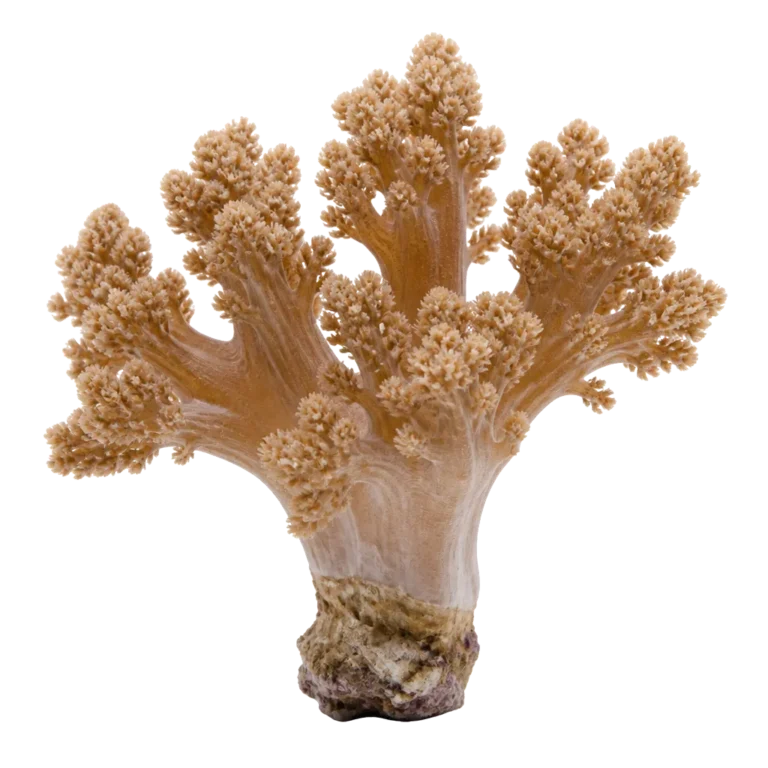
Sinularia Coral
Summary
Sinularia sp. is a soft coral genus rather than one single species, so branching, finger-like, lobed, and cabbage-like forms can all appear in the trade. Most aquarium forms are photosynthetic tropical Indo-Pacific soft corals that expand and contract noticeably with light, flow, and occasional shedding. Buy the colony for its eventual shape, not its frag size: many forms become broad, flexible colonies that can shade or crowd their own rockwork.
The main stocking consideration is chemical competition. Sinularia can grow easily while nearby corals, especially sensitive stony corals, lose extension or stall. It suits a soft-coral-focused aquarium best; a mixed reef needs deliberate spacing, active carbon, and room to remove or prune the colony later.
General care
Place Sinularia on a separate, secure rock in the middle of the aquascape, where it can receive moving water from more than one direction without being blasted by a pump. Isolating its rock makes future pruning or relocation far easier when the colony expands.
Handle only the firm base or attached plug, not the inflated branches. The flesh can tear if squeezed, pulled, or rubbed against rock; a damaged area may stay closed and collect film or algae. A newly shipped or moved colony may remain deflated or develop a dull surface film for several days, so avoid repeatedly moving it unless tissue is breaking down.
Lighting needs
Start a new Sinularia lower in the available light field or under a reduced fixture setting, then increase exposure gradually after it resumes regular polyp extension. This genus-level listing covers varied species and color forms, so judge the individual colony rather than moving it immediately to the brightest available position.
Adequate light is usually shown by a consistently inflated colony, normal daytime polyp extension, and stable color. Too little light commonly produces stretching toward the source, sparse extension, and slow growth. Too much light can cause persistent contraction, paling, or a waxy-looking shed soon after a lighting increase; reduce intensity or give the coral more indirect exposure rather than changing several conditions at once.
Flow needs
Provide medium-to-strong, irregular flow that makes the branches sway and keeps the surface clean without pinning the tissue in one direction. Correct flow lets polyps open while the colony moves naturally, and it helps the coral clear the film it periodically sheds.
Too little flow leaves detritus or a shed film on the colony, with reduced extension and algae settling on the base. Too much direct, laminar flow keeps polyps retracted, bends branches continuously the same way, or causes tissue to rub against nearby rock. Redirect the pump or diffuse the stream instead of simply increasing or decreasing all circulation.
Feeding and growth
Lighting supplies most of Sinularia's energy, but feeding can help a recently cut frag recover, support growth in very low-nutrient systems, or maintain a colony with limited fish-derived nutrition. Offer fine suspended foods, such as small zooplankton-sized particles or powdered coral foods, and avoid large meaty pieces that simply lodge in the branches.
Growth is often fast once the colony settles. Depending on the species, it may develop upright fingers, thick lobes, or a broad branching canopy; each form can occupy far more horizontal space than its original attachment point suggests. Leave an open pruning route and do not mount it where its future canopy will shade slower-growing corals.
Compatibility
Sinularia competes mainly through allelopathic chemicals released into the water and through physical overgrowth as it enlarges. Keep at least 15 cm5.9 in of open space between it and other corals as a practical starting point, but treat that distance as protection from contact rather than a solution to chemical competition. Run activated carbon and replace it regularly, particularly in mixed reefs or after cutting the colony.
Avoid placing it beside corals that react poorly to soft-coral chemical output, and watch nearby stony corals for reduced polyp extension, fading, or stalled growth even when they are not touching. Most reef-safe fish ignore established Sinularia, but persistent picking by angelfish, butterflyfish, or large grazing fish can prevent expansion and damage the soft tissue.
Water parameters
Sinularia is generally less demanding than many stony corals, but it responds poorly to abrupt salinity, temperature, or light changes. Keep changes gradual because a stressed colony may remain collapsed, shed heavily, or stop extending polyps even when test results appear acceptable.
It tolerates a normally nutrient-bearing reef better than an aggressively stripped system. Extremely low available nutrients can coincide with weak extension and poor growth, while excess suspended detritus becomes a problem where flow is insufficient and can foul the surface. In a mixed reef, monitor coral responses as well as test results: the water chemistry may suit Sinularia while its chemical output still suppresses neighboring species.