
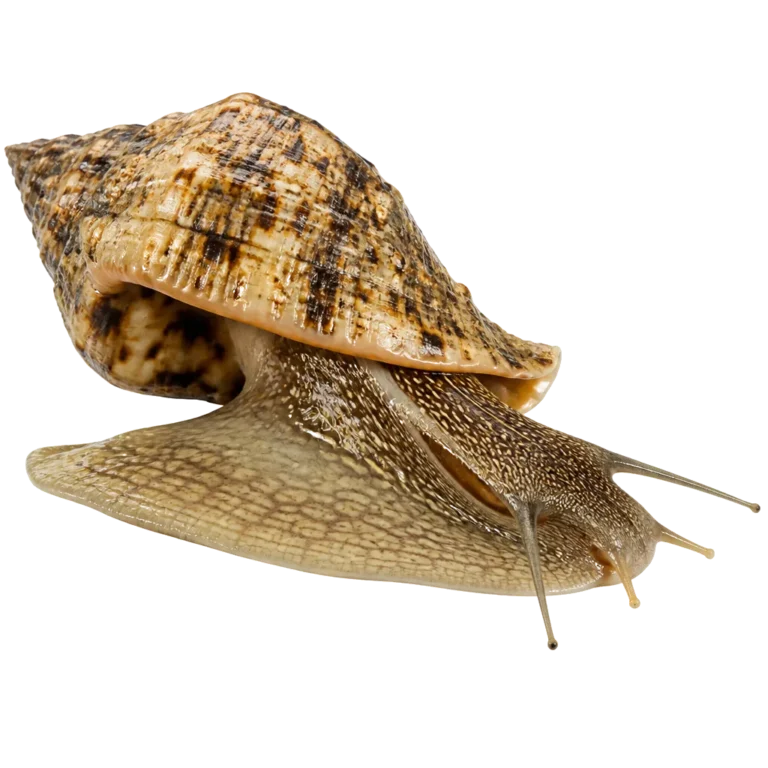
Silver Conch
Summary
Lentigo lentiginosus is a true conch from shallow Indo-Pacific lagoon and reef flats, where it travels over open sand and hard-bottom areas while grazing. Its long eye stalks and extendable feeding proboscis are normal features; it is an active surface grazer rather than a snail that spends its time buried beneath the substrate.
Choose it for a mature aquarium with a usable sandbed, not simply for an empty patch of white sand. A conch that has little open substrate or little natural film growth may survive poorly even when the aquarium otherwise appears clean.
Care
Leave a broad, unobstructed area of sand for grazing and travel. Rockwork that meets the sand is fine, but a substrate crowded with dense rubble, large shells, or frags gives this conch little room to feed and can leave it repeatedly stranded against obstacles.
A settled sandbed with established diatoms, biofilm, and other benthic growth is more important than intense lighting or specialized water movement. Add Lentigo lentiginosus after the aquarium has developed visible natural grazing material; a newly cycled, highly sterile system rarely provides enough food.
Feeding and role
It grazes diatoms, soft benthic algae, biofilm, and organic material on the substrate. If the sandbed looks consistently clean or several grazers share it, offer algae-based sinking foods near its usual path so it can feed without competition.
A single Silver Conch can keep a portion of accessible sand in motion and reduce light surface films, but it will not remove established nuisance algae from rockwork or correct a nutrient problem. Treat reduced activity, progressive inactivity, or a conch spending long periods searching bare sand as a prompt to check food availability rather than as proof that it has finished its job.
Compatibility
Lentigo lentiginosus is generally coral-safe, but its shell and strong foot can shift very small or unsecured frags as it crosses the sand. Seat loose frags firmly and keep them out of its regular travel lanes.
Keep it away from animals that can attack or crush snails, especially large hermit crabs and snail-eating fishes such as many triggers and puffers. A conch that stays tightly withdrawn, has damaged eye stalks, or repeatedly disappears under an aggressor’s territory needs protection or removal.
It has no known need for a partner or group. Add individuals according to available open substrate and, more importantly, the amount of natural grazing available; adding several to a modest sandbed can create food competition long before the aquarium looks overstocked.
Good to know
Like other marine snails, this species is highly vulnerable to copper and many medications intended for fish. Do not place it in a system being treated with copper, and investigate unexplained snail losses before adding another specimen.
Acclimate carefully to avoid abrupt salinity and temperature change. After introduction, confirm that the conch extends its foot, explores, and begins grazing; remaining closed for an extended period or failing to recover after being overturned warrants a close check for predation, poor acclimation, or a lack of suitable substrate and food.
Starvation is the main long-term risk in very clean aquariums. Supplemental algae foods can help, but they do not replace the value of a mature, food-producing sandbed.