
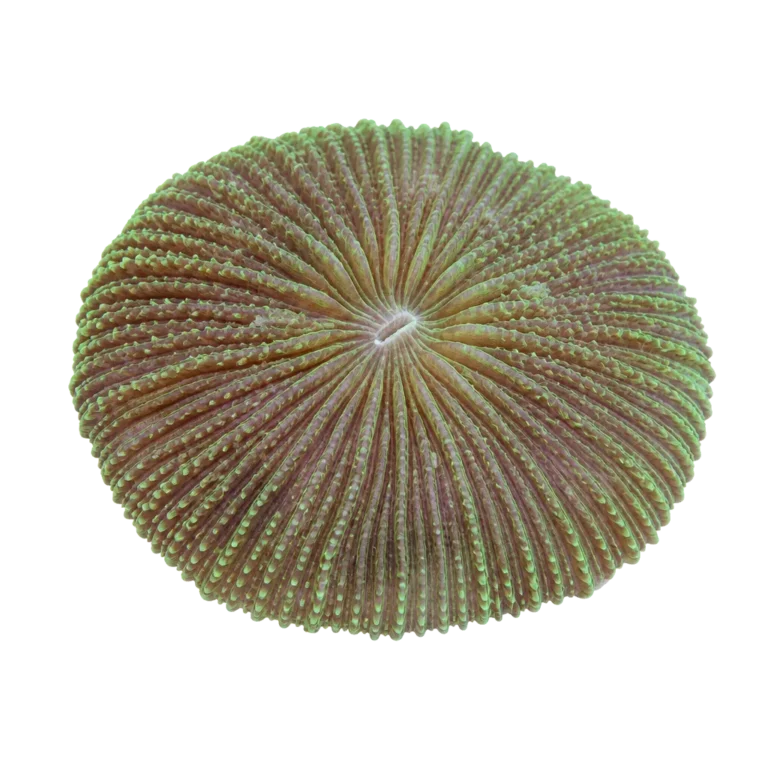
Short Tentacle Plate Coral
Summary
Fungia repanda is a solitary, free-living LPS plate coral: a fleshy, low disc with a central mouth, radiating skeletal ridges, and short tentacles that may become more obvious during feeding. It belongs on an open sandbed rather than in rockwork. Its natural free-living habit explains two practical traits: it can inflate or slowly shift position, and its expanding tissue is easily damaged when it rubs against sharp rock or a neighbouring coral.
General care
Set this coral upright on a stable area of fine sand with clear room around the entire disc. Do not glue it down, wedge it into a crevice, or rest it against rock; inflation and small movements can press the fleshy rim into abrasive surfaces and start tissue recession.
Handle Fungia repanda by supporting the clean underside of its skeleton, keeping fingers and tools away from the expanded upper tissue. Inspect the rim before purchase for tears, exposed white skeleton, or areas where tissue is pulling away from the edge. If it is overturned, return it upright promptly rather than leaving the tissue pressed into the sand.
Lighting needs
Acclimate a new specimen at the gentler end of its intended placement, then increase exposure gradually only after it remains consistently inflated and retains its colour. A coral moved abruptly into stronger light may stay tightly deflated, pale or bleach, or develop recession around the outer edge.
Too little light is more likely to show as reduced daytime inflation, a weak feeding response, and very slow tissue expansion despite otherwise clean conditions. Judge changes over several days rather than relocating it repeatedly after a single withdrawn day.
Flow needs
Provide indirect, moderate water movement that keeps fine detritus from settling while allowing the tissue and short tentacles to move gently in more than one direction. Correct flow lets the disc stay fully inflated and lets it hold food long enough to move it toward the central mouth.
If flow is too weak, sediment and uneaten food remain on the surface or around the rim. If it is too strong or direct, the tissue folds hard to one side, the coral stays contracted, food blows away, or the disc shifts and overturns. Redirect the pump before moving the coral.
Feeding and growth
Photosynthesis supplies much of its energy, but target feeding is useful for newly imported, recovering, or slowly growing specimens and in tanks with very lean feeding. Offer small meaty particles, such as mysis-sized items or finely chopped seafood, when tentacles are extended; oversized pieces are more likely to be rejected than consumed.
Fungia repanda grows as a single disc rather than branching into a compact colony. Expect its living tissue and skeletal footprint to broaden gradually, and leave its surrounding sandbed open so growth and small changes in position do not bring it into contact with another coral.
Compatibility
Give this plate coral at least 15 cm5.9 in of open clearance on every side. It can extend feeding or sweeper tentacles that sting nearby corals, and its slow movement makes a once-safe gap unreliable if the sandbed is crowded.
Avoid fish that pick at LPS tissue, and prevent large sand-moving animals from burying, overturning, or repeatedly abrading the disc. Shrimp and crabs may steal target food; if that happens, feed after dark or shield the coral briefly until it has drawn the food into its mouth.
Water parameters
Fungia repanda is moderately demanding rather than a good test coral for a newly cycling or rapidly changing reef. Keep its chemistry and salinity consistent, because abrupt corrections commonly show as prolonged deflation, reduced feeding, or recession beginning at the outer tissue edge.
It is especially vulnerable when a chemistry swing coincides with physical irritation, such as a torn rim, persistent sediment, or a sting from a neighbour. Treat unexplained recession as a reason to check for these combined stresses and correct the cause gradually, rather than making large parameter adjustments in response.