
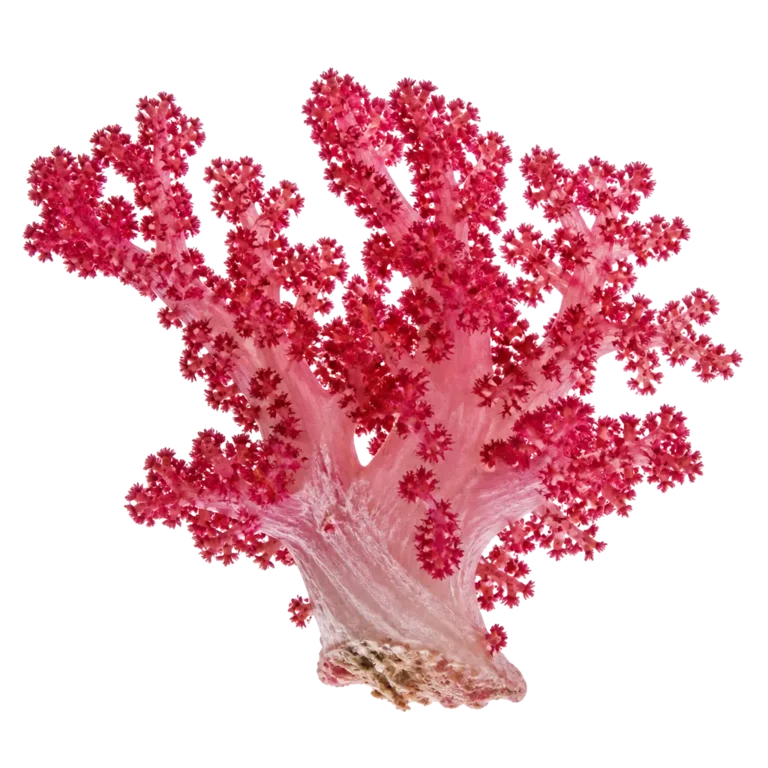
Scleronephthya Coral
Summary
Scleronephthya sp. is a genus-level, non-photosynthetic soft coral, so colony shape and colour can vary between imports. Its small feeding polyps are carried on a fleshy, often tree-like colony reinforced with tiny internal sclerites; it depends on suspended food rather than light. This is a difficult coral best reserved for an established system designed to deliver frequent fine foods while exporting the resulting waste.
In nature, Scleronephthya occurs where persistent current carries plankton past shaded ledges and deeper reef habitat. Reproduce that combination in the aquarium: shade is useful, but continuous access to food-rich moving water is what determines whether the colony remains inflated and extended.
General care
Mount Scleronephthya low in the aquascape, ideally beneath an overhang or in another shaded area that remains easy to observe and feed. Keep the base above the sand and clear of detritus; a buried or fouled base can begin to deteriorate before the rest of the colony shows obvious trouble.
Handle only by its attached base, plug, or the rock it is mounted on. Do not pinch, bend sharply, or lift it by the branch tips: the soft tissue can bruise or tear around its internal sclerites, and damaged areas can collect debris or break down. A newly moved colony may stay contracted briefly, but persistent collapse after it has settled is a husbandry warning rather than normal acclimation.
Lighting needs
Treat lighting as an algae-management and placement issue, not a food source. Acclimate a new Scleronephthya directly into shade or very subdued ambient light, then prioritize finding a position where its polyps can feed in moving water. There is no benefit in gradually increasing light exposure for growth.
Do not interpret a contracted colony under dim light as evidence that it needs more light. Persistent poor expansion is more usefully investigated through feeding frequency, particle delivery, flow pattern, detritus, and tissue condition. If bright placement contributes to algae or cyanobacteria settling on contracted tissue, move the coral to a shadier, cleaner-flowing location.
Flow needs
Provide strong, indirect, changing flow that keeps fine food suspended and passes it through the open branches. At the right setting, the colony stays upright or gently sways, individual polyps extend, and no area repeatedly collects detritus.
Increase or redirect flow if the coral remains limp, stays closed while food passes elsewhere in the tank, or accumulates mucus and debris between branches. Reduce direct flow if the colony is held rigidly over in one direction, branch tissue is whipped against rockwork, or polyps cannot remain extended. Aim pumps across the coral or off nearby rockwork rather than at one branch tip.
Feeding and growth
Feeding is essential rather than an occasional growth supplement: Scleronephthya sp. must receive frequent, ideally near-continuous, suspended microfoods. Use phytoplankton, fine zooplankton, rotifers, and other appropriately small planktonic foods that remain available in the water column; large meaty pieces are poorly matched to its fine filter-feeding polyps.
Feed where water movement distributes food through the whole colony instead of blasting a concentrated cloud into one spot. A useful response is widespread polyp extension and a fuller colony during or after food delivery. Repeatedly missed feedings can show first as weaker extension, a thinner-looking colony, and progressive loss of tissue from the base or branches.
Growth is usually branching and tree-like rather than a flat encrusting spread. Leave room above and around the colony for its expanded branch network and for unobstructed flow; crowding it into a crevice can turn a growing colony into a detritus trap.
Compatibility
Scleronephthya sp. is generally peaceful and is not a coral chosen for long sweeper tentacles or overt stinging. Still, allow at least 5 cm2 in of open space around it so neighbouring corals cannot touch its delicate branches, shade its feeding surface, or disrupt the flow path it needs.
The larger compatibility problem is system design. Heavy plankton feeding can raise dissolved and particulate nutrients in a mixed reef, while many light-loving corals are kept in clearer, leaner water and may not tolerate the same feeding routine. It is often more practical in a dedicated non-photosynthetic system or a mixed reef with filtration sized for regular food additions.
Avoid animals that perch on, nip, or repeatedly pick at the branches. Large or food-driven shrimp and crabs can steal delivered food and irritate open polyps, so watch the coral during feeding rather than assuming a peaceful community will leave it alone.
Water parameters
This coral needs a stable, mature reef system, but its main challenge is balancing abundant suspended nutrition with clean, oxygenated water and effective export. An ultra-lean system that strips food rapidly can leave the colony underfed, while an overfed system can foul the tissue with bacterial films, algae, or detritus.
Avoid abrupt changes in salinity, temperature, and alkalinity, especially while the coral is already adjusting to a new feeding or flow routine. For Scleronephthya sp., declining polyp extension combined with a persistently deflated colony is a reason to check food delivery, flow, detritus accumulation, and recent chemistry swings together; treating it as a lighting problem commonly delays the correct response.