
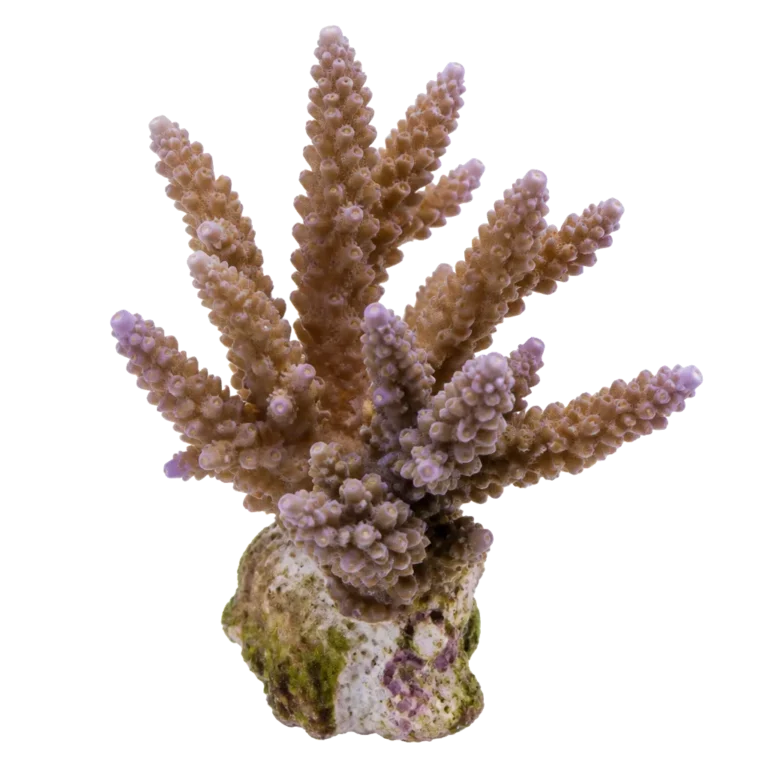
Samoensis Acropora
Summary
Acropora samoensis is a fast-growing SPS coral with thick, slightly tapered, curved branches that can form upright, corymbose, or low prostrate colonies. Its natural upper-reef-slope habitat explains its need for intense light, vigorous water movement, and consistently clean branch surfaces rather than a sheltered, low-energy position.
Plan for the colony’s eventual footprint rather than the size of the frag. Branches can multiply quickly and shade or contact nearby corals, so this is best suited to an established reef where high-energy placement and future pruning are practical.
General care
Mount Acropora samoensis high in the rockwork where it receives strong, indirect circulation from more than one direction. Secure the frag before it encrusts; repeated relocation can interrupt acclimation and makes it harder to identify whether light, flow, or water chemistry is causing a problem.
Handle it only by the plug or bare skeleton at the base. The branches are breakable and the living tissue is thin, so scraping tissue, trapping it against rock, or allowing a fallen frag to rub in the current can lead to localized tissue loss.
Lighting needs
Introduce a new frag below its intended final intensity or reduce the fixture’s output, then increase exposure gradually as the coral settles. This species comes from bright, shallow reef habitat, but a recently transported or previously lower-light specimen can bleach if moved directly into full output.
A settled coral should retain color and show consistent polyp extension, encrusting, or tip growth. Darkening or browning with slow growth can indicate insufficient usable light, although elevated nutrients can produce the same look. Pale tissue, bright white branch tips spreading beyond normal new growth, persistent polyp retraction, or tissue loss on the most exposed surfaces suggest excessive light or overly rapid acclimation.
Flow needs
Provide strong, turbulent flow that reaches between branches and changes direction instead of aiming a single hard jet at one side. At suitable flow, polyps extend without being held flat, and detritus does not remain lodged around the branch bases.
Weak flow often leaves debris in the colony, reduces gas exchange, and can precede recession in shaded interior areas. Excessively direct flow can keep polyps tightly pinned, produce bare or irritated patches on the blast-facing side, and prevent tissue from settling over newly encrusted areas.
Feeding and growth
Most energy comes from light, so feeding is most useful when the system is nutrient-lean, when a new frag is recovering, or when you are supporting faster growth without destabilizing water quality. Offer very fine zooplankton-sized foods or suspended microfoods in a broadcast feeding; large particles are poorly suited to its small polyps and excess food can create the nutrient instability this coral dislikes.
Growth commonly begins as encrusting at the base, then develops into a branching, rounded or spreading colony. Leave open water and light above the future branch tips, and expect to prune or relocate nearby corals as the colony expands.
Compatibility
Acropora samoensis is semi-aggressive at contact range and may expose mesenterial filaments against a competing coral. Keep at least 10–15 cm3.9–5.9 in of open space from neighboring corals, with more room on the sides and above a rapidly growing colony; do not rely on a small initial frag size when planning clearance.
Avoid placing it where branches will soon touch fleshy LPS corals, anemones, or fast-spreading corals. Butterflyfish and known coral-nipping angelfish can remove polyp tissue, while large or clumsy invertebrates can snap branches or dislodge a fresh mount.
Water parameters
This is less forgiving than a typical mixed-reef coral and is best added only after the aquarium’s dosing, salinity, and temperature are already predictable. Sudden shifts, particularly in alkalinity, can show up as stalled tips, loss of color, or tissue recession before hardier corals react.
Keep nutrients available but controlled rather than driving them to zero. Abrupt nutrient reduction can pale the colony and slow growth, while accumulating nutrients can darken tissue and encourage poor coloration; make corrections gradually and judge the response over time rather than chasing a day-to-day color change.