
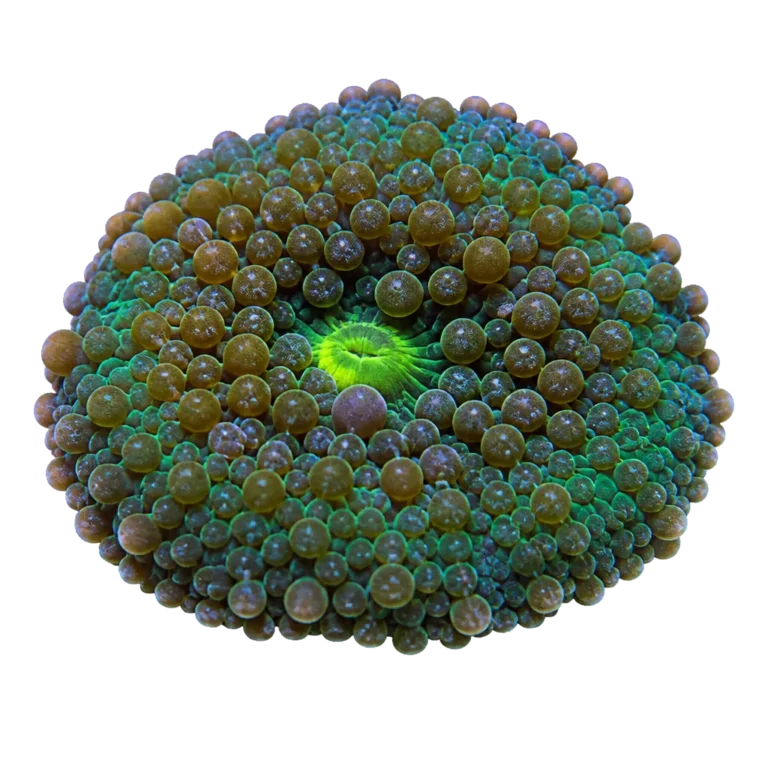
Saint Thomas Mushroom Coral
Summary
Ricordea sanctithomae is a Caribbean mushroom coral recognized by its fleshy, round oral disc covered in short, bead-like tentacles. It stays soft-bodied rather than building a hard skeleton, so its size and shape can change noticeably as it inflates, deflates, or settles into a new location.
In nature it occurs on sheltered reef rock and rubble, which suits its preference for lower tank areas with moderate conditions rather than intense light or direct, forceful flow. A settled specimen should remain broadly expanded for much of the light cycle.
General care
Place Ricordea sanctithomae low on stable rock or a small piece of rubble where it can attach without being shaded by a larger coral. It can slowly reposition or detach if it dislikes its location, so avoid placing it where a loose mushroom could drift into pumps, overflows, or other corals.
Handle the attached rock rather than squeezing the disc or pulling on the foot. Its soft tissue tears more easily than a stony coral’s tissue; if it arrives detached, place it in a low-flow container with rubble until the foot secures, rather than gluing the oral disc.
Lighting needs
Begin new specimens in the dimmer end of the available placement area and increase exposure gradually over a few weeks. A healthy mushroom usually opens into a full, even disc with visible tentacles; it may temporarily contract after introduction or a lighting change.
A coral that repeatedly stretches upward, stays unusually flat, or develops a long-looking column may be seeking more light. Reduce exposure if the disc remains tightly contracted during the photoperiod, develops pale or bleached areas, or loses its normal coloration after being moved higher.
Flow needs
Provide a gentle, irregular current that lets the disc inflate fully and lets its tentacles move without being folded over. The flow should carry away settled debris while allowing the foot to stay firmly attached.
Too little flow can leave detritus and mucus on the disc, with the coral staying dull or partly closed. Too much direct flow makes the disc cup, wrinkle, lift at the edges, or repeatedly detach; redirect the outlet rather than placing the mushroom directly in the stream.
Feeding and growth
Light supplies most of this coral’s energy, but occasional feeding is useful in nutrient-lean systems and can support recovery after shipping, damage, or division. Offer very small zooplankton-sized foods or finely minced marine foods only when the disc is open, and remove food that is not retained rather than repeatedly overfeeding.
Ricordea sanctithomae usually begins as individual discs, then spreads through division or small daughter mushrooms around the original attachment point. Leave room for a patch to expand across its rock, and plan for the possibility that detached or newly divided pieces may establish nearby.
Compatibility
This coral competes mainly through direct contact: its expanded tissue can sting, smother, or gradually overgrow nearby sessile invertebrates. Give it at least 10 cm3.9 in of open rock from other corals, with extra room around delicate encrusting corals and slow-growing LPS.
Avoid placing it where grazing fish, large hermit crabs, or mobile invertebrates routinely walk across the disc or dislodge it. Most reef fish ignore a healthy, attached mushroom, but persistent nipping or repeated disturbance can keep it closed and prevent secure attachment.
Water parameters
Ricordea sanctithomae is generally less demanding than many stony corals, but it responds poorly to abrupt salinity and temperature changes. Make adjustments slowly; a mushroom that suddenly stays closed, produces excess mucus, or detaches after maintenance is often reacting to a rapid environmental shift.
Avoid an overly stripped system as well as unstable nutrient spikes. Consistent alkalinity and salinity help the coral remain inflated and attached, while persistently poor water quality can encourage contraction, fading, and tissue deterioration even when lighting and flow appear suitable.