
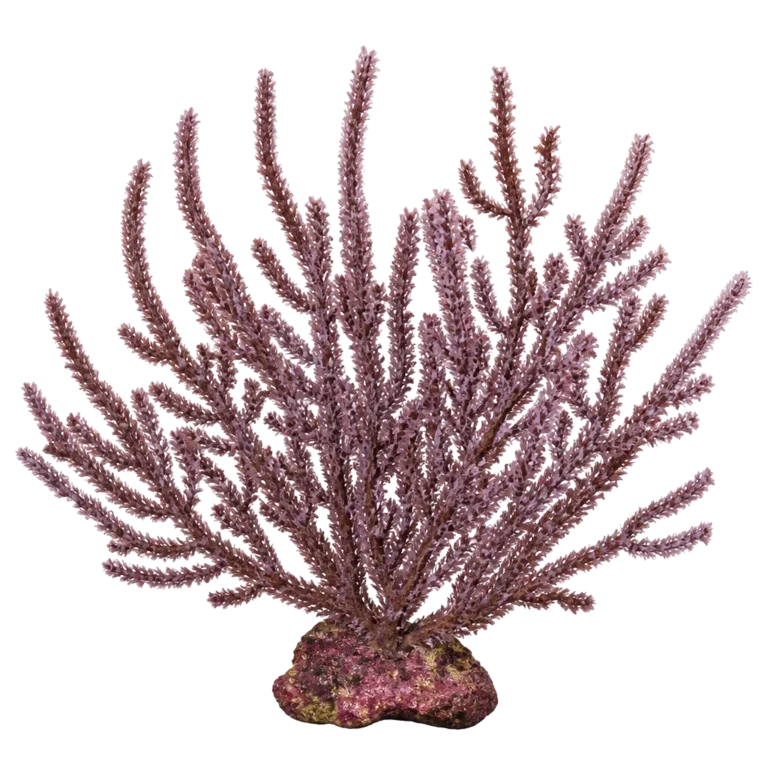
Rumphella Gorgonian
Summary
Rumphella sp. is a photosynthetic, branching gorgonian with a flexible internal support rather than a hard stony-coral skeleton. The trade name covers a genus-level identification, so branch density, colour and ultimate shape can vary between specimens. Its bushy branches are adapted to intercept light and suspended food in moving water; plan for an open mid-level position rather than treating it like a compact soft-coral frag.
General care
Mount the holdfast securely to stable rock in an open area where the colony can sway without touching surrounding corals. Handle it by the base or attached plug, not by squeezing, twisting or pulling the branches; damage to the living outer tissue can create a site for algae and tissue loss.
Inspect the branch surfaces before buying. A healthy specimen should have intact tissue, clean branch tips and polyps that extend when conditions suit it. Avoid colonies with bare patches, persistent algae trapped in the branches, or tissue peeling away from the internal axis.
Lighting needs
Start a new Rumphella sp. in the lower end of its stated light allowance, then increase exposure gradually over several weeks once the polyps are extending reliably. Sudden placement under a stronger fixture can cause a pale, washed-out appearance and prolonged polyp closure.
Too little light usually shows as slow establishment, weak extension and a colony that remains dull despite clean tissue and suitable flow. Excess light is more urgent: reduce exposure if tissue lightens quickly, branch tips fade, or polyps remain withdrawn during the normal light period.
Flow needs
Provide varied, medium-to-strong water movement that reaches all sides of the colony. Correct flow keeps the branches gently and continually moving, brings fine food to the polyps, and leaves no visible detritus caught between branches.
Increase or redirect flow if polyps rarely extend, sediment collects in the colony, or nuisance algae persists on the branch surface. Reduce direct blast flow if branches are pinned in one direction, repeatedly fold against rock, or develop abrasion where they strike nearby hard surfaces.
Feeding and growth
Light supplies most of this coral's energy, but feeding is useful during recovery, when growth has stalled, or in very low-nutrient systems. Offer fine suspended foods such as microplankton or fine zooplankton-based coral food upstream of the colony so the open polyps can capture particles; large meaty pieces are poorly suited to its small polyps.
Growth is typically an upright, increasingly bushy network of branches rather than a low encrusting mat. Leave 10–15 cm3.9–5.9 in of open space around a small colony from the outset, and reassess as it fills out so moving branches cannot repeatedly contact other corals.
Compatibility
Rumphella sp. is generally peaceful, but its flexible branches can still irritate or be injured by repeated contact with corals that sting. Keep at least 10–15 cm3.9–5.9 in of clearance from neighbouring colonies, with extra room beside corals that expand at night or have long sweepers.
Avoid fish and invertebrates that repeatedly pick at coral tissue or perch heavily in the branches. Small reef fish may use the colony as cover without causing a problem, but persistent nipping can keep the polyps closed and leave damaged areas that collect algae.
Water parameters
This is moderately demanding mainly because it responds poorly to abrupt changes while it is acclimating. Keep salinity and temperature consistent, and avoid rapid corrections to reef chemistry; a colony that stays closed after a change should be observed closely for paling, tissue recession or algae settling on the branches.
It is less dependent on heavy skeletal-building supplementation than stony corals, but it still needs a mature reef system with dependable chemistry and clean, circulating water. Do not drive nutrients so low that the colony becomes pale and stops growing, and do not allow dissolved waste or detritus to accumulate where its fine polyps must feed.