
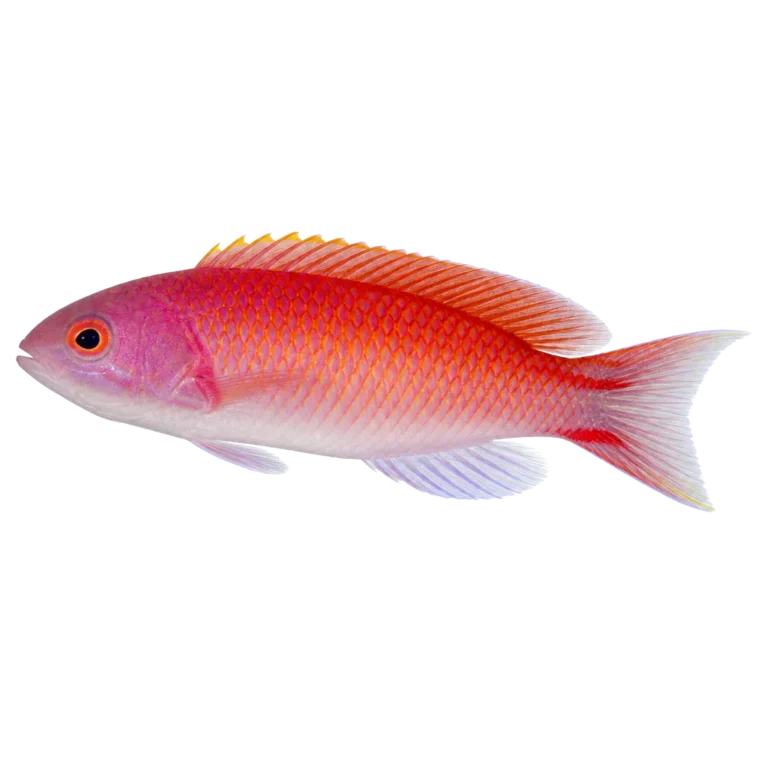
Rosy-scaled Fairy Wrasse
Summary
Cirrhilabrus rubrisquamis is a continually active, open-water fairy wrasse that spends much of the day making short feeding passes above and between the rockwork. Its natural habit of picking suspended zooplankton explains both its constant motion and its need for regular small meals rather than one large feeding.
A newly introduced fish may remain close to cover, make brief dashes into the water column, and retreat when approached. This is normal settling behaviour; it should gradually spend longer periods in view once it recognizes the aquarium as a safe feeding area.
Care
Build the aquascape with open swimming lanes across the front and upper portions of the reef, backed by branching rockwork and shaded crevices. C. rubrisquamis needs space to cruise, but it also needs immediate cover when startled; a fish that is repeatedly trapped in exposed corners is more likely to stay withdrawn or attempt to jump.
Use a tight-fitting lid or mesh screen that also covers overflow gaps and cable openings. Fairy wrasses can launch upward during alarm responses, especially during their first days in the aquarium or when chased by an established fish.
Moderate, varied circulation suits its active swimming style when calmer pockets remain available around the rockwork. If it constantly fights a direct pump stream or avoids the display area entirely, redirect the flow rather than assuming shyness is the only cause.
Feeding
Feed small, meaty foods several times through the day: mysis, enriched brine shrimp, copepods, finely chopped marine foods, and a good small-particle pellet are useful staples. Rotate foods rather than relying on brine shrimp alone, which can leave an active zooplankton feeder undernourished despite eating eagerly.
Deliver part of each meal into the water column away from dominant feeders. C. rubrisquamis is quick, but it can lose out to larger wrasses, anthias, tangs, or assertive damsels; a fish that repeatedly joins the feeding rush but remains thin needs a more protected feeding opportunity.
Do not depend on natural pod populations as its sole food source. It may hunt between meals, but a sparse or newly established aquarium rarely supplies enough planktonic prey to sustain its activity level.
Compatibility
Keep a single C. rubrisquamis for the most predictable result. A properly sourced social group can work when introduced together, with one male and multiple females, but adding another male or an unfamiliar similar-looking fairy wrasse to an established male’s territory can provoke persistent displaying and chasing.
Choose peaceful community fish that leave the midwater feeding zone accessible. Small gobies, cardinals, blennies, peaceful dartfish, and similarly non-confrontational reef fish are generally better companions than territorial damselfish, dottybacks, large hawkfish, or forceful wrasses.
Add this wrasse before more assertive open-water fish where possible. Introducing it after a dominant fish has claimed the rockwork can turn normal initial caution into chronic hiding and poor feeding response.
It is considered reef compatible and is a suitable choice around corals and established ornamental crustaceans. The practical exception is not coral predation but competition: animals that monopolize broadcast foods can prevent it from receiving enough to eat.
Good to know
Male display behaviour toward similar fairy wrasses can look dramatic, with intensified colour, flared fins, and looping passes. Brief displays are not necessarily a problem; intervene if one fish is excluded from food, pinned near the surface, or remains hidden for most of the day.
Like other fairy wrasses, this species is protogynous: females can become male in response to social conditions. Do not assume a group will retain its original sex ratio, and avoid adding a second male later on the expectation that two colourful fish will simply coexist.
A sudden disappearance is often a lid-check issue before it is a mystery illness. Check the floor, overflow, rear chambers, and every narrow opening promptly, because startled fairy wrasses can escape through surprisingly small gaps.