
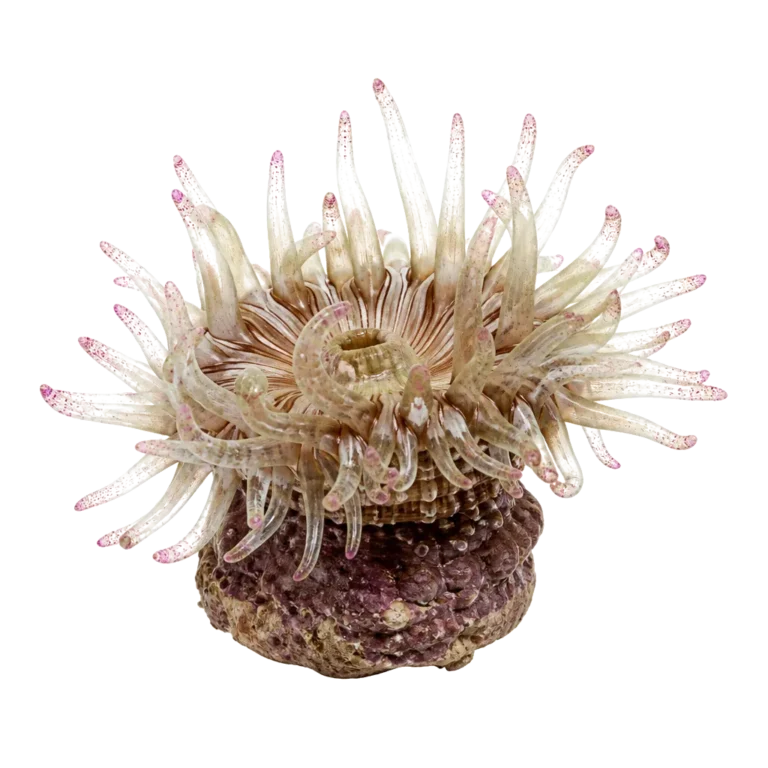
Rock Flower Anemone
Summary
Phymanthus crucifer is a Caribbean rock flower anemone that naturally anchors to rock or dead coral rubble while burying its column in nearby sand. In an aquarium, that habit explains its preference for a sand pocket against firm rockwork, often with only the oral disc and tentacles visible. Its tentacles carry stinging cells, so its apparent stillness should not be mistaken for harmless contact with nearby sessile livestock.
Care
Place it in a shallow sandy area beside stable rock or rubble so it can secure its foot below the surface; an exposed, unsupported foot is more likely to lead to wandering. Use moderate lighting to support its symbiotic algae and gentle-to-moderate, indirect flow that keeps debris from settling without folding or whipping the disc. A mature reef system is important because newly established tanks can swing in salinity and nutrients quickly enough to cause repeated deflation or detachment.
Feeding and role
Light supplies much of this anemone’s energy, but offer small portions of mysis, finely chopped marine seafood, or similar meaty foods as a direct supplement. Give only food it can close around and swallow; oversized pieces or excess food can be rejected and decay in the aquarium. Phymanthus crucifer is not a meaningful algae or detritus cleaner: it may catch suspended particles and uneaten food, but it will not control nuisance algae or replace a purposeful cleanup crew.
Compatibility
Keep corals, clams, and other fixed invertebrates beyond the reach of its fully expanded tentacles, and allow for the possibility that it may relocate after introduction. A sting can leave a retracted, damaged, or persistently closed neighbor even when the anemone otherwise appears healthy. Avoid fish and invertebrate predators that pick at anemones, especially triggerfish, puffers, butterflyfish, large angelfish, and destructive crabs.
Multiple rock flower anemones can be kept in the same aquarium when each has room to settle into its own sand-and-rock pocket. Add specimens individually rather than forcing a tight arrangement; if they remain expanded without repeatedly moving or contacting one another, the spacing is working.
Good to know
Acclimate slowly to salinity and temperature changes, then place the animal where it can attach undisturbed. A firm attachment, intact tissue, and a closed or only slightly open mouth are better signs than coloration alone. Persistent gaping, repeated deflation, loss of attachment, or tissue breakdown calls for prompt investigation; remove a clearly failing specimen before it deteriorates and fouls the water.
Do not use copper-based medications in a system containing Phymanthus crucifer. Cover pump and overflow intakes before introduction or whenever it begins moving, because a detached anemone can be drawn into equipment and badly damaged.