
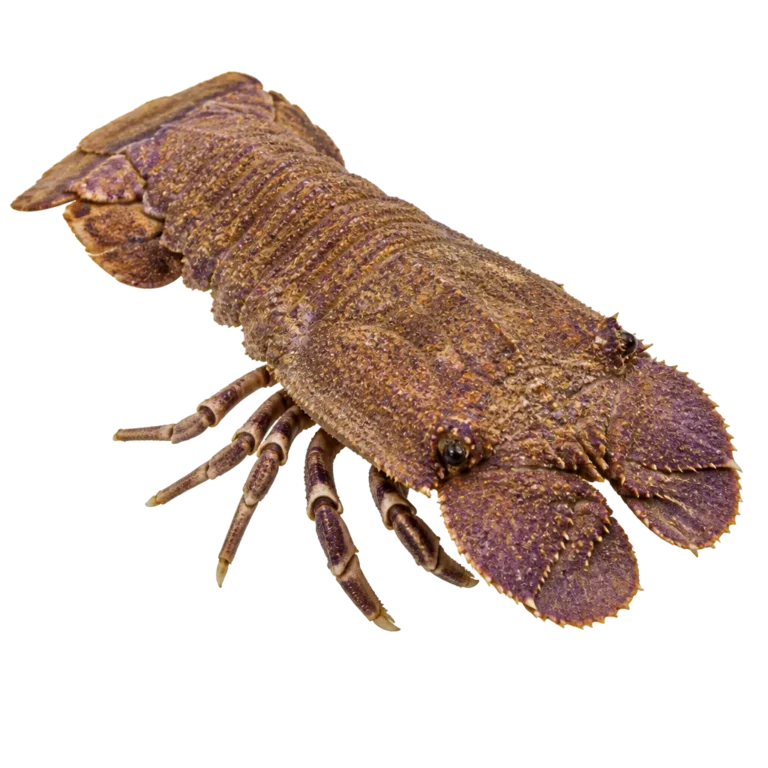
Ridged Slipper Lobster
Summary
The Ridged Slipper Lobster, Scyllarides nodifer, is a broad, flattened, clawless lobster identified by its plate-like antennae and raised ridges along the abdomen. It naturally occupies sandy and mixed soft bottoms in the western Atlantic, often burying or remaining concealed by day and becoming active after dark. Expect a mostly hidden daytime animal rather than a continuously visible display invertebrate.
Care
Provide a broad area of open, soft sand that can be excavated, with a shaded retreat nearby. Secure heavy rockwork directly on the tank bottom rather than on movable sand, because this lobster can dig beneath structures and shift loose rocks or corals as it travels.
Use flow that keeps the substrate clean without creating a constant sandstorm or exposing the animal’s resting area. Specialized lighting is unnecessary; a sheltered, dim daytime area is more useful than bright illumination.
Add it only to a biologically established, generously filtered aquarium that can handle regular meaty feedings and the waste they produce. A newly set-up tank is a poor fit if its sandbed and filtration are still unstable.
Feeding and role
Target-feed a varied marine carnivore diet, emphasizing pieces of clam, mussel, other mollusks, and crustaceans. Offer food near its shelter after dark, then remove uneaten pieces so they do not decay in the sand. Shell-on foods can encourage natural handling and feeding behaviour.
Do not buy this species as a cleanup-crew substitute. It may scavenge missed meaty food, but it does not control nuisance algae and will eventually treat many desirable bottom-dwelling invertebrates as food.
Compatibility
Keep the Ridged Slipper Lobster out of reef clean-up crews containing snails, clams, and other slow or sedentary invertebrates. It can also undermine or push against unsecured aquascape, leaving corals buried, tilted, or dislodged even when the coral itself is not the feeding target.
Most suitably sized fish are less at risk than ornamental invertebrates, but large predatory fish with crushing jaws can injure or consume the lobster, particularly around a molt. Avoid housing it with triggerfish, large puffers, or other fishes known to attack crustaceans.
One individual is the simplest stocking choice. This species has been observed sheltering with conspecifics, but a group is not required; only attempt multiple animals where there is ample sandy floor space, several retreats, and enough food to prevent competition.
Good to know
This lobster molts as it grows. A hiding individual that eats less before shedding should be left undisturbed, and its shed exoskeleton should not be mistaken for a dead animal. Do not move, handle, or expose a newly molted lobster to predatory tankmates; its soft body is especially vulnerable until the new shell hardens.
Avoid copper-based medications and copper-contaminated systems, as with other crustaceans. Acclimate slowly to the aquarium’s salinity and chemistry, then release it close to a prepared shelter rather than into open, brightly lit space.