
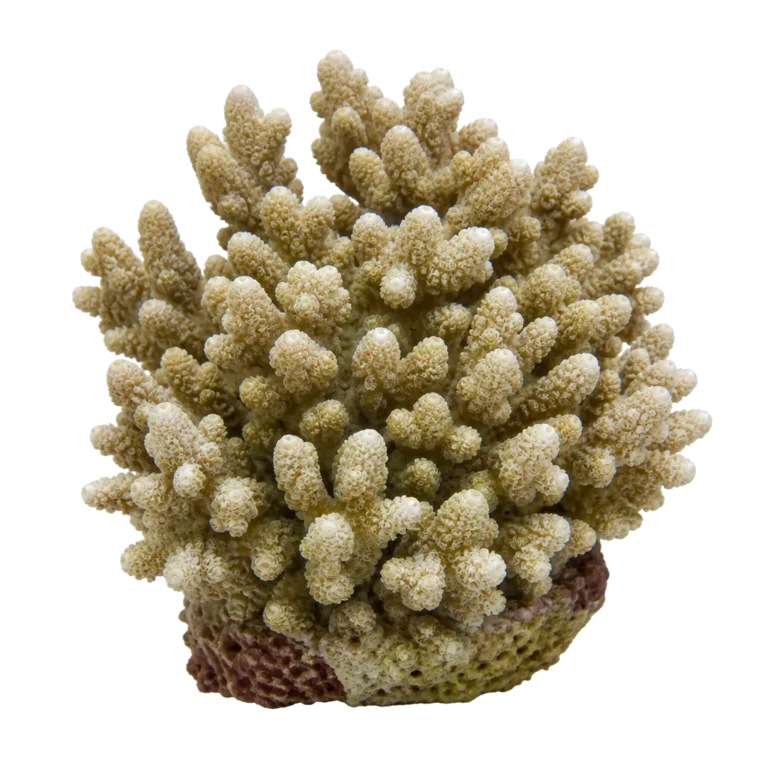
Rice Coral
Summary
Montipora capitata, the Rice Coral, is an SPS coral associated with Hawaiian reefs and able to grow as an encrusting, plating, or irregularly branching colony. That variation matters in an aquarium: buy and place it for the footprint it may create, not just the shape of the small frag. Its fine, rice-like surface texture and thin living tissue are typical of the species.
A healthy colony can add new crust over its mounting surface quickly, then form shelves or upright lobes that intercept light from below. Choose a permanent rock position with open space above and around it, because moving an established colony usually means breaking or cutting attached growth.
General care
Mount Montipora capitata securely on upper-middle rockwork where all sides receive water movement. Isolate it on a removable rock or leave a clear boundary around the base; once it encrusts onto the aquascape, controlling its spread requires cutting living skeleton.
Handle the plug or bare skeleton rather than the living surface and growing margins. The tissue is thin and can be scraped, crushed, or damaged where it contacts rock; a fall can also fracture the colony and leave damaged areas vulnerable to recession.
Lighting needs
Acclimate a new frag from gentler light, then increase exposure gradually over a few weeks by raising it in stages or using a temporary diffuser. This is especially important for frags that have been held under different lighting, since abrupt exposure can bleach tissue before the coral adapts.
Too much light usually shows first as pale or whitening tissue on the most exposed surfaces, sometimes followed by recession at the edges. Too little light is more often seen as stalled encrusting growth and a darker, less defined appearance; confirm that nutrients and flow are adequate before increasing light.
Flow needs
Provide varied, indirect flow that keeps the surface and folds of the colony clear without pinning its fine polyps shut. Correct flow produces a clean-looking surface, gentle polyp movement, and no persistent debris in the base or under developing shelves.
If flow is too weak, detritus and film algae settle in low areas and tissue may recede from shaded or dirty spots. If a pump creates a constant hard stream, the impacted face may remain tightly retracted, thin, or recede; redirect the stream to create intersecting, turbulent movement instead.
Feeding and growth
Light provides most of this coral’s energy, so direct feeding is optional rather than essential. Supplemental broadcast feeding can help in very lean systems or when growth has stalled despite suitable light and stable chemistry; use suspended, dust-fine zooplankton or coral foods rather than large particles that settle on the colony.
Growth can be fast and begins by spreading across nearby rock before forming plates, lobes, or short branches. Plan for both lateral spread and upward shading: a plate can deprive corals beneath it of light, while encrusting growth can claim the surrounding rockwork.
Compatibility
Montipora capitata is not a major sweeper-tentacle coral, but it competes effectively by encrusting, overtopping, and shading nearby corals. Leave at least 8 cm3.1 in of open space at introduction, and allow substantially more room beside corals with long sweeper tentacles or fast-growing plates; the initial gap will shrink as the colony expands.
Most reef-safe fish and clean-up invertebrates leave healthy tissue alone, but coral-picking fish such as many butterflyfish, angelfish, and filefish can cause repeated localized damage. Inspect new Montipora closely for Montipora-eating nudibranchs and their egg clusters, particularly on the underside and around the base, because these pests can cause progressive bare patches.
Water parameters
This is a moderately demanding SPS coral: it is generally more forgiving than many Acropora, but it responds poorly to sudden changes in alkalinity, salinity, temperature, or nutrient availability. Keep dosing and water changes consistent rather than making large corrections after a single test, because abrupt swings can show up as paling or tissue recession at the growing edge.
Avoid driving nutrients down so aggressively that the colony becomes pale and stops extending over the rock. Stable availability of the building blocks for skeleton growth is more useful than chasing rapid growth; when chemistry changes are necessary, make them gradually and watch the newest tissue for loss of color or recession.