
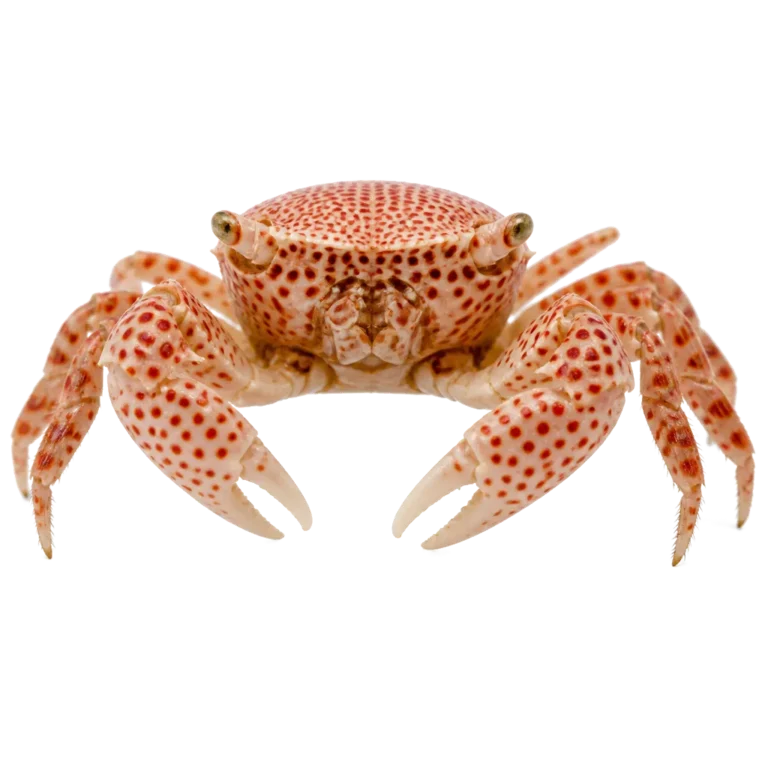
Red-spotted Coral Crab
Summary
Trapezia rufopunctata is a small, red-spotted coral crab that lives within the branches of pocilloporid stony corals in Indo-Pacific reefs. Its host coral is not just decoration: the dense branches provide its primary refuge and a continuing food source, so this crab is best chosen for a reef already built around a healthy, established branching host coral.
Expect it to remain deep in the colony for much of the day, often becoming visible only while it picks at food or responds to activity near its coral. A crab roaming persistently around the aquarium instead of returning to the host can indicate that the colony is too small, unsuitable, or declining.
Care
Add this species only to a mature reef with a robust, open-branched pocilloporid coral large enough to shelter it. Place the coral where its own lighting and water movement needs are met; the crab follows the coral’s placement rather than needing a separate cave, sand bed, or special substrate.
Avoid burying the host in detritus or placing it where fish can easily pick the crab from between the branches. The crab depends on access to the colony’s interior, and a damaged or deteriorating host can leave it exposed and without dependable nutrition.
Feeding and role
Most of its diet comes from coral mucus, material caught among the branches, and tiny planktonic foods. In an established host colony, regular reef feeding usually supplies incidental food, but gently broadcast fine zooplankton-sized or finely minced meaty foods near the coral if the system is very sparsely fed or the crab is rarely seen feeding.
Treat it as a host-associated scavenger, not a general cleanup-crew animal. It may remove trapped particles around its own coral and can help defend that colony from some coral-feeding invertebrates, but one crab will not control algae, clean the sand bed, or materially process aquarium-wide detritus.
Compatibility
Trapezia rufopunctata is reef compatible when given its natural branching coral host. It normally lives without harming a healthy host, but it is not suitable for a coral-free aquarium or for a tank where the intended host is already stressed.
Keep it away from fish that hunt crustaceans, especially larger wrasses, triggerfish, puffers, hawkfish, and other opportunistic crab predators. Repeated pecking at the colony, a missing crab after introduction, or a crab that never emerges to feed are practical warning signs that it is being harassed.
Add one crab to a small host colony, or retain a known pair that arrived together. Adults of the same species can defend a colony against rivals, so do not add multiple unrelated individuals to the same coral. Larger, complex colonies may support more than one coral-crab species, but that should not be assumed in a home aquarium.
Good to know
A shed shell inside the coral is usually a molt, not necessarily a dead crab. Leave the host undisturbed and avoid trying to extract the crab; it will be soft and highly vulnerable until the new shell hardens.
Acclimate carefully to avoid abrupt salinity change, and never expose the crab to copper-based medications. If it arrives with a coral, inspect the branches before using any coral dip: many dips are intended to kill crustaceans and can kill or drive out the crab along with unwanted hitchhikers.
Do not purchase this species as a substitute for maintaining the host coral. If the coral loses tissue, becomes overgrown with algae, or dies, move the crab only to another suitable established branching host rather than expecting it to thrive in rockwork alone.