
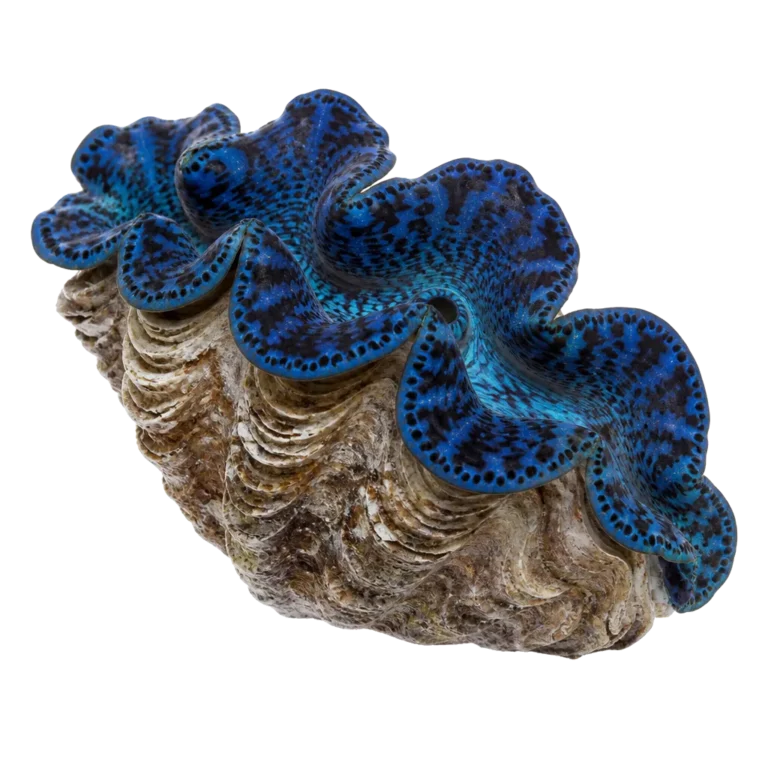
Red Sea Giant Clam
Summary
The Red Sea Giant Clam, Tridacna squamosina, is a rare Red Sea endemic that is easily confused with the more familiar fluted clam, Tridacna squamosa; confirm the scientific name rather than buying by common name alone. Its asymmetrical, deeply folded shell and mottled mantle with a green-edged, textured appearance are useful clues, but natural variation and dealer misidentification make provenance important.
In nature it occurs in very shallow, bright reef-flat, rubble-flat, and seagrass-associated habitats. That origin explains its demand for strong light and a secure, open placement: a clam that repeatedly contracts its mantle, shifts, or remains partly shaded is not settled in a suitable spot.
Care
Place it where the mantle can receive strong, unobstructed reef lighting for the full photoperiod. Use a stable sand, rubble, or flat-rock site that cannot tip or allow the shell to become buried; young clams may attach by byssal threads, so decide on placement before it settles rather than moving it later.
Provide moderate, indirect flow that carries suspended food across the mantle without making it fold, whip, or remain tightly retracted. Avoid a direct pump stream and avoid placing it in a low-flow pocket where detritus collects around the shell.
Add this species only to a mature reef with established lighting, reliable calcium and alkalinity consumption, and a consistent supply of fine suspended food. Newly assembled systems often look clear and suitable but lack both the biological stability and nutrition needed for a demanding photosymbiotic clam.
Feeding and role
Most nutrition comes from the clam’s symbiotic zooxanthellae, so lighting is the foundation of feeding rather than an optional extra. It also filters phytoplankton and fine suspended organic particles; occasional appropriately sized phytoplankton additions can be useful, especially for smaller specimens, but heavy feeding that clouds the water or drives nuisance algae is counterproductive.
Do not buy it as a cleanup-crew animal. It filters very small suspended particles, but it will not remove settled detritus, control filamentous algae, or replace mechanical filtration and husbandry.
Compatibility
Keep it away from fish that investigate or nip fleshy invertebrates, especially many angelfish, butterflyfish, triggers, puffers, and some wrasses. Repeated mantle nipping can leave the clam persistently closed, unable to photosynthesize effectively, and may lead to tissue damage.
Give the mantle clear space from corals with long sweeper tentacles or strong stings. A coral can injure a clam without visibly touching the shell, so respond to recurring retraction by checking the area after dark as well as during the day.
A single specimen is appropriate; it does not require companions. Add additional giant clams only when each can have its own illuminated, secure position without crowding, shading, or forcing future relocation.
Good to know
Never expose the clam to copper-based medication. If fish require treatment, move the fish to a separate treatment system rather than medicating the display.
Acclimate carefully to temperature, salinity, and especially light. A clam moved abruptly from dim holding conditions into intense lighting may stay retracted or show mantle bleaching; begin it lower or partially shaded and increase exposure gradually while preserving adequate flow.
Once it has attached, do not pull it free by the shell. Tearing the byssal area can cause severe injury, so move the supporting rock or substrate with the clam whenever possible. Check the shell and undersides after lights-out for pyramidellid snails or egg clusters, as these parasites can weaken a clam gradually before obvious daytime symptoms appear.
Brief reactions to a passing shadow are normal. Persistent gaping, failure to extend the mantle in suitable light, bleaching, tissue recession, or repeated unexplained retraction are warning signs that call for an immediate check of lighting, flow, nearby stinging corals, and predation.