
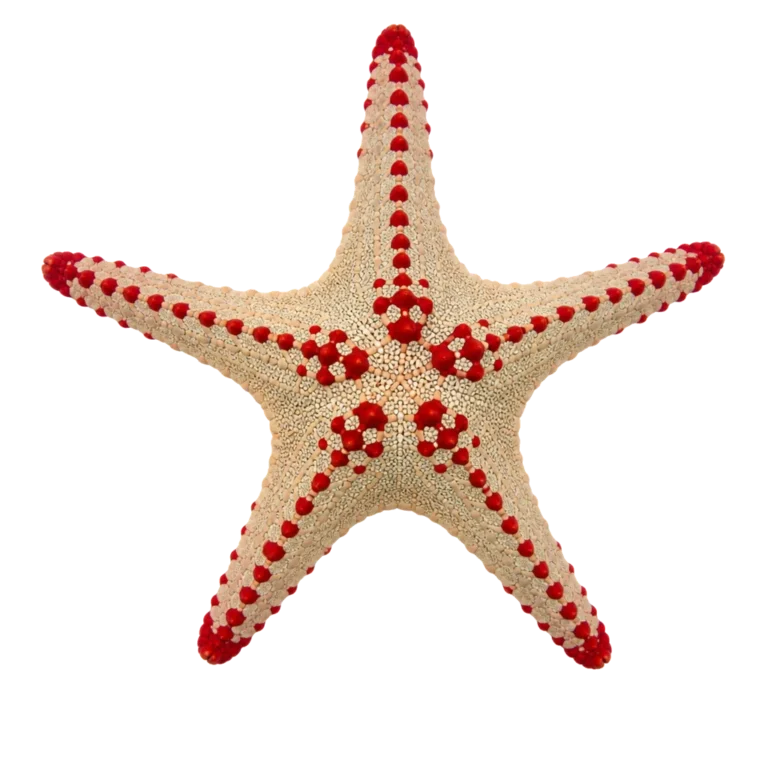
Red Necklace Starfish
Summary
Fromia monilis is a small, five-armed, tile-plated sea star whose red to orange pattern can resemble other Fromia species. Its Indo-West Pacific reef habitat explains its husbandry: it spends much of its time slowly grazing the living films and encrusting growth on rockwork, rather than hunting large foods or sifting sand. It is difficult chiefly because a visually clean, newly established aquarium may not produce enough of that natural food.
Care
Add this sea star only to a long-established reef with extensive, well-grown live rock and varied shaded and exposed rock surfaces. Sand is not a requirement, and neither special lighting nor unusually strong flow is needed; the important feature is mature rockwork that continually supports biofilm, microfauna, algae films, and encrusting life.
Choose a system that has been biologically stable for a substantial period, not one that has merely completed its nitrogen cycle. A Fromia that continually searches glass and rock in a sparse young tank can appear active while gradually exhausting the available grazing.
Feeding and role
Most feeding should come from grazing biofilm, microorganisms, fine algae, detritus, sponges, and other encrusting material on mature live rock. Offer tiny portions of finely chopped marine food near the star periodically, but do not assume it can be converted reliably to prepared foods; many specimens continue to depend on natural grazing.
Its cleanup role is limited and slow. One specimen may consume small amounts of film and detritus while it forages, but it will not control a visible algae outbreak, clean a sand bed, or replace ordinary maintenance. Avoid buying one to solve a nuisance-algae problem, because the food supply may collapse once the outbreak is removed.
Compatibility
Fromia monilis is generally safe with corals, but it may graze encrusting sponges and similar growth on rock. Keep it away from animals that eat or pick at echinoderms, including harlequin shrimp and predatory fish capable of biting its arms or underside, such as large wrasses, puffers, and triggerfish.
Keep one unless the aquarium is exceptionally mature and has enough separate rock surface to support more than one grazer. Adding several does not make cleanup more effective; it increases competition for the same slow-growing natural foods.
Good to know
Acclimate slowly and keep the animal submerged during transfer. Like other sea stars, it is highly vulnerable to abrupt changes in salinity and other water chemistry; early trouble may show as weak attachment, a limp posture, or failure to stay upright.
Do not use copper medications in its system. Also treat progressive tissue loss, softening, or an arm beginning to break down as urgent warning signs rather than a normal adjustment period: starvation or acclimation injury can become irreversible quickly, and a deteriorating sea star should be removed if it dies to prevent a rapid organic spike.