
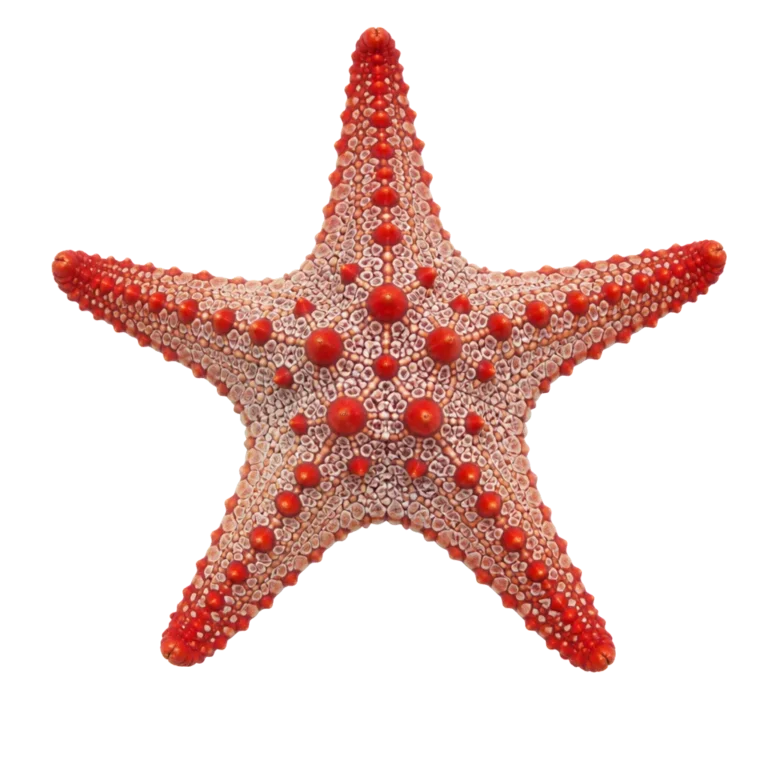
Red Knob Sea Star
Summary
Echinaster echinophorus is a Caribbean and western Atlantic sea star recognized by its red to orange, knobbly body and usually five short arms. It naturally occurs on reefs and rocky bottoms, where it moves slowly across hard surfaces to graze biofilms and feed on sponges and other attached organisms.
Choose it for a mature rock-based system with enough natural surface growth and a keeper willing to target-feed it. Its slow, deliberate movement and tendency to remain over one patch of rock or an attached invertebrate can be normal feeding behaviour, not necessarily inactivity.
Care
Provide extensive established live rock and other hard surfaces rather than relying on a sandy bed; this is not a sand-sifting sea star. Rockwork with mature biofilm, cryptic growth and natural crevices gives it the grazing area it uses between feedings.
Use moderate, indirect flow that keeps detritus from collecting on the animal but does not repeatedly dislodge it from the glass or rock. Lighting is not a direct requirement, although a normally lit mature reef supports the films and attached growth it investigates.
Add Echinaster echinophorus only to a demonstrably mature aquarium. A newly set-up or overly sterile system may look clean but can offer too little natural forage, leaving the star dependent on foods it may not immediately recognize.
Feeding and role
Offer small, meaty marine foods such as clam, mussel or shrimp directly beneath the sea star or against its underside, where the mouth is located. Feed deliberately rather than assuming it will live on leftovers; a star that repeatedly roams glass and rock without settling to feed may be searching for scarce food.
It grazes biofilm and consumes detritus, sponges and small sessile organisms, but it is not a substitute for routine maintenance. One specimen will not meaningfully control a tank-wide detritus problem, and its grazing can remove desirable cryptic sponge growth as readily as unwanted material.
Compatibility
Keep it away from animals that nip, flip or crush echinoderms, especially triggerfish, puffers, large wrasses and predatory crabs. Damage to an arm or repeated harassment can prevent feeding and create an entry point for tissue decline.
Reef compatibility is conditional. Do not add it to a display built around ornamental sponges, tunicates or other small attached invertebrates, because Echinaster echinophorus may eat them. Watch any individual that repeatedly stays tightly positioned over a coral or sessile animal, and relocate it if tissue loss follows.
Keep a single specimen unless the system has ample established feeding area and each animal can be target-fed. Adding several stars to a modest reef increases competition for the same limited biofilm and sessile prey rather than improving cleanup.
Good to know
Acclimate slowly to the display’s salinity and water chemistry, because sea stars react poorly to sudden changes. Loss of grip, limp arms or an inability to remain attached after introduction should be treated as a warning sign rather than normal settling-in behaviour.
Do not use copper medications in the display or place the sea star in a system with residual copper treatment. Echinoderms are highly copper-sensitive, and exposure can lead to rapid loss of movement and tissue damage.
Starvation can be gradual and is easy to miss. A shrinking body, thinning arms, persistent failure to take offered food, soft spots or worsening pale lesions are not normal. Remove a deteriorating individual promptly if tissue begins to break down, as it can foul the aquarium quickly.