
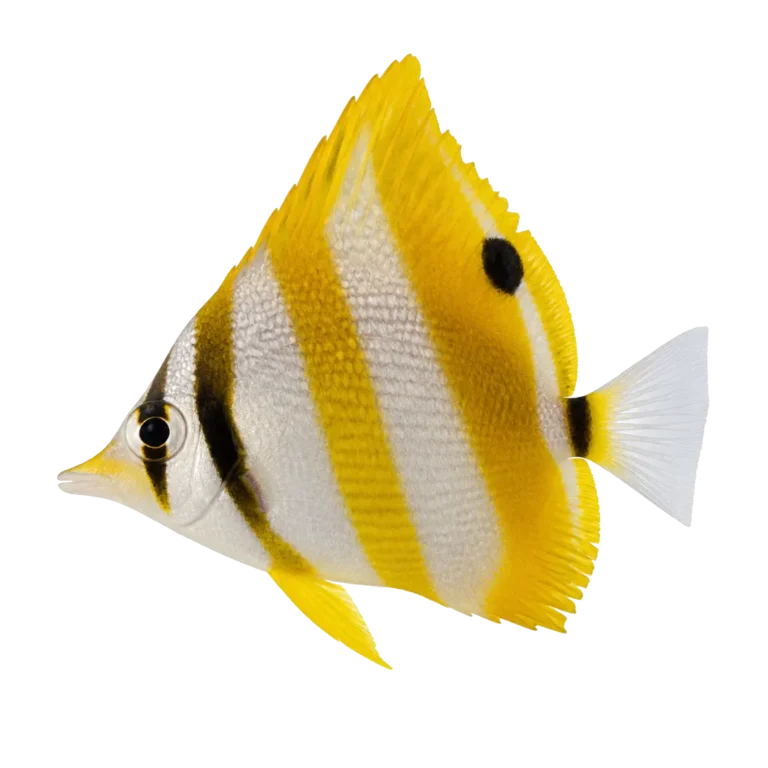
Pyramid Butterflyfish
Summary
Hemitaurichthys polylepis is unusual among butterflyfish because it spends much of the day cruising in midwater and taking suspended plankton, rather than repeatedly picking at coral and rock. Expect an active fish that travels through the water column; one that remains pressed into cover or will not emerge for food after its settling period is more likely being intimidated or poorly accommodated than simply resting.
Its peaceful nature makes it suitable for a calm reef community, but its constant movement and repeated feeding needs make it a poor choice for a sparse, low-nutrient display designed around infrequent feeding.
Care
Build the rockwork around the edges and leave a broad, uninterrupted swimming lane through the centre and upper water column. Hemitaurichthys polylepis uses caves, ledges, and shaded breaks as retreat points, but a solid wall of rock removes the open route it uses for normal cruising.
Use enough dispersed flow to keep fine foods moving through the water column without forcing the fish to fight a concentrated jet. Plan strong aeration and nutrient export from the outset: this species thrives on frequent feeding, and a system unable to process that input will show accumulating nutrients and nuisance algae.
Feeding
Feed several small meals spread through the daylight period. Offer varied small marine foods such as enriched mysis, copepod-based foods, finely chopped crustaceans, and high-quality small pellets or frozen blends; include algae-containing marine preparations as part of the rotation rather than treating it as a strictly carnivorous fish.
Release food into the current and, in a busy community, feed from more than one area so the fish can intercept suspended particles. Fast anthias, damselfish, wrasses, and other midwater feeders can strip the food before a shy new Pyramid Butterflyfish joins in. Do not rely on one heavy daily feeding: a pinched belly or loss of fullness behind the head is a practical warning that it is losing the feeding competition or receiving too little overall.
Compatibility
Hemitaurichthys polylepis can be kept singly, as a compatible pair, or in a group when the aquarium has enough open water and filtration for the added activity and feeding load. If keeping more than one, introduce the intended group together; adding a lone fish to an established individual or group is more likely to produce persistent chasing.
Choose calm community fish that do not dominate the open water at feeding time. Avoid large predatory fish and belligerent triggers, puffers, or territorial fish that can keep this naturally non-confrontational butterflyfish confined to cover. Add it before the aquarium is stocked with dominant midwater feeders whenever possible.
It is generally coral-compatible, but do not treat that as invertebrate-proof. Feather dusters, tube worms, small ornamental molluscs, and small edible crustaceans may be picked at, especially if the fish is underfed.
Good to know
A newly introduced fish may spend its first days close to rockwork, but it should progressively join feeding activity and resume open-water cruising. Continued hiding, darkened appearance, refusal of repeatedly offered foods, or waiting until other fish have finished are signs to check for bullying and feeding competition rather than assuming it will adapt on its own.
Frequent feeding is the central long-term management issue. Match the feeding plan with effective export before purchase; if nutrients begin rising or algae expands after introduction, correct feeding delivery and filtration capacity rather than cutting this planktivore back to an inadequate single meal.