
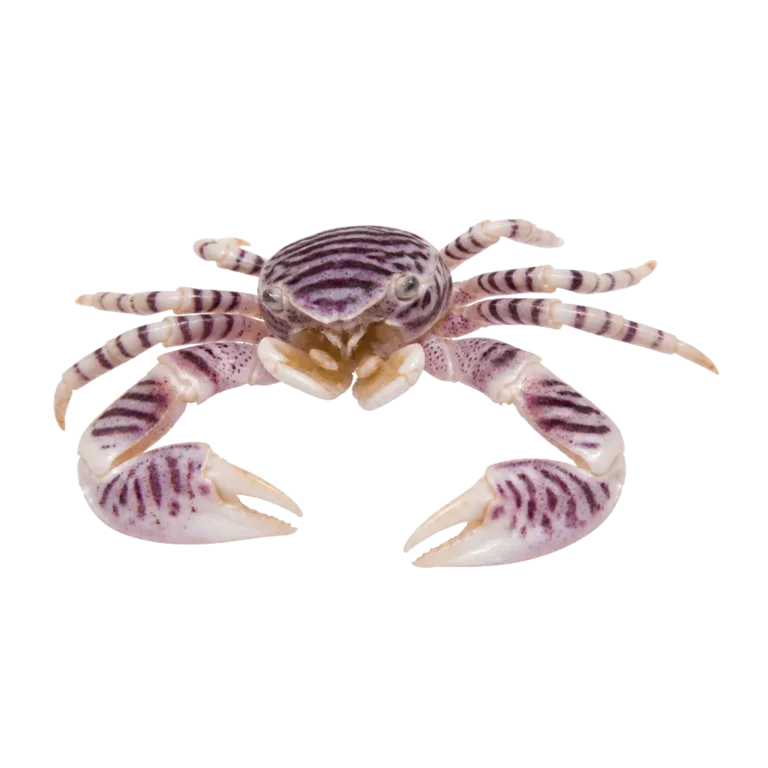
Purple Zebra Porcelain Crab
Summary
The Purple Zebra Porcelain Crab, Petrolisthes bolivarensis, is a small, secretive Caribbean porcelain crab that usually wedges itself beneath rubble or deep in rockwork rather than roaming in the open. Its purple striping, orange claw spots, and blue feeding appendages help distinguish it from similar Petrolisthes crabs, which are easily confused in the trade.
Its conspicuous fan-like mouthparts are feeding structures, not a threat display: a settled crab will face into moving water and repeatedly sweep suspended particles from it. Expect long periods out of sight; a crab that has selected a tight crevice with a reliable current can be behaving normally.
Care
Build in narrow rock crevices, stable coral rubble, or a sheltered overhang before introduction. This crab needs a secure retreat close to a current path, allowing it to remain protected while extending its feeding fans into the flow; exposed, open-bottom layouts often leave it hiding continuously or vulnerable to fish.
Provide a moderate, directed flow lane that carries food past its chosen shelter, while leaving the crab a calm recess to retreat into. It does not require special lighting or a particular sandbed. Add it to an established aquarium with regular planktonic feeding rather than a newly started, sparsely fed system, because it cannot rely on occasional scraps reaching its hiding place.
Feeding and role
Feed fine suspended foods deliberately, including microplankton-sized frozen foods, finely divided meaty foods, and tiny pellets. Release food upstream of its perch so the current delivers particles through its feeding fans; seeing the fans extend and sweep rhythmically during feeding is a useful sign that placement and food size are working.
Do not buy this species as an algae or detritus solution. Its useful role is limited to consuming suspended food and very small particles that reach it, and one hidden crab will not make a noticeable dent in film algae, nuisance algae, or accumulated waste.
Compatibility
Keep it with peaceful fish and invertebrates that will not investigate or crush a small crustacean. Hawkfish, large wrasses, triggerfish, puffers, larger crabs, and other crab-eating fish can turn a crab that is otherwise reef-safe into food, especially when it emerges or molts.
It is suitable around corals because it filter-feeds rather than grazing coral tissue. Add it singly in most reef aquariums: it occupies a small, sheltered feeding station, and multiple crabs may compete for the same limited crevices and current-facing positions.
Good to know
A sudden disappearance can be normal after a molt. Check for a hollow shed shell before assuming the crab has died, and avoid dismantling its rockwork while it is soft and hidden; the vulnerable period after molting is when predatory tankmates are most likely to injure it.
Like other crustaceans, it is highly vulnerable to copper-based medications and other treatments not labeled safe for marine invertebrates. Acclimate carefully to avoid an abrupt salinity change, then release it directly beside a prepared crevice; this reduces the chance that the small crab is swept into open territory before it can establish a refuge.
Porcelain crabs can drop a limb when seized or badly stressed. A missing appendage may regrow through later molts, but limb loss is a warning to reassess predation, rough handling, or competition around its shelter.