
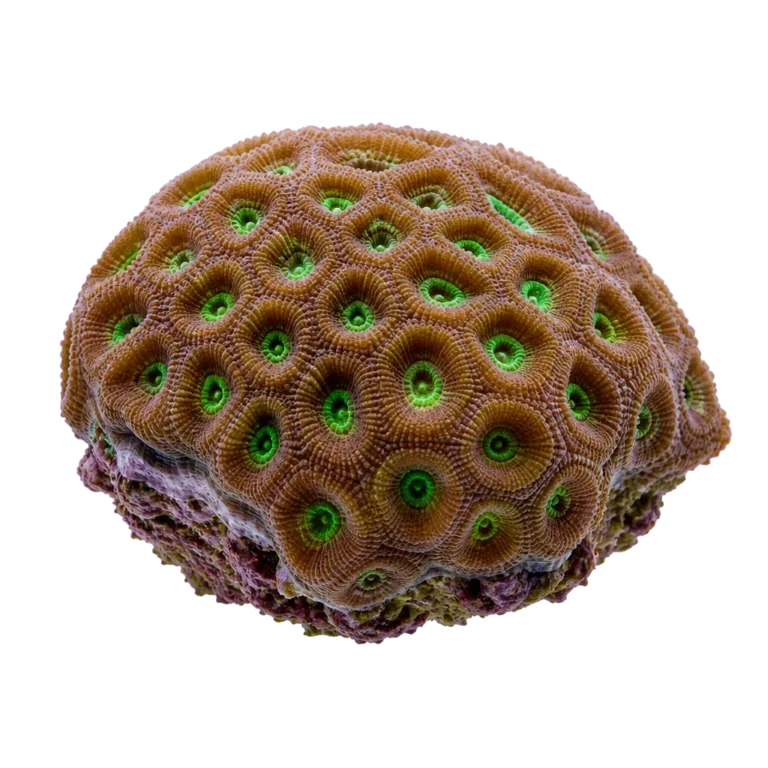
Psammocora Coral
Summary
Psammocora sp. is a genus-level identification, so the exact growth shape and tolerance can vary among trade specimens. Most offered for aquariums are compact, fine-textured SPS corals that encrust rock or a frag plug before building a thicker, uneven colony. That tendency makes a small frag a long-term space user rather than a coral that stays confined to its plug.
Its small polyps and photosynthetic tissue suit a stable, established reef with clean surfaces and consistent conditions. It is generally a forgiving SPS choice, but settled debris or abrupt chemistry changes can still turn a healthy growing edge into a patch of exposed skeleton.
General care
Mount Psammocora sp. on secure middle rockwork where its growing margin can be inspected and kept clear of sand. Do not place it where shifting sand, a grazing snail, or a loose frag can repeatedly abrade the colony; fine surface texture traps sediment easily, and covered areas may lose tissue.
Handle the plug or bare underside rather than rubbing the living surface or newly encrusted edge. The skeleton is hard, but thin growing margins and small upright projections can chip when a frag is pried, dropped, or wedged tightly into rockwork.
Lighting needs
Begin a new frag in a less intense part of its intended area, then move it into its final exposure gradually. This gives the symbiotic algae time to adjust and avoids the sudden paling that can follow a move from dealer lighting or a dimmer tank zone.
A colony receiving suitable light usually holds color and extends its encrusting edge. Persistent browning, a darker dull appearance, or stalled growth can indicate insufficient exposure; bleaching, washed-out color, or recession on the most exposed surfaces calls for reducing intensity or moving the coral to gentler light.
Flow needs
Provide moderate, irregular flow that sweeps across the entire colony without blasting one face continuously. Correct flow keeps the textured surface free of settled particles while allowing the tiny polyps to remain normally extended or visibly textured rather than held tightly shut.
If flow is too weak, detritus collects in the surface pits, a film develops, and tissue may recede beneath algae. If it is too forceful or direct, polyps remain retracted, the colony looks persistently irritated, and food is blown past before it can be captured; redirect the stream rather than simply increasing total flow.
Feeding and growth
Light supplies most of Psammocora sp.'s energy, so feeding is most useful for supporting growth in a lean system or for helping a newly settled frag build tissue. Offer fine suspended foods such as powdered coral foods, microplankton, rotifers, or similarly small particulate foods; large chunks are poorly matched to its tiny polyps. Broadcast feeding is usually more useful than forceful spot feeding.
Many specimens rapidly cover their plug, then spread outward over adjacent rock and may add low knobs or short branches depending on the species and morph. Give the growing perimeter open rock from the start, because pruning an established encrusting base is harder than relocating a small frag.
Compatibility
Psammocora sp. is usually peaceful in the sense that it is not a reliable long-range stinger, but its advancing encrusting edge can still kill tissue where it meets another coral. Leave at least 5 cm2 in of open space around a new frag and increase that buffer where a fast-growing neighbour can reach it from the opposite direction. Because this is a genus-level record, do not pack it tightly based on an assumption that every specimen will behave identically.
Most reef-safe fish ignore it, but coral-nipping fish and persistent picking by crabs can leave small bare patches that algae can colonize. Keep it out of the reach of long-sweeper corals and chemically aggressive soft corals; Psammocora is more likely to lose a prolonged encounter than to defend its territory.
Water parameters
Psammocora sp. is less demanding than many delicate SPS corals, but it still needs reef chemistry that changes slowly rather than swinging between maintenance events. Sudden alkalinity shifts are especially likely to stall growth or cause recession at the actively growing edge, even when the coral had appeared hardy beforehand.
Avoid allowing detritus, algae, or cyanobacteria to remain on the colony after a nutrient increase or a flow change. A healthy coral can tolerate a normally maintained reef, whereas a colony repeatedly coated with deposits often declines from the covered areas outward despite otherwise acceptable test results.