
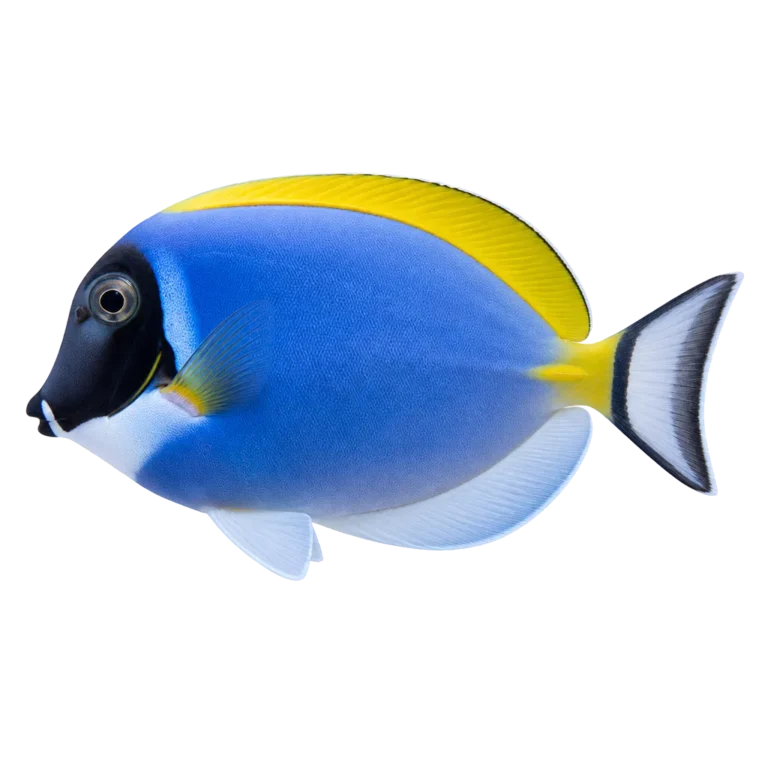
Powder Blue Tang
Summary
Acanthurus leucosternon is a fast, persistent daytime grazer that spends much of its time patrolling rockwork and picking at short algae films, including growth in crevices. It needs a system that can accommodate constant movement and regular herbivore feeding rather than one where it is expected to live on incidental algae alone.
Its difficult reputation comes from the combination of high activity, strong territorial responses to rival tangs, and marked susceptibility to stress-associated parasitic outbreaks. A settled fish should graze confidently in the open; hiding for long periods, refusing algae, or repeatedly pacing the glass are warning signs to address early.
Care
Build the aquascape with broad, unobstructed swimming lanes around secure rock structures. Leave grazing surfaces and a few visual breaks so the fish can move out of another fish’s line of sight; a solid wall of rock can turn normal patrol behaviour into repeated confrontations.
Use brisk, well-oxygenated circulation and a mature reef with dependable biological filtration. This tang is a high-output, active fish, so deteriorating water quality or low oxygen can quickly show as heavy breathing, loss of grazing interest, darkened colour, or persistent sheltering.
Avoid rearranging the entire reef after it has established a territory unless necessary. Acanthurus leucosternon learns its patrol route and preferred feeding areas, and disruption can trigger stress or a renewed campaign against tankmates.
Feeding
Offer marine algae every day, using nori or other dried marine seaweed alongside spirulina-based herbivore foods and quality prepared foods. Give small portions across the day when possible, because this is adapted to frequent grazing rather than a single large meal.
Supplement with modest amounts of varied meaty frozen foods, but keep algae as the dietary foundation. A fish that accepts only rich frozen foods may look eager at feeding time while gradually becoming hollow through the belly or losing body condition behind the head.
Place algae in more than one feeding location when assertive fish are present. Watch the Powder Blue Tang actually feed: being repeatedly displaced from a clip can lead to weight loss and stress even when plenty of food enters the aquarium.
Compatibility
Keep one Acanthurus leucosternon per aquarium. Although the species may be seen feeding in groups in nature, confined individuals commonly treat one another as direct territorial rivals, and chasing can escalate to slashing with the tail spine.
Choose tankmates that use different space and food niches, such as peaceful reef fish that do not resemble a tang. Avoid other Acanthurus species and similarly shaped, active algae grazers; established tangs are especially likely to provoke prolonged displays, chasing, and feeding exclusion.
If a mixed tang community is attempted, establish the less confrontational tangs first and introduce the Powder Blue Tang last. It is usually reef-safe with corals and ornamental invertebrates, but it may consume decorative macroalgae, so do not rely on a planted refugium display as a permanent food source.
Good to know
Plan disease prevention before purchase. Acanthurus leucosternon is notably prone to marine ich and other stress-linked parasitic problems; a fish can appear normal at purchase and then develop white spots, flashing, clamped fins, rapid breathing, or appetite loss after introduction. Do not add one directly to a display containing other fish, because a visible outbreak can become a whole-system problem.
Aggression can emerge after an apparently peaceful settling period. Repeated side-on displays, tail flicks, chasing at feeding stations, torn fins, or a tankmate confined to a corner mean the territory is no longer workable; adding more food alone rarely resolves a persistent tang conflict.
Handle this surgeonfish only when unavoidable and use a rigid container rather than a net when practical. The sharp tail spines can injure both fish and keeper, and a stressed fish can become entangled while struggling in mesh.