
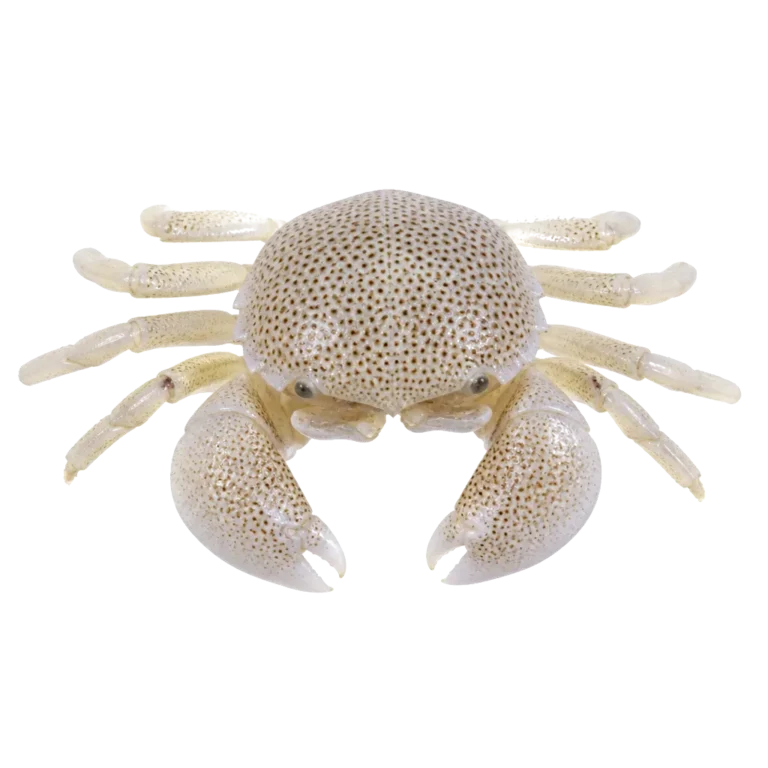
Porcelain Pebble Crab
Summary
Leucosia anatum, sold as the Porcelain Pebble Crab, is a rounded leucosiid crab rather than a true porcelain crab. Its smooth, pebble-like body and small claws suit a bottom-dwelling life on soft subtidal sand and mud across the Indo-Pacific; in an aquarium, that means it is better treated as a specialized sand-bottom crab than as an anemone-associated filter feeder. Identification deserves care because L. anatum has been treated as a species complex, so similarly shaped imported pebble crabs may not have identical needs.
Care
Use an established marine aquarium with a broad area of fine, clean sand where the crab can settle, forage, and partially cover itself. Coarse rubble, a bare bottom, or a rockscape packed tightly to the sand leaves it exposed and removes the substrate it naturally works over.
Keep water movement gentle to moderate at the sand surface rather than directing a hard stream at its resting area. Lighting is not a care requirement for the crab itself; choose it for the corals and other livestock, while ensuring the animal has shaded gaps beneath rock edges or open sand away from intense flow.
Feeding and role
Feed small, sinking portions of varied marine foods directly to the sand near the crab: finely chopped shrimp, clam or other mollusc flesh, mysis, and quality frozen omnivore foods are appropriate choices. Its wild diet includes detritus and small animal material, so a tank that looks clean is not proof that it is fed; a crab that repeatedly roams exposed areas or loses body condition should receive more deliberate target feeding.
Expect incidental scavenging of uneaten food and organic debris, not meaningful algae control or a complete cleanup-crew service. One crab will work only a small patch of substrate, and it should never be added to solve an accumulation problem caused by excess feeding or inadequate maintenance.
Compatibility
Keep it with peaceful fish that will not investigate, nip, or crush a small crab. Large wrasses, puffers, triggerfish, hawkfish, and other crab-eating fish can turn a normally hidden animal into food, especially just after a molt. Predatory crabs and large predatory shrimp are also poor companions.
Do not regard this species as proven reef-safe simply because it is small. Its diet is opportunistic and animal-based, and aquarium evidence for its behavior around corals and other sessile invertebrates is limited; observe it closely around fleshy polyps, tiny ornamental invertebrates, and newly settled animals. Add specimens individually rather than assuming they will form a social group; there is no strong basis for recommending dense groups of this species.
Good to know
A missing crab is often a molting crab rather than a dead one. Leave a newly molted individual undisturbed, avoid moving the sand around its refuge, and keep potential predators away; the soft crab is particularly vulnerable until its shell hardens. An intact empty shell may simply be the molt rather than evidence of a loss.
Acclimate slowly and avoid any exposure to copper-based medications or contaminated equipment, as with other marine crustaceans. Sudden salinity change can be especially damaging after collection and transport; poor coordination, inability to right itself, or persistent immobility in the open after introduction warrants checking acclimation and water conditions rather than assuming normal hiding behavior.