
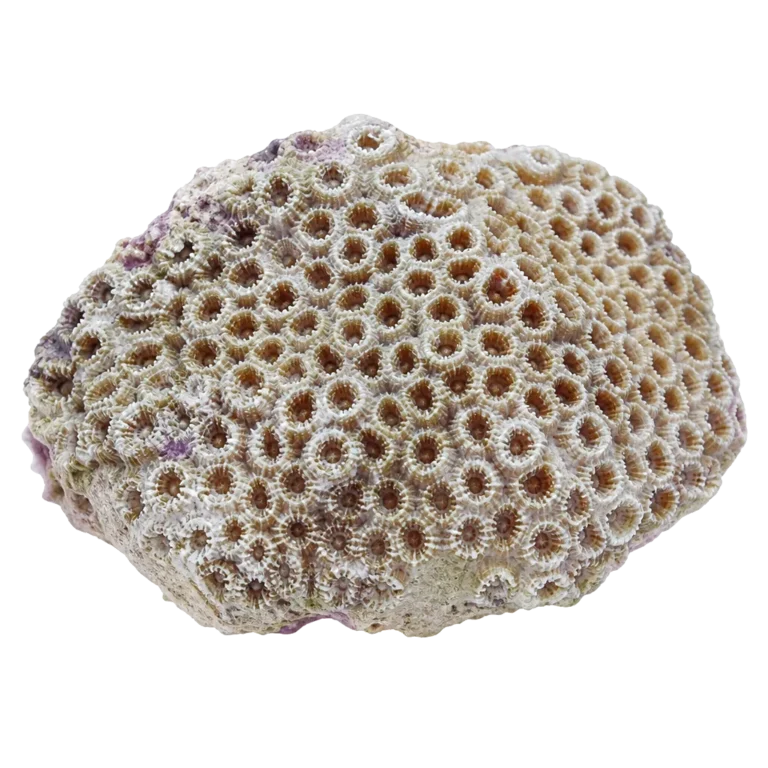
Porcelain Coral
Summary
Porcelain Coral, Leptoseris tubulifera, is a zooxanthellate stony coral adapted to deep, lower-light reef habitat. Its thin, one-sided colony develops irregular fronds and may form upright tubes as growing edges curl and fuse, so it is better suited to a dim lower-rockwork position than to an exposed SPS crest.
Choose a frag with intact tissue all the way to its growing edge. The delicate, plate-like skeleton and lower-light preference make this a moderate-care coral despite its generally peaceful temperament.
General care
Mount Leptoseris tubulifera low on rockwork where its expanding edge can be watched and reached for cleaning. Keep the frag upright or at a modest angle rather than wedged where detritus can settle over its surface; persistent deposits can smother tissue along ridges and margins.
Handle the plug or solid base, not the thin colony edge. The skeleton can chip easily, and damage at a growing rim may become a site for recession; inspect the perimeter after transport, fragging, or an accidental bump.
Lighting needs
Start a new frag in the dimmest suitable part of the aquarium and increase exposure gradually only after it has remained fully colored and continues to extend at the edge. This species comes from deep water, so an abrupt move from shaded holding conditions into a bright, direct hotspot is a common cause of bleaching or edge recession.
Too little light is suggested by a progressively dull or brown appearance and little new growth despite clean tissue. Too much light is more urgent: tissue may fade, become patchy or pale, then recede from exposed edges; move it into shade or reduce intensity rather than waiting for it to adapt.
Flow needs
Provide gentle to moderate, indirect, variable flow that keeps the ridged surface and tube openings clear without pinning tissue in one direction. Correct flow lets the coral remain clean and evenly colored while fine suspended food and detritus do not accumulate on its surface.
Increase flow slightly or redirect it if sediment repeatedly settles in folds, film algae persists, or tissue looks dirty despite otherwise good husbandry. Reduce or diffuse flow if a direct jet causes localized paling, a sharply receding edge, or tissue that appears continuously blasted on one side.
Feeding and growth
Photosynthesis supplies most of this coral’s energy, but occasional feeding can help a newly established, recovering, or actively growing colony when the aquarium is lean on suspended foods. Offer very fine planktonic foods in low flow so particles remain available briefly; large, meaty pieces are poorly matched to its small polyps and can foul the colony.
Growth begins by encrusting across the mounting surface, then may develop irregular plates, fronds, or upright tubes. Reserve open rock around every growing edge from the start, because a colony can gradually shade, touch, or overgrow sessile neighbors rather than remaining confined to its original plug.
Compatibility
Leptoseris tubulifera is generally peaceful in direct encounters, but its practical aggression is space competition: its advancing encrusting margin can overtake slower corals. Leave at least 10 cm3.9 in of clear hardscape around the colony, and trim or remount it before it reaches another coral rather than assuming a peaceful species will stop at contact.
Keep it away from corals with long reach or strong localized stings, especially where its thin edge cannot retreat. Fish and invertebrates that routinely pick at coral tissue, overturn loose frags, or cover the colony with sand can turn minor mechanical damage into tissue loss.
Water parameters
Treat this as a lower-light SPS coral, not as a low-demand soft coral. It benefits from the same consistency in salinity, alkalinity, calcium, and magnesium that supports any calcifying coral; abrupt corrections are more likely to show as stalled margins or recession than as immediate collapse.
Avoid rapidly stripping nutrients or making large chemistry changes while the coral is acclimating. A colony that loses color, stops extending, or recedes only at newly exposed edges should prompt a check for recent alkalinity swings, salinity change, excessive light, and accumulated detritus before adding more food or increasing flow.